



 Chat with AI
Exam 4: Economic Efficiency, government Price Setting, and Taxes

Exam 1: Economics: Foundations and Models233 Questions
Exam 2: Trade-Offs, comparative Advantage, and the Market System259 Questions
Exam 3: Where Prices Come From: the Interaction of Demand and Supply242 Questions
Exam 4: Economic Efficiency, government Price Setting, and Taxes208 Questions
Exam 5: Externalities, environmental Policy, and Public Goods267 Questions
Exam 6: Elasticity: The Responsiveness of Demand and Supply295 Questions
Exam 7: The Economics of Health Care169 Questions
Exam 8: Firms, the Stock Market, and Corporate Governance278 Questions
Exam 9: Comparative Advantage and the Gains From International Trade189 Questions
Exam 10: Consumer Choice and Behavioral Economics302 Questions
Exam 11: Technology, production, and Costs330 Questions
Exam 12: Firms in Perfectly Competitive Markets298 Questions
Exam 13: Monopolistic Competition: the Competitive Model in a More Realistic Setting278 Questions
Exam 14: Oligopoly: Firms in Less Competitive Markets262 Questions
Exam 15: Monopoly and Antitrust Policy271 Questions
Exam 16: Pricing Strategy263 Questions
Exam 17: The Markets for Labor and Other Factors of Production286 Questions
Exam 18: Public Choice,taxes,and the Distribution of Income258 Questions
Select questions type


Figure 4-7 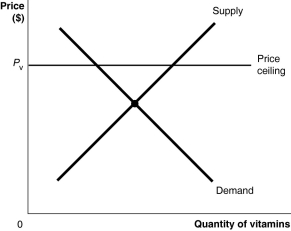 -Refer to Table 4-5.An agricultural price floor is a price that the government guarantees farmers will receive for a particular crop.Suppose the federal government sets a price floor for corn at $12 per bushel.
a.What is the amount of shortage or surplus in the corn market as result of the price floor?
b.If the government agrees to purchase any surplus output at $12,how much will it cost the government?
c.If the government buys all of the farmers' output at the floor price,how many bushels of corn will it have to purchase and how much will it cost the government?
d.Suppose the government buys up all of the farmers' output at the floor price and then sells the output to consumers at whatever price it can get.Under this scheme,what is the price at which the government will be able to sell off all of the output it had purchased from farmers? What is the revenue received from the government's sale?
e.In this problem we have considered two government schemes: (1)a price floor is established and the government purchases any excess output and (2)the government buys all the farmers' output at the floor price and resells at whatever price it can get.Which scheme will taxpayers prefer?
f.Consider again the two schemes.Which scheme will the farmers prefer?
g.Consider again the two schemes.Which scheme will corn buyers prefer?
-Refer to Table 4-5.An agricultural price floor is a price that the government guarantees farmers will receive for a particular crop.Suppose the federal government sets a price floor for corn at $12 per bushel.
a.What is the amount of shortage or surplus in the corn market as result of the price floor?
b.If the government agrees to purchase any surplus output at $12,how much will it cost the government?
c.If the government buys all of the farmers' output at the floor price,how many bushels of corn will it have to purchase and how much will it cost the government?
d.Suppose the government buys up all of the farmers' output at the floor price and then sells the output to consumers at whatever price it can get.Under this scheme,what is the price at which the government will be able to sell off all of the output it had purchased from farmers? What is the revenue received from the government's sale?
e.In this problem we have considered two government schemes: (1)a price floor is established and the government purchases any excess output and (2)the government buys all the farmers' output at the floor price and resells at whatever price it can get.Which scheme will taxpayers prefer?
f.Consider again the two schemes.Which scheme will the farmers prefer?
g.Consider again the two schemes.Which scheme will corn buyers prefer? (Essay)
4.7/5  (93)
(93) Figure 4-3  Figure 4-3 shows the market for tiger shrimp. The market is initially in equilibrium at a price of $15 and a quantity of 80. Now suppose producers decide to cut output to 40 in order to raise the price to $18.
-Refer to Figure 4-3.What is the value of the deadweight loss at the equilibrium price of $15?
Figure 4-3 shows the market for tiger shrimp. The market is initially in equilibrium at a price of $15 and a quantity of 80. Now suppose producers decide to cut output to 40 in order to raise the price to $18.
-Refer to Figure 4-3.What is the value of the deadweight loss at the equilibrium price of $15? (Multiple Choice)
5.0/5 (81)
(81) Suppose that in Canada the government places a $1,500 tax on the buyers of new snowmobiles.After the purchase of a new snowmobile,a buyer must pay the government $1,500.How would the imposition of the tax on buyers be illustrated in a graph?
(Multiple Choice)
4.9/5 (91)
(91) Table 4-4
 Table 4-4 shows the demand and supply schedules for labor market in the city of Pixley.
-Refer to Table 4-4.What is the equilibrium hourly wage (W*)and the equilibrium quantity of labor (Q*)?
Table 4-4 shows the demand and supply schedules for labor market in the city of Pixley.
-Refer to Table 4-4.What is the equilibrium hourly wage (W*)and the equilibrium quantity of labor (Q*)? (Multiple Choice)
4.8/5 (84)
(84) The total amount of consumer surplus in a market is equal to the area below the demand curve.
(True/False)
4.9/5 (76)
(76) Table 4-2
 -Refer to Table 4-2.The table above lists the highest prices five consumers are willing to pay for a theater ticket.If the price of one ticket rises from $10 to $19
 (Multiple Choice)
4.8/5 (84)
(84) Figure 4-4  -Refer to Figure 4-4.The figure above represents the market for pecans.Assume that this is a competitive market.Which of the following is true?
 (Multiple Choice)
4.8/5 (80)
(80) Figure 4-5  Figure 4-5 shows the market for apartments in Springfield. Recently, the government imposed a rent ceiling of $1,000 per month.
-Refer to Figure 4-5.What is the value of consumer surplus after the imposition of the ceiling?
Figure 4-5 shows the market for apartments in Springfield. Recently, the government imposed a rent ceiling of $1,000 per month.
-Refer to Figure 4-5.What is the value of consumer surplus after the imposition of the ceiling? (Multiple Choice)
4.9/5 (82)
(82) Figure 4-1  Figure 4-1 shows Arnold's demand curve for burritos.
-Refer to Figure 4-1.If the market price is $2.00,what is the consumer surplus on the second burrito?
Figure 4-1 shows Arnold's demand curve for burritos.
-Refer to Figure 4-1.If the market price is $2.00,what is the consumer surplus on the second burrito? (Multiple Choice)
4.9/5 (95)
(95) Table 4-6
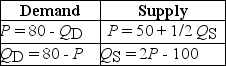 -Refer to Table 4-6.The equations above describe the demand and supply for Chef Ernie's Sushi-on-a-Stick.The equilibrium price and quantity for Chef Ernie's sushi are $60 and 20 thousand units.What is the value of producer surplus?
 (Multiple Choice)
4.8/5 (77)
(77) Figure 4-6  Figure 4-6 shows the demand and supply curves for the almond market. The government believes that the equilibrium price is too low and tries to help almond growers by setting a price floor at Pf.
-Refer to Figure 4-6.What area represents consumer surplus after the imposition of the price floor?
Figure 4-6 shows the demand and supply curves for the almond market. The government believes that the equilibrium price is too low and tries to help almond growers by setting a price floor at Pf.
-Refer to Figure 4-6.What area represents consumer surplus after the imposition of the price floor? (Multiple Choice)
4.9/5 (74)
(74) The graph below represents the market for lychee nuts.The equilibrium price is $7.00 per bushel,but the market price is $5.00 per bushel.Identify the areas representing consumer surplus,producer surplus,and deadweight loss at the equilibrium price of $7.00 and at the market price of $5.00. 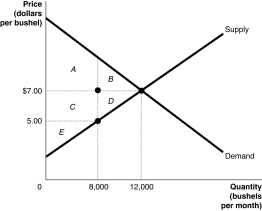
(Essay)
4.9/5 (81)
(81) Figure 4-1 Figure 4-1 shows Arnold's demand curve for burritos.
-Refer to Figure 4-1.Arnold's marginal benefit from consuming the second burrito is
Figure 4-1 shows Arnold's demand curve for burritos.
-Refer to Figure 4-1.Arnold's marginal benefit from consuming the second burrito is (Multiple Choice)
4.9/5 (76)
(76) Frieda is at her local florist to buy a dozen roses.She is willing to pay $75 for the roses,and buys them for $75.Frieda's consumer surplus from the purchase is
(Multiple Choice)
4.8/5 (80)
(80) ________ refers to the reduction in economic surplus resulting from not being in competitive equilibrium.
(Multiple Choice)
4.8/5 (85)
(85) Figure 4-4
-Refer to Figure 4-4.The figure above represents the market for pecans.Assume that this is a competitive market.If 4,000 pounds of pecans are sold
-Refer to Figure 4-4.The figure above represents the market for pecans.Assume that this is a competitive market.If 4,000 pounds of pecans are sold (Multiple Choice)
4.8/5 (80)
(80) 
Filters
- Essay(0)
- Multiple Choice(0)
- Short Answer(0)
- True False(0)
- Matching(0)