



 Chat with AI
Exam 11: Strategic Cost Management

Exam 1: Introduction to Cost Management157 Questions
Exam 2: Basic Cost Management Concepts201 Questions
Exam 3: Cost Behavior200 Questions
Exam 4: Activity-Based Costing201 Questions
Exam 5: Product and Service Costing: Job-Order System150 Questions
Exam 6: Process Costing188 Questions
Exam 7: Allocating Costs of Support Departments and Joint Products173 Questions
Exam 8: Budgeting for Planning and Control Key200 Questions
Exam 9: Standard Costing: a Functional-Based Control Approach123 Questions
Exam 10: Decentralization: Responsibility Accounting, Performance Evaluation, and Transfer Pricing139 Questions
Exam 11: Strategic Cost Management151 Questions
Exam 12: Activity-Based Management146 Questions
Exam 13: The Balanced Scorecard: Strategic-Based Control124 Questions
Exam 14: Quality and Environmental Cost Management202 Questions
Exam 15: Lean Accounting and Productivity Measurement172 Questions
Exam 16: Cost-Volume-Profit Analysis138 Questions
Exam 17: Activity Resource Usage Model and Tactical Decision Making128 Questions
Exam 18: Pricing and Profitability Analysis164 Questions
Exam 19: Capital Investment126 Questions
Exam 20: Inventory Management: Economic Order Quantity, Jit, and the Theory of Constraints127 Questions
Select questions type


Figure 11-4 the Algonquin Company developed the following budgeted life-cycle income statement for two proposed products. Each product's life cycle is expected to be two years.
 A 10 percent return on sales is required for new products. Because the proposed products did not have a 10 percent return on sales, the products were going to be dropped.
Relative to Product B, Product A requires more research and development costs but fewer resources to market the product. Sixty percent of the research and development costs are traceable to Product A, and 30 percent of the marketing costs are traceable to Product A.
Refer to Figure 11-4. Return on sales for Product A would be
A 10 percent return on sales is required for new products. Because the proposed products did not have a 10 percent return on sales, the products were going to be dropped.
Relative to Product B, Product A requires more research and development costs but fewer resources to market the product. Sixty percent of the research and development costs are traceable to Product A, and 30 percent of the marketing costs are traceable to Product A.
Refer to Figure 11-4. Return on sales for Product A would be (Multiple Choice)
4.8/5  (84)
(84) Accounting for the cost accounting cycle in a JIT environment is simplified by using __________ costing.
(Short Answer)
4.9/5 (80)
(80) The period of time when sales increase at an increasing rate is called the:
(Multiple Choice)
4.8/5 (69)
(69) Figure 11-2 Blue Vibrance Company sells a product used in many manufacturing processes. The sales activity involves three activity areas:
 The following customer information is given:
 Refer to Figure 11-2. What is the profitability of customer BY?
The following customer information is given:
Refer to Figure 11-2. What is the profitability of customer BY? (Multiple Choice)
4.9/5 (67)
(67) Figure 11-1 Ambrosia Corp. is a manufacturer of equipment used in manufacturing. It currently produces a product with 30 parts but through redesign has reduced the number of parts to 9. Then current activity capacity and demand for the 30 unit configuration and expected activity demand for the 9 part configuration are provided below:
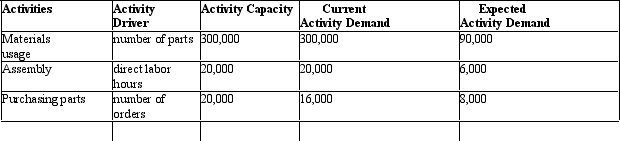 Materials usage has a rate of $6 per part and no fixed costs. Assembly has a rate of $20 per labor hour with no fixed component. Purchasing requires clerks that can process 5,000 purchase orders. Each clerk earns $40,000 per year. There is also a $1 per order processing cost.
Refer to Figure 11-1. What is the total cost reduction of the new design?
Materials usage has a rate of $6 per part and no fixed costs. Assembly has a rate of $20 per labor hour with no fixed component. Purchasing requires clerks that can process 5,000 purchase orders. Each clerk earns $40,000 per year. There is also a $1 per order processing cost.
Refer to Figure 11-1. What is the total cost reduction of the new design? (Multiple Choice)
4.9/5 (75)
(75) When a computer company selects a mix of strategies in order to create sustainable competitive advantage, it is following a
(Multiple Choice)
4.8/5 (93)
(93) Laramie Company has a traditional, unit-based cost system. The Kansas City plant of Laramie produces eight different electronic products. Each year, 100,000 units of all products are produced. The demand for each product is about the same; thus, the average output for each product is 12,500 units. Although the products differ in complexity, each product uses about the same labor time and materials. The plant has used direct labor hours for years to assign overhead to products. The cost accounting department developed the following cost equation to help design engineers understand the assumed cost relationships. (The equation describes the relationship between total manufacturing costs and direct labor hours. The equation is supported by a coefficient of determination of 63 percent):
Y = $5,000,000 + $60X where X is the number of direct labor hours
The variable rate of $60 is broken down as follows:
 Because of competitive pressures, product engineering was asked to redesign products to reduce the total cost of manufacturing. Using the above cost relationships, product engineering adopted the strategy of redesigning to reduce direct labor content. As each design was completed, an engineering change order was cut, triggering a series of events such as design approval, vendor selection, bill of materials update, redrawing of schematic, test runs, changes in setup procedures, development of new inspection procedures, and so on.
After one year of design change, the normal volume of direct labor was reduced from 125,000 hours to 100,000 hours, with the 100,000 units being built. Although each product differs in its labor content, the redesign efforts reduced the labor content for all products. On average, labor content per unit of product dropped from 1.25 hours per unit to 1 hour per unit. Fixed overhead, however, increased from $5,000,000 to $6,000,000.
Required:

Because of competitive pressures, product engineering was asked to redesign products to reduce the total cost of manufacturing. Using the above cost relationships, product engineering adopted the strategy of redesigning to reduce direct labor content. As each design was completed, an engineering change order was cut, triggering a series of events such as design approval, vendor selection, bill of materials update, redrawing of schematic, test runs, changes in setup procedures, development of new inspection procedures, and so on.
After one year of design change, the normal volume of direct labor was reduced from 125,000 hours to 100,000 hours, with the 100,000 units being built. Although each product differs in its labor content, the redesign efforts reduced the labor content for all products. On average, labor content per unit of product dropped from 1.25 hours per unit to 1 hour per unit. Fixed overhead, however, increased from $5,000,000 to $6,000,000.
Required:
(Essay)
4.8/5 (70)
(70) Prior to installing a JIT system, Clarendon Company used machine hours to assign maintenance costs to its three products of 6-inch, 8-inch, and 11-inch insulation. The maintenance costs totaled $400,000 per year. The machine hours used by each product and the quantity produced of each product are as follows:  After installing JIT, three manufacturing cells were created and the cell workers were trained to perform maintenance. Maintenance costs for the three cells still totaled $400,000; however, these costs are now traceable to each cell.
 After installing JIT, the maintenance cost per roll of 6-inch insulation would be
After installing JIT, three manufacturing cells were created and the cell workers were trained to perform maintenance. Maintenance costs for the three cells still totaled $400,000; however, these costs are now traceable to each cell.
After installing JIT, the maintenance cost per roll of 6-inch insulation would be (Multiple Choice)
4.8/5 (81)
(81) The viewpoint that describes the general sales pattern of a product as it passes through the introduction, growth, maturity, and decline stages is called the:
(Multiple Choice)
4.8/5 (75)
(75) Which stage in the marketing viewpoint is characterized by preproduction and startup activities?
(Multiple Choice)
4.8/5 (87)
(87) Which of the following are true about total quality control?
(Multiple Choice)
4.9/5 (83)
(83) Which of the following is NOT a stage of the production life-cycle viewpoint?
(Multiple Choice)
4.8/5 (79)
(79) Figure 11-1 Ambrosia Corp. is a manufacturer of equipment used in manufacturing. It currently produces a product with 30 parts but through redesign has reduced the number of parts to 9. Then current activity capacity and demand for the 30 unit configuration and expected activity demand for the 9 part configuration are provided below:
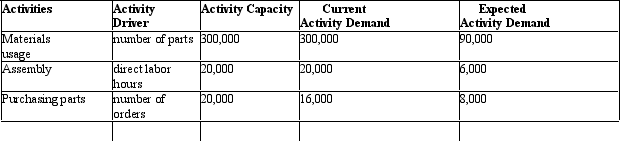 Materials usage has a rate of $6 per part and no fixed costs. Assembly has a rate of $20 per labor hour with no fixed component. Purchasing requires clerks that can process 5,000 purchase orders. Each clerk earns $40,000 per year. There is also a $1 per order processing cost.
Refer to Figure 11-1. What is the cost savings from purchasing parts?
Materials usage has a rate of $6 per part and no fixed costs. Assembly has a rate of $20 per labor hour with no fixed component. Purchasing requires clerks that can process 5,000 purchase orders. Each clerk earns $40,000 per year. There is also a $1 per order processing cost.
Refer to Figure 11-1. What is the cost savings from purchasing parts? (Multiple Choice)
4.9/5 (74)
(74) the traditional approach of permitting defects to occur as long as they do NOT exceed a certain level is called
(Multiple Choice)
4.9/5 (86)
(86) Which of the following manufacturing costs is assigned to products in a traditional and JIT environment using allocation?
(Multiple Choice)
4.9/5 (78)
(78) If JIT manufacturing is used and each manufacturing cell produces a single product, all of the following are considered direct product costs EXCEPT
(Multiple Choice)
4.9/5 (85)
(85) 
Filters
- Essay(0)
- Multiple Choice(0)
- Short Answer(0)
- True False(0)
- Matching(0)