



 Chat with AI
Exam 11: Strategic Cost Management

Exam 1: Introduction to Cost Management157 Questions
Exam 2: Basic Cost Management Concepts201 Questions
Exam 3: Cost Behavior200 Questions
Exam 4: Activity-Based Costing201 Questions
Exam 5: Product and Service Costing: Job-Order System150 Questions
Exam 6: Process Costing188 Questions
Exam 7: Allocating Costs of Support Departments and Joint Products173 Questions
Exam 8: Budgeting for Planning and Control Key200 Questions
Exam 9: Standard Costing: a Functional-Based Control Approach123 Questions
Exam 10: Decentralization: Responsibility Accounting, Performance Evaluation, and Transfer Pricing139 Questions
Exam 11: Strategic Cost Management151 Questions
Exam 12: Activity-Based Management146 Questions
Exam 13: The Balanced Scorecard: Strategic-Based Control124 Questions
Exam 14: Quality and Environmental Cost Management202 Questions
Exam 15: Lean Accounting and Productivity Measurement172 Questions
Exam 16: Cost-Volume-Profit Analysis138 Questions
Exam 17: Activity Resource Usage Model and Tactical Decision Making128 Questions
Exam 18: Pricing and Profitability Analysis164 Questions
Exam 19: Capital Investment126 Questions
Exam 20: Inventory Management: Economic Order Quantity, Jit, and the Theory of Constraints127 Questions
Select questions type


Choosing alternative strategies that provide long-term growth involves __________ decision making.
(Short Answer)
4.9/5  (78)
(78) Figure 11-4 the Algonquin Company developed the following budgeted life-cycle income statement for two proposed products. Each product's life cycle is expected to be two years.
 A 10 percent return on sales is required for new products. Because the proposed products did not have a 10 percent return on sales, the products were going to be dropped.
Relative to Product B, Product A requires more research and development costs but fewer resources to market the product. Sixty percent of the research and development costs are traceable to Product A, and 30 percent of the marketing costs are traceable to Product A.
Refer to figure 11-4. If research and development costs and marketing costs are traced to each product, life-cycle income for Product B would be
A 10 percent return on sales is required for new products. Because the proposed products did not have a 10 percent return on sales, the products were going to be dropped.
Relative to Product B, Product A requires more research and development costs but fewer resources to market the product. Sixty percent of the research and development costs are traceable to Product A, and 30 percent of the marketing costs are traceable to Product A.
Refer to figure 11-4. If research and development costs and marketing costs are traced to each product, life-cycle income for Product B would be (Multiple Choice)
4.8/5 (90)
(90) Which of the following is a trait of a traditional manufacturing system?
(Multiple Choice)
4.9/5 (62)
(62) Luminous Company sells a product for $450 per unit. Its market share is 25 percent. The marketing manager feels that the market share can be increased to 33 percent with a reduction in price to $390. The product is currently earning a profit of $72 per unit. The president of Luminous Company feels that the $72 profit per unit must be maintained. What is the original cost per unit?
(Multiple Choice)
4.9/5 (79)
(79) A firm that has implemented JIT had the following transactions: 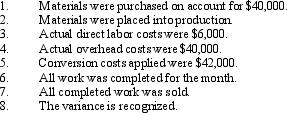 Which of the following would NOT be an entry under the backflush system, assuming the second trigger point is the completion of goods?
 (Multiple Choice)
4.9/5 (81)
(81) The operational activity of assembling parts is an example of a
(Multiple Choice)
4.8/5 (65)
(65) Which of the following manufacturing costs is assigned to products in a traditional and JIT environment using direct tracing?
(Multiple Choice)
4.8/5 (83)
(83) JIT manufacturing eliminates waste by producing products only when, and in the quantities needed.
(True/False)
4.8/5 (77)
(77) In traditional and JIT environments using direct tracing, the manufacturing costs assigned to products are the direct materials costs and the __________ costs.
(Short Answer)
4.8/5 (71)
(71) Building plants, management structuring, and grouping employees are examples of
(Multiple Choice)
4.7/5 (74)
(74) Information for life-cycle cost management is supported by a(n)
(Multiple Choice)
4.7/5 (69)
(69) The difference between what a customer receives and what the customer gives up is called:
(Multiple Choice)
4.9/5 (72)
(72) The following transactions take place after the implementation of JIT: 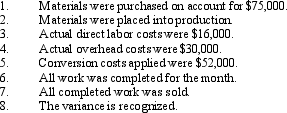 What will be the entry to record material placed into production using the traditional approach?
 (Multiple Choice)
4.8/5 (85)
(85) Which of the following is NOT a stage of the marketing viewpoint of the product life cycle?
(Multiple Choice)
4.9/5 (87)
(87) The relationships among activities that are performed with a firm's portion of the value chain is(are) called:
(Multiple Choice)
4.8/5 (79)
(79) If JIT manufacturing is used and each manufacturing cell produces a single product, which of the following is considered a direct product cost?
(Multiple Choice)
4.8/5 (83)
(83) 
Filters
- Essay(0)
- Multiple Choice(0)
- Short Answer(0)
- True False(0)
- Matching(0)