



 Chat with AI
Exam 5: Financial Reporting and Analysis

Exam 1: Uses of Accounting Information and the Financial Statements167 Questions
Exam 2: Analyzing Business Transactions189 Questions
Exam 3: Measuring Business Income171 Questions
Exam 4: Completing the Accounting Cycle176 Questions
Exam 5: Financial Reporting and Analysis177 Questions
Exam 6: The Operating Cycle and Merchandising Operations145 Questions
Exam 7: Internal Control117 Questions
Exam 8: Inventories154 Questions
Exam 9: Cash and Receivables177 Questions
Exam 10: Current Liabilities and Fair Value Accounting180 Questions
Exam 11: Long Term Assets241 Questions
Exam 12: Contributed Capital189 Questions
Exam 13: Long Term Liabilities194 Questions
Exam 14: The Corporate Income Statement and the Statement of Stockholders Equity176 Questions
Exam 15: The Statement of Cash Flows149 Questions
Exam 16: Financial Performance Measurement163 Questions
Exam 17: Partnerships129 Questions
Exam 18: The Changing Business Environment-A Managers Pers130 Questions
Exam 19: Cost Concepts and Cost Allocation188 Questions
Exam 20: Costing Systems: Job Order Costing88 Questions
Exam 21: Costing Systems Process Costing136 Questions
Exam 22: Activity-Based Systems-Abm and Lean152 Questions
Exam 23: Cost Behavior Analysis166 Questions
Exam 24: The Budgeting Process116 Questions
Exam 25: Performance Management and Evaluation117 Questions
Exam 26: Standard Costing and Variance Analysis120 Questions
Exam 27: Short Run Decision Analysis90 Questions
Exam 28: Capital Investment Analysis123 Questions
Select questions type


Income from operations is the difference between gross margin and operating expenses.
(True/False)
4.7/5  (84)
(84) The following lettered items represent a classification scheme for a multistep income statement. In the blank next to each account, write the letter indicating to which category it belongs.
a. Revenues
b. Cost of goods sold
c. Selling expenses
d. General and administrative expenses
e. Other revenues and expenses
f. Not on income statement
_____ 1. Interest Income
_____ 2. Accumulated
Depreciation
_____ 3. Sales Returns and
Allowances
_____ 4. Inventories
_____ 5. Company President's
Salary
_____ 6. Utilities Expense for Store
_____ 7. Interest Expense
_____ 8. Freight-Out Expense
_____ 9. Office Salaries Expense for
Headquarters
_____ 10. Interest Receivable
(Essay)
4.8/5 (76)
(76) Natural resources, such as coal mines and oil wells, are classified as intangible assets.
(True/False)
4.9/5 (68)
(68) Positive operating income will result if gross margin exceeds
(Multiple Choice)
4.9/5 (76)
(76) Use this balance sheet and income statement to answer the following question. Use ending balances whenever average balances are required for computing ratios. 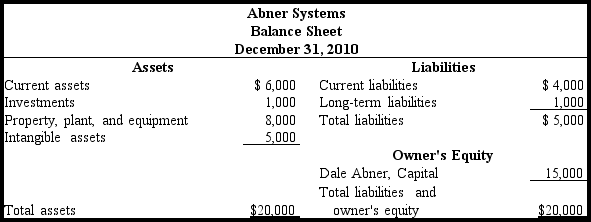
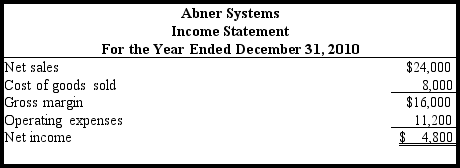 The return on equity for Abner Systems is
 (Multiple Choice)
4.9/5 (85)
(85) Use this balance sheet and income statement to answer the following question. Use ending balances whenever average balances are required for computing ratios. 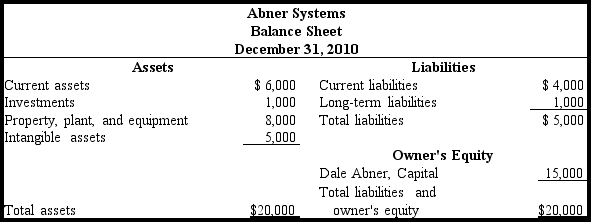
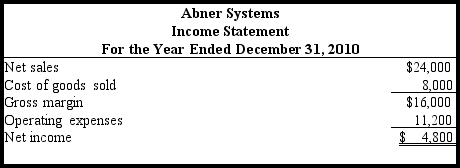 The return on assets for Abner Systems is
 (Multiple Choice)
5.0/5 (85)
(85) The qualitative characteristic of faithful representation contains all the following features except
(Multiple Choice)
4.8/5 (67)
(67) A different set of financial statements usually is prepared for each user.
(True/False)
4.9/5 (70)
(70) The cost-benefit convention holds that the benefits to be gained from providing accounting information should be less than the costs of providing it.
(True/False)
4.8/5 (73)
(73) The convention of consistency pertains to the use of the same accounting principles by firms in the same industry.
(True/False)
4.8/5 (68)
(68) The investments category on the balance sheet normally includes investments that are intended to be held for a short period of time.
(True/False)
4.9/5 (85)
(85) Use this information to answer the following question. 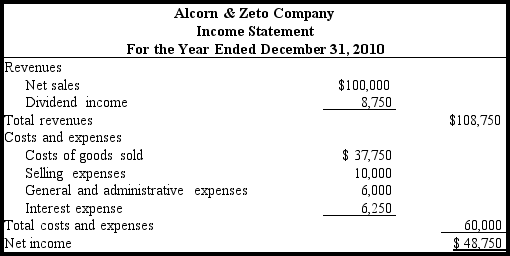 If the income statement were prepared in a multistep form, operating expenses would be
 (Multiple Choice)
4.8/5 (74)
(74) Interest paid on debt would be entered on the multistep income statement in the category called
(Multiple Choice)
4.7/5 (86)
(86) The main difference among the balance sheets of the sole proprietorship, the partnership, and the corporation is found in the owner's equity section.
(True/False)
4.8/5 (81)
(81) One of the three objectives of financial reporting established by the FASB is to provide information that is useful to potential customers.
(True/False)
4.8/5 (80)
(80) The main difference between intangible assets and property, plant, and equipment is the length of the asset's life.
(True/False)
4.8/5 (69)
(69) Use the following information to calculate the liquidity and profitability ratios listed below. Round to two decimal places.
Average owner's equity \ 9,250 Net income \ 1,500 Average total assets 18,000 Net sales 15,625 Current assets 11,250 Total liabilities 8,750 Current liabilities 7,500
a. Current ratio
b. Working capital
c. Return on equity
d. Profit margin
e. Debt to equity ratio
f. Return on assets
g. Asset turnover
(Essay)
4.8/5 (88)
(88) 
Filters
- Essay(0)
- Multiple Choice(0)
- Short Answer(0)
- True False(0)
- Matching(0)