



 Chat with AI
Exam 5: Financial Reporting and Analysis

Exam 1: Uses of Accounting Information and the Financial Statements167 Questions
Exam 2: Analyzing Business Transactions189 Questions
Exam 3: Measuring Business Income171 Questions
Exam 4: Completing the Accounting Cycle176 Questions
Exam 5: Financial Reporting and Analysis177 Questions
Exam 6: The Operating Cycle and Merchandising Operations145 Questions
Exam 7: Internal Control117 Questions
Exam 8: Inventories154 Questions
Exam 9: Cash and Receivables177 Questions
Exam 10: Current Liabilities and Fair Value Accounting180 Questions
Exam 11: Long Term Assets241 Questions
Exam 12: Contributed Capital189 Questions
Exam 13: Long Term Liabilities194 Questions
Exam 14: The Corporate Income Statement and the Statement of Stockholders Equity176 Questions
Exam 15: The Statement of Cash Flows149 Questions
Exam 16: Financial Performance Measurement163 Questions
Exam 17: Partnerships129 Questions
Exam 18: The Changing Business Environment-A Managers Pers130 Questions
Exam 19: Cost Concepts and Cost Allocation188 Questions
Exam 20: Costing Systems: Job Order Costing88 Questions
Exam 21: Costing Systems Process Costing136 Questions
Exam 22: Activity-Based Systems-Abm and Lean152 Questions
Exam 23: Cost Behavior Analysis166 Questions
Exam 24: The Budgeting Process116 Questions
Exam 25: Performance Management and Evaluation117 Questions
Exam 26: Standard Costing and Variance Analysis120 Questions
Exam 27: Short Run Decision Analysis90 Questions
Exam 28: Capital Investment Analysis123 Questions
Select questions type


It is possible for an asset to be a current asset even though the expected conversion of that asset into cash is to be longer than one year.
(True/False)
4.9/5  (85)
(85) To understand accounting information, users must be familiar with the accounting conventions, or rules of thumb, used in preparing financial statements.
(True/False)
4.9/5 (82)
(82) A company with a current ratio of 1.0 is considered more liquid than a company with a current ratio of 2.0.
(True/False)
4.8/5 (83)
(83) Use this balance sheet and income statement for the first year of operations for Layton Novelties to answer the following question. Use ending balances whenever average balances are required for computing ratios. 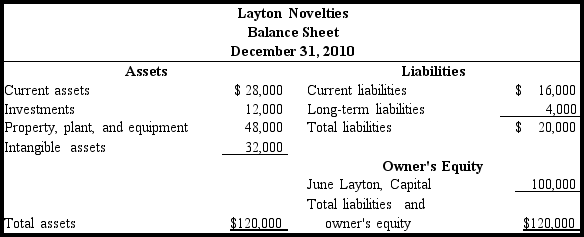 Laytan Navelties
Income St-tement
Far the Year Ended December 31, 2010
Net sales \ 80,000 Cost of goods sold 32,000 Gross margin \ 48,000 Operating expenses 26,400 Net income \2 1,600 The debt to equity ratio for Layton Novelties is
Laytan Navelties
Income St-tement
Far the Year Ended December 31, 2010
Net sales \ 80,000 Cost of goods sold 32,000 Gross margin \ 48,000 Operating expenses 26,400 Net income \2 1,600 The debt to equity ratio for Layton Novelties is (Multiple Choice)
4.9/5 (77)
(77) Which of the following should not be classified as a current asset?
(Multiple Choice)
4.8/5 (68)
(68) Which of the following accounts is most likely to appear on the balance sheet as a current liability?
(Multiple Choice)
4.9/5 (76)
(76) Profitability means having enough cash on hand to pay bills when they become due.
(True/False)
4.9/5 (84)
(84) Use this information to answer the following question. 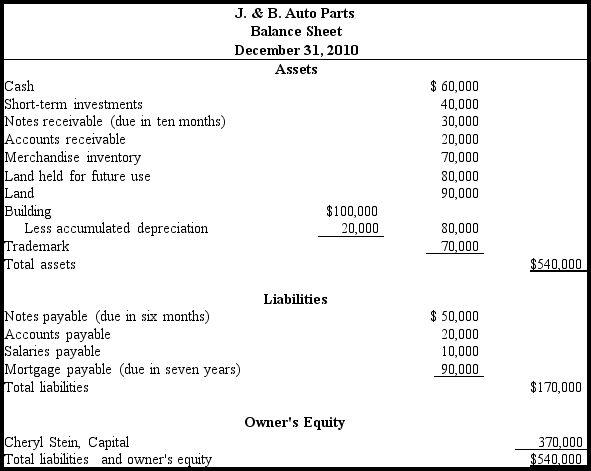 The total dollar amount of assets to be classified as investments is
 (Multiple Choice)
4.8/5 (76)
(76) Each of the following statements violates a concept or convention of accounting. Write the letter in the blank next to each statement corresponding to the concept or convention violated.
a. Consistency
b. Materiality
c. Conservatism
_____ 1. A note to the financial statements indicating a change in inventory methods is omitted.
_____ 2. When management is unsure of which estimates to use in a given situation, the estimate resulting in the largest net income is always used.
_____ 3. In 2009, a company uses straight-line depreciation and in 2010 the company uses declining-balance depreciation.
_____ 4. A small company expenses all expenditures under $10,000.
_____ 5. A small company purchases a $50,000 computer to save $3,000 per year in bookkeeping wages.
d. Full disclosure
e. Cost-benefit
(Essay)
4.8/5 (80)
(80) In which category would office salaries expense be included?
(Multiple Choice)
4.8/5 (81)
(81) The Sarbanes-Oxley Act requires a company to guarantee that its financial statements are 100 percent accurate.
(True/False)
4.8/5 (80)
(80) Income from operations is arrived after considering all except
(Multiple Choice)
4.9/5 (71)
(71) Match the following financial statement ratios with their definition.
1. Working capital _____
2. Current ratio _______
3. Profit margin ______
4. Return on assets______
5. Debt to equity ratio________
6. Return on equity_______
7. Asset turnover_________
a. A measure of profitability that shows the proportion of a company's assets that is financed by creditors and the proportion financed by owners
b. A measure of liquidity that shows the net current assets on hand to continue business operations
c. A measure of profitability that relates the amount earned by a business to the owner's investment in the business
d. A measure of profitability that shows the percentage of each sales dollar that results in net income
e. A measure of liquidity; current assets divided by current liabilities
(Essay)
4.8/5 (75)
(75) The income statement of a company that provides a service only will contain gross margin.
(True/False)
4.9/5 (80)
(80) Accounting information contains numerous estimates, classifications, summarizations, judgments, and allocations.
(True/False)
4.7/5 (85)
(85) Use this information to answer the following question. 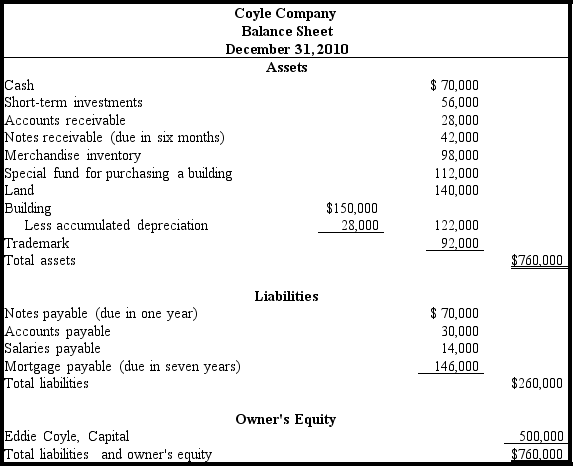 The total dollar amount of assets to be classified as property, plant, and equipment is
 (Multiple Choice)
4.8/5 (81)
(81) The use of the lower-of-cost-or-market method for inventory is an application of the convention of conservatism.
(True/False)
4.7/5 (80)
(80) 
Filters
- Essay(0)
- Multiple Choice(0)
- Short Answer(0)
- True False(0)
- Matching(0)