



 Chat with AI
Exam 17: Partnerships

Exam 1: Uses of Accounting Information and the Financial Statements167 Questions
Exam 2: Analyzing Business Transactions189 Questions
Exam 3: Measuring Business Income171 Questions
Exam 4: Completing the Accounting Cycle176 Questions
Exam 5: Financial Reporting and Analysis177 Questions
Exam 6: The Operating Cycle and Merchandising Operations145 Questions
Exam 7: Internal Control117 Questions
Exam 8: Inventories154 Questions
Exam 9: Cash and Receivables177 Questions
Exam 10: Current Liabilities and Fair Value Accounting180 Questions
Exam 11: Long Term Assets241 Questions
Exam 12: Contributed Capital189 Questions
Exam 13: Long Term Liabilities194 Questions
Exam 14: The Corporate Income Statement and the Statement of Stockholders Equity176 Questions
Exam 15: The Statement of Cash Flows149 Questions
Exam 16: Financial Performance Measurement163 Questions
Exam 17: Partnerships129 Questions
Exam 18: The Changing Business Environment-A Managers Pers130 Questions
Exam 19: Cost Concepts and Cost Allocation188 Questions
Exam 20: Costing Systems: Job Order Costing88 Questions
Exam 21: Costing Systems Process Costing136 Questions
Exam 22: Activity-Based Systems-Abm and Lean152 Questions
Exam 23: Cost Behavior Analysis166 Questions
Exam 24: The Budgeting Process116 Questions
Exam 25: Performance Management and Evaluation117 Questions
Exam 26: Standard Costing and Variance Analysis120 Questions
Exam 27: Short Run Decision Analysis90 Questions
Exam 28: Capital Investment Analysis123 Questions
Select questions type


When a partner withdraws from a partnership taking assets that represent less than his or her capital balance,
(Multiple Choice)
4.8/5  (63)
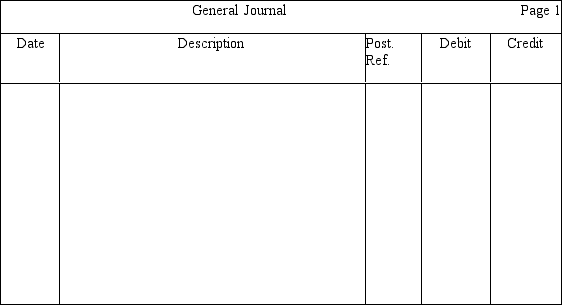
(63) A, B, and C are partners who share profits and losses in a ratio of 3:1:2, respectively. C's Capital account has a $50,000 balance. A and B have agreed to let C take $62,000 of the company's cash when she retires. Prepare an entry in journal form without explanation to record C's exit, including the recognition of a bonus to C.
(Essay)
4.9/5 (80)
(80) Which of the following methods of distributing income and losses cannot be accomplished (cannot stand alone)?
(Multiple Choice)
4.9/5 (76)
(76) Jeb and Kelly divide partnership income and losses solely on the basis of their average capital balances. Jeb had $45,000 invested during all of 2010; Kelly had $30,000 invested from January 1 to September 30, and she invested another $20,000 on October 1. If income was $200,000 during 2010, how much should each partner receive?
(Essay)
4.8/5 (79)
(79) Income and losses are divided equally among the partners unless the partnership agreement specifies otherwise.
(True/False)
4.9/5 (74)
(74) Tracy and Dennis are partners in a business. Tracy's original capital contribution was $40,000, and Dennis's was $60,000. They agreed to share profits and losses as follows:
Tracy Dennis As salaries \ 36,000 \ 48,000 As interest on original capital 10\% 10\% Remaining profits or losses 2/3 1/3 Calculate each partner's share of profits and losses, assuming (a) the profit was $100,000, (b) the profit was $70,000, and (c) the loss was $8,000.
(Essay)
4.7/5 (73)
(73) Partner A purchases partner B's $3,000 interest from partner B for $5,000. The entry to record the transaction is for $3,000.
(True/False)
4.8/5 (86)
(86) The salary, interest, and stated ratio method of allocation cannot be applied when a net loss has occurred.
(True/False)
5.0/5 (87)
(87) Total partners' equity will not change when a withdrawing partner
(Multiple Choice)
4.9/5 (82)
(82) Which of the following is not a characteristic of partnerships?
(Multiple Choice)
4.8/5 (71)
(71) Kelly invests $40,000 for a 10 percent interest in a partnership that has total capital of $300,000 after admitting Kelly. Which of the following is true?
(Multiple Choice)
4.8/5 (85)
(85) An advantage of the partnership form of business is that each partner's potential loss is limited to that partner's investment in the partnership.
(True/False)
4.9/5 (76)
(76) Liabilities related to assets invested in a partnership by a new partner cannot be transferred to the partnership.
(True/False)
4.8/5 (76)
(76) The salary allocation to partners also appears as Salaries Expense on the partnership income statement.
(True/False)
5.0/5 (78)
(78) The potential loss of all partners in an ordinary partnership is limited only by personal bankruptcy laws.
(True/False)
4.9/5 (76)
(76) 
Filters
- Essay(0)
- Multiple Choice(0)
- Short Answer(0)
- True False(0)
- Matching(0)