



 Chat with AI
Exam 17: Partnerships

Exam 1: Uses of Accounting Information and the Financial Statements167 Questions
Exam 2: Analyzing Business Transactions189 Questions
Exam 3: Measuring Business Income171 Questions
Exam 4: Completing the Accounting Cycle176 Questions
Exam 5: Financial Reporting and Analysis177 Questions
Exam 6: The Operating Cycle and Merchandising Operations145 Questions
Exam 7: Internal Control117 Questions
Exam 8: Inventories154 Questions
Exam 9: Cash and Receivables177 Questions
Exam 10: Current Liabilities and Fair Value Accounting180 Questions
Exam 11: Long Term Assets241 Questions
Exam 12: Contributed Capital189 Questions
Exam 13: Long Term Liabilities194 Questions
Exam 14: The Corporate Income Statement and the Statement of Stockholders Equity176 Questions
Exam 15: The Statement of Cash Flows149 Questions
Exam 16: Financial Performance Measurement163 Questions
Exam 17: Partnerships129 Questions
Exam 18: The Changing Business Environment-A Managers Pers130 Questions
Exam 19: Cost Concepts and Cost Allocation188 Questions
Exam 20: Costing Systems: Job Order Costing88 Questions
Exam 21: Costing Systems Process Costing136 Questions
Exam 22: Activity-Based Systems-Abm and Lean152 Questions
Exam 23: Cost Behavior Analysis166 Questions
Exam 24: The Budgeting Process116 Questions
Exam 25: Performance Management and Evaluation117 Questions
Exam 26: Standard Costing and Variance Analysis120 Questions
Exam 27: Short Run Decision Analysis90 Questions
Exam 28: Capital Investment Analysis123 Questions
Select questions type


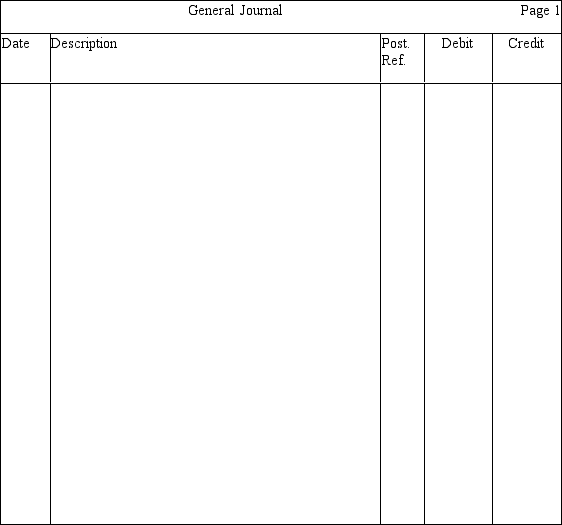
Jimmy, Karol, and Lui are partners in JKL Company, with average capital balances for the year of $30,000, $40,000, and $20,000, respectively. They share remaining income and losses in a 2:5:3 ratio, respectively, after each receives a $15,000 salary and 10 percent interest on his average capital balances. In the journal provided, prepare the entries without explanations to close income or loss into their Capital accounts, assuming (a) net income of $74,000, (b) net income of $14,000, and (c) net loss of $6,000.
(Essay)
4.7/5  (81)
(81) X, Y, and Z are partners who share profits and losses in a ratio of 1:2:3, respectively. Z's Capital account has a $60,000 balance. X and Y have agreed to let Z take $78,000 of the company's cash when he retires. Prepare an entry in journal form without explanation to record Z's exit, including the recognition of a bonus to Z
(Essay)
4.9/5 (80)
(80) A limited partnership normally has one or more general partners whose liability is unlimited.
(True/False)
4.9/5 (83)
(83) Which of the following will not result in dissolution of a partnership?
(Multiple Choice)
4.9/5 (71)
(71) If liquidation of a partnership results in a negative balance in a partner's account, the partner must pay into the partnership the amount of the negative balance.
(True/False)
4.7/5 (67)
(67) Bjorn and Canute are partners who share profits and losses in a ratio of 2:3, respectively, and have the following capital balances on September 30, 2010:
Bjorn, Capital Canute, Capital \ 100,000. \ 150,000. The partners agree to admit Davis to the partnership. Calculate the capital balances of each partner after the admission of Davis, assuming that bonuses are recorded when appropriate for each of the following assumptions:
a. Davis pays Bjorn $50,000 for 40 percent of his interest
b. Davis invests $50,000 for a one-sixth interest in the partnership
c. Davis invests $50,000 for a 25 percent interest in the partnership
d. Davis invests $50,000 for a 15 percent interest in the partnership
(Essay)
4.9/5 (87)
(87) W and X are partners who have agreed to admit Y, who will invest $15,000 for a 20 percent interest. The previous capital balances were $15,000 and $30,000 for W and X, respectively. W and X had shared profits and losses equally. What amount will be recorded in Y's Capital account?
(Multiple Choice)
5.0/5 (73)
(73) The ability of a partner to enter into a contract on behalf of all partners is called
(Multiple Choice)
4.7/5 (79)
(79) A partner has a capital balance of $40,000 for five months, $50,000 for four months, and $60,000 for three months. The average capital balance is
(Multiple Choice)
4.7/5 (81)
(81) On December 31, 2010, the D&K Partnership had the following assets, liabilities, and partners' equity:
 When the partners agreed to liquidate the business, the assets were sold for $80,000 and the liabilities were paid. D and K share profits and losses in a ratio of 3:1, respectively. What is the final cash distribution to each partner after liquidation?
 (Short Answer)
4.7/5 (71)
(71) W and X are partners who have agreed to admit Y, who will invest $15,000 for a 20 percent interest. The previous capital balances were $15,000 and $30,000 for W and X, respectively. W and X had shared profits and losses equally. The entry that records Y's admission to the partnership is: 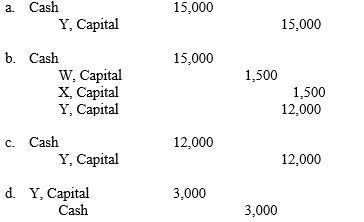
(Short Answer)
4.9/5 (84)
(84) Accounting for a partnership comes closer to accounting for a sole proprietorship than to accounting for a corporation.
(True/False)
4.9/5 (77)
(77) A new partner must have the consent of all the partners before being admitted into the partnership.
(True/False)
4.8/5 (74)
(74) When a loss is closed into the partners' Capital accounts, Income Summary is credited.
(True/False)
4.8/5 (63)
(63) A liquidation differs from a dissolution is that in a liquidation
(Multiple Choice)
4.8/5 (79)
(79) Partner X purchases Partner Y's $25,000 interest from Partner Y for $30,000. The entry to record the transaction is for $30,000.
(True/False)
4.8/5 (84)
(84) On December 31, 2010, the C&J Partnership had the following assets, liabilities, and partners' equity:
 When the partners agreed to liquidate the business, the assets were sold for $90,000 and the liabilities were paid. C and J share profits and losses in a ratio of 2:1, respectively. What is the final cash distribution to each partner after liquidation?
 (Short Answer)
4.8/5 (65)
(65) 
Filters
- Essay(0)
- Multiple Choice(0)
- Short Answer(0)
- True False(0)
- Matching(0)