



 Chat with AI
Exam 12: Intermolecular Forces: Liquids,solids,and Phase Changes

Exam 1: Keys to the Study of Chemistry66 Questions
Exam 2: The Components of Matter91 Questions
Exam 3: Stoichiometry of Formulas and Equations90 Questions
Exam 4: Three Major Classes of Chemical Reactions84 Questions
Exam 5: Gases and the Kinetic-Molecular Theory93 Questions
Exam 6: Thermochemistry: Energy Flow and Chemical Change71 Questions
Exam 7: Quantum Theory and Atomic Structure72 Questions
Exam 8: Electron Configuration and Chemical Periodicity70 Questions
Exam 9: Models of Chemical Bonding60 Questions
Exam 10: The Shapes of Molecules94 Questions
Exam 11: Theories of Covalent Bonding49 Questions
Exam 12: Intermolecular Forces: Liquids,solids,and Phase Changes89 Questions
Exam 13: The Properties of Solutions73 Questions
Exam 14: The Main-Group Elements: Applying Principles of Bonding and Structure58 Questions
Exam 15: Organic Compounds and the Atomic Properties of Carbon95 Questions
Exam 16: Kinetics: Rates and Mechanisms of Chemical Reactions76 Questions
Exam 17: Equilibrium: the Extent of Chemical Reactions85 Questions
Exam 18: Acid-Base Equilibria90 Questions
Exam 19: Ionic Equilibria in Aqueous Systems96 Questions
Exam 20: Thermodynamics: Entropy, free Energy, and the Direction of Chemical Reactions84 Questions
Exam 21: Electrochemistry: Chemical Change and Electrical Work97 Questions
Exam 22: The Transition Elements and Their Coordination Compounds72 Questions
Exam 23: Nuclear Reactions and Their Applications75 Questions
Select questions type


Liquid ammonia (boiling point = -33.4°C)can be used as a refrigerant and heat transfer fluid.How much energy is needed to heat 25.0 g of NH3(l)from -65.0°C to -12.0°C? 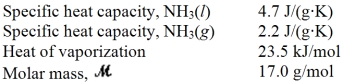
(Multiple Choice)
4.8/5  (83)
(83) Polonium crystallizes in the simple cubic lattice.What is the coordination number for Po?
(Multiple Choice)
4.7/5 (80)
(80) Use molecular orbital band diagrams to explain why metals are good conductors but semiconductors are not.
(Essay)
5.0/5 (85)
(85) The energy gap between the conduction band and the valence band is large for
(Multiple Choice)
4.8/5 (71)
(71) Consider the phase diagram shown below. 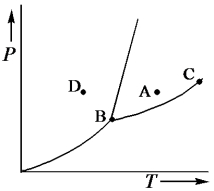 a.What phase(s)is/are present at point A?
b.What phase(s)is/are present at point B?
c.Name point C and explain its significance.
d.Starting at D,if the pressure is lowered while the temperature remains constant,describe what will happen.
a.What phase(s)is/are present at point A?
b.What phase(s)is/are present at point B?
c.Name point C and explain its significance.
d.Starting at D,if the pressure is lowered while the temperature remains constant,describe what will happen. (Essay)
4.8/5 (74)
(74) Examine the following phase diagram and identify the feature represented by point B. 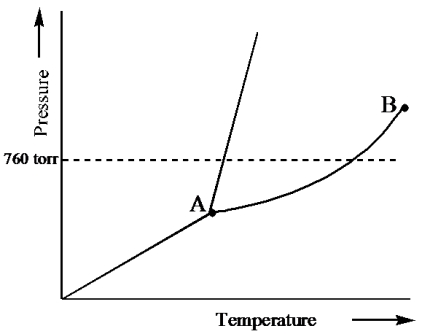
(Multiple Choice)
4.8/5 (82)
(82) Which one of the following substances does not exist in the indicated solid type?
(Multiple Choice)
4.8/5 (92)
(92) The energy needed to increase the surface area of a liquid is
(Multiple Choice)
4.9/5 (78)
(78) Iron has a body-centered cubic unit cell,and a density of 7.87 g/cm3.Calculate the edge length of the unit cell,in pm.(The atomic mass of iron is 55.85 amu.Also,1 amu = 1.661 10-24g. )
(Short Answer)
4.9/5 (99)
(99) Of the five major types of crystalline solid,which would you expect each of the following to form? (e.g. ,H2O: molecular)
a.Sn
b.Si
c.KCl
d.Xe
e.F2
(Essay)
4.8/5 (73)
(73) a.State the essential requirements for hydrogen bonding to be important in a compound.
b.List four properties of water which are significantly influenced by the presence of hydrogen bonding.
(Essay)
4.9/5 (90)
(90) Which of the following pairs is arranged with the particle of higher polarizability listed first?
(Multiple Choice)
4.9/5 (74)
(74) A metal such as chromium in the face-centered cubic lattice will have ________________ atom(s)per unit cell.
(Multiple Choice)
4.8/5 (73)
(73) Draw a fully labeled phase diagram (P versus T)of a substance whose solid phase can melt due to applied pressure (i.e. ,solid is less dense than liquid).Clearly label the triple point and the critical temperature on your diagram.
(Essay)
4.8/5 (91)
(91) When liquid bromine is cooled to form a solid,which of the following types of solid would it form?
(Multiple Choice)
4.9/5 (80)
(80) A metal in the simple cubic lattice will have ________________ atom(s)per unit cell.
(Multiple Choice)
4.9/5 (87)
(87) Which of the following should have the highest surface tension at a given temperature?
(Multiple Choice)
4.9/5 (90)
(90) Strontium metal crystallizes in a cubic unit cell which has an edge length of 612 pm.If the mass of an atom of Sr is 87.62 amu,and the density of Sr metal is 2.54 g/cm3,calculate the number of atoms per unit cell.(1 amu = 1.661 10-24 g. )
(Short Answer)
4.8/5 (89)
(89) The highest temperature at which superconductivity has been achieved is approximately
(Multiple Choice)
4.8/5 (83)
(83) 
Filters
- Essay(0)
- Multiple Choice(0)
- Short Answer(0)
- True False(0)
- Matching(0)