



 Chat with AI
Exam 12: Intermolecular Forces: Liquids,solids,and Phase Changes

Exam 1: Keys to the Study of Chemistry66 Questions
Exam 2: The Components of Matter91 Questions
Exam 3: Stoichiometry of Formulas and Equations90 Questions
Exam 4: Three Major Classes of Chemical Reactions84 Questions
Exam 5: Gases and the Kinetic-Molecular Theory93 Questions
Exam 6: Thermochemistry: Energy Flow and Chemical Change71 Questions
Exam 7: Quantum Theory and Atomic Structure72 Questions
Exam 8: Electron Configuration and Chemical Periodicity70 Questions
Exam 9: Models of Chemical Bonding60 Questions
Exam 10: The Shapes of Molecules94 Questions
Exam 11: Theories of Covalent Bonding49 Questions
Exam 12: Intermolecular Forces: Liquids,solids,and Phase Changes89 Questions
Exam 13: The Properties of Solutions73 Questions
Exam 14: The Main-Group Elements: Applying Principles of Bonding and Structure58 Questions
Exam 15: Organic Compounds and the Atomic Properties of Carbon95 Questions
Exam 16: Kinetics: Rates and Mechanisms of Chemical Reactions76 Questions
Exam 17: Equilibrium: the Extent of Chemical Reactions85 Questions
Exam 18: Acid-Base Equilibria90 Questions
Exam 19: Ionic Equilibria in Aqueous Systems96 Questions
Exam 20: Thermodynamics: Entropy, free Energy, and the Direction of Chemical Reactions84 Questions
Exam 21: Electrochemistry: Chemical Change and Electrical Work97 Questions
Exam 22: The Transition Elements and Their Coordination Compounds72 Questions
Exam 23: Nuclear Reactions and Their Applications75 Questions
Select questions type


The coordination number of sodium and chloride ions in the NaCl lattice,are,respectively:
(Multiple Choice)
4.9/5  (72)
(72) The strongest intermolecular interactions between hydrogen fluoride (HF)molecules arise from
(Multiple Choice)
4.9/5 (92)
(92) The strongest intermolecular interactions between hydrogen sulfide (H2S)molecules arise from
(Multiple Choice)
4.9/5 (67)
(67) Octane has a vapor pressure of 40.torr at 45.1°C and 400.torr at 104.0°C.What is its heat of vaporization?
(Multiple Choice)
4.9/5 (73)
(73) a.Name the two unit cells which occur in close packing of identical atoms.
b.Briefly explain how the two types of close-packed lattices of identical atoms differ,in terms of atomic arrangements.
(Essay)
4.8/5 (82)
(82) A sample of octane in equilibrium with its vapor in a closed 1.0-L container has a vapor pressure of 50.0 torr at 45°C.The container's volume is increased to 2.0 L at constant temperature and the liquid/vapor equilibrium is reestablished.What is the vapor pressure?
(Multiple Choice)
4.9/5 (84)
(84) Which of the following is true about kinetic energy,Ek,and potential energy,Ep,when ethyl alcohol at 40°C is compared with ethyl alcohol at 20°C?
(Multiple Choice)
4.9/5 (82)
(82) When the electron cloud of a molecule is easily distorted,the molecule has a high
(Multiple Choice)
4.8/5 (83)
(83) Which of the following should have the highest surface tension at a given temperature? 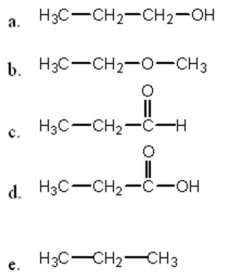
(Multiple Choice)
4.9/5 (75)
(75) The maximum number of phases of a single substance which can coexist in equilibrium is two.
(True/False)
4.7/5 (83)
(83) The strongest intermolecular interactions between pentane (C5H12)molecules arise from
(Multiple Choice)
4.9/5 (84)
(84) Only molecules which do not have dipole moments can experience dispersion forces.
(True/False)
4.7/5 (84)
(84) The strongest intermolecular interactions between ethyl alcohol (CH3CH2OH)molecules arise from
(Multiple Choice)
4.9/5 (75)
(75) A single water molecule can participate in at most two hydrogen bonds at any instant.
(True/False)
4.9/5 (88)
(88) Which of the following factors contributes to a low viscosity for a liquid?
(Multiple Choice)
4.7/5 (78)
(78) Which of the following pairs is arranged with the particle of higher polarizability listed first?
(Multiple Choice)
4.7/5 (70)
(70) Which one of the following quantities is generally not obtainable from a single heating or cooling curve of a substance,measured at atmospheric pressure?
(Multiple Choice)
4.8/5 (82)
(82) Which one of the following statements about unit cells and packing in solids is incorrect?
(Multiple Choice)
4.7/5 (60)
(60) When the adhesive forces between a liquid and the walls of a capillary tube are greater than the cohesive forces within the liquid
(Multiple Choice)
4.8/5 (84)
(84) Examine the following phase diagram and identify the feature represented by point A. 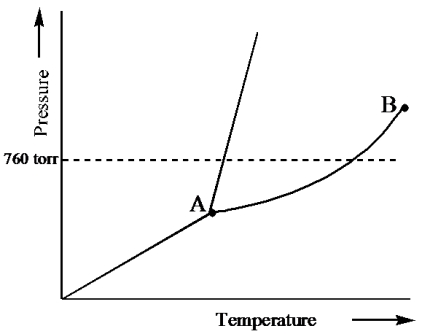
(Multiple Choice)
4.8/5 (76)
(76) 
Filters
- Essay(0)
- Multiple Choice(0)
- Short Answer(0)
- True False(0)
- Matching(0)