



 Chat with AI
Exam 26: Capital Investment Decisions

Exam 1: Accounting and the Business Environment197 Questions
Exam 2: Recording Business Transactions177 Questions
Exam 3: The Adjusting Process179 Questions
Exam 4: Completing the Accounting Cycle170 Questions
Exam 5: Merchandising Operations203 Questions
Exam 6: Merchandise Inventory163 Questions
Exam 7: Accounting Information Systems143 Questions
Exam 8: Internal Control and Cash185 Questions
Exam 9: Receivables170 Questions
Exam 10: Plant Assets, natural Resources, and Intangibles181 Questions
Exam 11: Current Liabilities and Payroll187 Questions
Exam 12: Partnerships161 Questions
Exam 13: Corporations206 Questions
Exam 14: Long-Term Liabilities192 Questions
Exam 15: Investments146 Questions
Exam 16: The Statement of Cash Flows164 Questions
Exam 17: Financial Statement Analysis167 Questions
Exam 18: Introduction to Managerial Accounting210 Questions
Exam 19: Job Order Costing170 Questions
Exam 20: Process Costing167 Questions
Exam 21: Cost-Volume-Profit Analysis238 Questions
Exam 22: Master Budgets172 Questions
Exam 23: Flexible Budgets and Standard Cost Systems204 Questions
Exam 24: Cost Allocation and Responsibility Accounting189 Questions
Exam 25: Short-Term Business Decisions181 Questions
Exam 26: Capital Investment Decisions142 Questions
Select questions type


The accounting rate of return is calculated by dividing the average annual operating income by the average amount invested.
(True/False)
4.8/5  (83)
(83) Bill Jones has just won the state lottery and has the following three payout options for after-tax prize money:
1.$150,000 per year at the end of each of the next six years
2.$304,000 (lump sum)now
3.$500,000 (lump sum)six years from now
The annual discount rate is 9%.Compute the present value of the first option.(Round your answer to the nearest whole dollar. )
Present value of an ordinary annuity of $1:
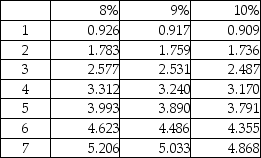 Present value of $1:
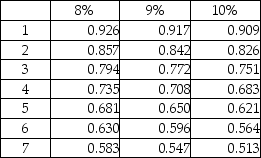
Present value of $1:
(Multiple Choice)
5.0/5 (82)
(82) 
Filters
- Essay(0)
- Multiple Choice(0)
- Short Answer(0)
- True False(0)
- Matching(0)