



 Chat with AI
Exam 22: Catalysis in Organic Reactions and in Enzymatic Reactions

Exam 1: Remembering General Chemistry: Electronic Structure and Bonding90 Questions
Exam 2: Acids and Bases: Central to Understanding Organic Chemistry43 Questions
Exam 3: An Introduction to Organic Compounds: Nomenclature, physical Properties, and Structure136 Questions
Exam 4: Isomers: the Arrangement of Atoms in Space125 Questions
Exam 5: Alkenes: Structure,nomenclature,and an Introduction to Reactivity - Thermodynamics and Kinetics84 Questions
Exam 6: The Reactions of Alkenes - the Stereochemistry of Addition Reactions89 Questions
Exam 7: The Reactions of Alkynes - Introduction to Multistep Synthesis124 Questions
Exam 8: Delocalized Electrons: Their Effect on Stability, pka, and the Products of a Reaction - Aromaticity and Electronic Effects: an Introduction to the Reactions of Benzene185 Questions
Exam 9: Substitution and Elimination Reactions of Alkyl Halides228 Questions
Exam 10: Reactions of Alcohols, ethers, epoxides, amines and Sulfur-Containing Compounds109 Questions
Exam 11: Organometallic Compounds65 Questions
Exam 12: Radicals141 Questions
Exam 13: Mass Spectrometry,infrared Spectroscopy,and Uvvis Spectroscopy140 Questions
Exam 14: Nmr Spectroscopy122 Questions
Exam 15: Reactions of Carboxylic Acids and Carboxylic Acid Derivatives126 Questions
Exam 16: Reactions of Aldehydes and Ketones122 Questions
Exam 17: Reactions at the Α-Carbon121 Questions
Exam 18: Reactions of Benzene and Substituted Benzenes168 Questions
Exam 19: More About Amines - Reactions of Heterocylic Compounds126 Questions
Exam 20: The Organic Chemistry of Carbohydrates110 Questions
Exam 21: Amino Acids,peptides,and Proteins117 Questions
Exam 22: Catalysis in Organic Reactions and in Enzymatic Reactions92 Questions
Exam 23: The Organic Chemistry of the Coenzymes, compounds Derived From Vitamins102 Questions
Exam 24: The Organic Chemistry of the Metabolic Pathways90 Questions
Exam 25: The Organic Chemistry of Lipids37 Questions
Exam 26: The Chemistry of the Nucleic Acids94 Questions
Exam 27: Synthetic Polymers116 Questions
Exam 28: Pericyclic Reactions102 Questions
Select questions type


Stabilization of a charge by an opposite charge is called ________ catalysis.
(Multiple Choice)
4.8/5  (79)
(79) Explain why an intramolecular reaction resulting in the formation of five- or six-membered rings occurs more readily than the corresponding intermolecular reaction.
(Essay)
4.8/5 (84)
(84) Which of the following is a step in the mechanism of the reaction shown below? 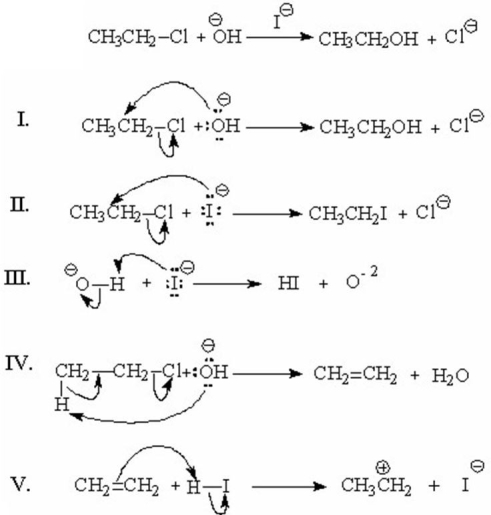
(Multiple Choice)
4.8/5 (83)
(83) Which of the following residues acts as a general-acid catalyst in aldolase but as a general-base catalyst in chymotrypsin?
(Multiple Choice)
4.9/5 (60)
(60) Which of the labeled bonds in the following peptide chain will break when carboxypeptidase A is used to hydrolyze the chain? 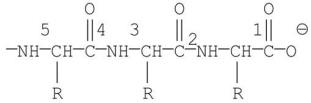
(Multiple Choice)
4.7/5 (81)
(81) Which of the following residues acts as a general-base catalyst in the cleavage of the C3-C4 bond in the mechanism of the aldolase-catalyzed reaction?
(Multiple Choice)
4.9/5 (79)
(79) Which of the following is not true about metal-ion catalysts?
(Multiple Choice)
4.8/5 (80)
(80) A nucleophilic catalyst increases the rate of the reaction by
(Multiple Choice)
4.7/5 (84)
(84) 
Filters
- Essay(0)
- Multiple Choice(0)
- Short Answer(0)
- True False(0)
- Matching(0)