



 Chat with AI
Exam 2: Acids and Bases: Central to Understanding Organic Chemistry

Exam 1: Remembering General Chemistry: Electronic Structure and Bonding90 Questions
Exam 2: Acids and Bases: Central to Understanding Organic Chemistry43 Questions
Exam 3: An Introduction to Organic Compounds: Nomenclature, physical Properties, and Structure136 Questions
Exam 4: Isomers: the Arrangement of Atoms in Space125 Questions
Exam 5: Alkenes: Structure,nomenclature,and an Introduction to Reactivity - Thermodynamics and Kinetics84 Questions
Exam 6: The Reactions of Alkenes - the Stereochemistry of Addition Reactions89 Questions
Exam 7: The Reactions of Alkynes - Introduction to Multistep Synthesis124 Questions
Exam 8: Delocalized Electrons: Their Effect on Stability, pka, and the Products of a Reaction - Aromaticity and Electronic Effects: an Introduction to the Reactions of Benzene185 Questions
Exam 9: Substitution and Elimination Reactions of Alkyl Halides228 Questions
Exam 10: Reactions of Alcohols, ethers, epoxides, amines and Sulfur-Containing Compounds109 Questions
Exam 11: Organometallic Compounds65 Questions
Exam 12: Radicals141 Questions
Exam 13: Mass Spectrometry,infrared Spectroscopy,and Uvvis Spectroscopy140 Questions
Exam 14: Nmr Spectroscopy122 Questions
Exam 15: Reactions of Carboxylic Acids and Carboxylic Acid Derivatives126 Questions
Exam 16: Reactions of Aldehydes and Ketones122 Questions
Exam 17: Reactions at the Α-Carbon121 Questions
Exam 18: Reactions of Benzene and Substituted Benzenes168 Questions
Exam 19: More About Amines - Reactions of Heterocylic Compounds126 Questions
Exam 20: The Organic Chemistry of Carbohydrates110 Questions
Exam 21: Amino Acids,peptides,and Proteins117 Questions
Exam 22: Catalysis in Organic Reactions and in Enzymatic Reactions92 Questions
Exam 23: The Organic Chemistry of the Coenzymes, compounds Derived From Vitamins102 Questions
Exam 24: The Organic Chemistry of the Metabolic Pathways90 Questions
Exam 25: The Organic Chemistry of Lipids37 Questions
Exam 26: The Chemistry of the Nucleic Acids94 Questions
Exam 27: Synthetic Polymers116 Questions
Exam 28: Pericyclic Reactions102 Questions
Select questions type


What is the pH of a 0.1 M solution of HCl? (Note: pKa for HCl is -6.)

Free
(Multiple Choice)
4.9/5  (79)
(79) Correct Answer: Verified
C
The pKa of CH3COOH is 4.8.If the pH of an aqueous solution of CH3COOH and CH3COO- is 4.8,then one knows
Free
(Multiple Choice)
4.9/5 (82)
(82) Correct Answer:Verified
VerifiedC
Which of the following anions,CH3CHBrCO2- or CH3CHFCO2- is the stronger base? Explain your choice.
Free
(Essay)
4.9/5 (80)
(80) Correct Answer:Verified
VerifiedCH3CHBrCO2- is the stronger base.The more electronegative F atom can more effectively delocalize the negative charge via induction.This greater delocalization stabilizes CH3CHFCO2- relative to CH3CHBrCO2- and makes it a weaker base.
The pKa of CH3COOH is 4.8 and the pKa of HCOOH is 3.8.Given this information,one knows that
(Multiple Choice)
4.8/5 (78)
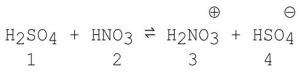
(78) Buffering is used to maintain the pH of human blood in the relatively narrow 7.3 - 7.4 range.What acid/base pair serves to buffer the blood?
(Multiple Choice)
5.0/5 (74)
(74) 
Write a completed equation for the acid-base pair shown below.
HCO2H + -NH2 →
(Essay)
4.9/5 (58)
(58) The amino acid glycine (H3N+CH2CO2H)has two acidic Hs,one with pKa = 2.34 and the other with pKa=9.60.Draw the structure of the form of glycine that predominates at a pH of 12.
(Essay)
4.9/5 (80)
(80) When a small amount of hexanoic acid [CH3(CH2)4CO2H,pKa~4.8],is added to a separatory funnel which contains the organic solvent diethyl ether and water with a pH of 2.0,it is found mainly in the ________ phase as ________.
(Multiple Choice)
5.0/5 (88)
(88) HCN has a pKa = 9.1.What form of the compound,HCN or CN-,will predominate in a solution of pH = 7.0
(Short Answer)
4.7/5 (84)
(84) Which of the following species cannot function as a Lewis acid?
(Multiple Choice)
4.8/5 (69)
(69) 
Filters
- Essay(0)
- Multiple Choice(0)
- Short Answer(0)
- True False(0)
- Matching(0)