



 Chat with AI
Exam 12: Hunger, Eating, and Health

Exam 1: Biopsychology as a Neuroscience: What is Biopsychology, Anyway?89 Questions
Exam 2: Evolution, Genetics, and Experience: Thinking About the Biology of Behavior146 Questions
Exam 3: The Anatomy of the Nervous System153 Questions
Exam 4: Neural Conduction and Synaptic Transmission152 Questions
Exam 5: The Research Methods of Biopsychology161 Questions
Exam 6: The Visual System149 Questions
Exam 7: Mechanisms of Perception150 Questions
Exam 8: The Sensorimotor System119 Questions
Exam 9: Development of the Nervous System125 Questions
Exam 10: Brain Damage and Neuroplasticity181 Questions
Exam 11: Learning, Memory, and Amnesia146 Questions
Exam 12: Hunger, Eating, and Health145 Questions
Exam 13: Hormones and Sex158 Questions
Exam 14: Sleep, Dreaming, and Circadian Rhythms187 Questions
Exam 15: Drug Addiction and the Brain’s Reward Circuits153 Questions
Exam 16: Lateralization, Language, and the Split Brain170 Questions
Exam 17: Biopsychology of Emotion, Stress, and Health154 Questions
Exam 18: Biopsychology of Psychiatric Disorders138 Questions
Select questions type


The idea that the LH is a hunger center has largely been abandoned because
(Multiple Choice)
4.9/5  (80)
(80) Human patients who have had their stomachs surgically removed eat
(Multiple Choice)
4.8/5 (71)
(71) 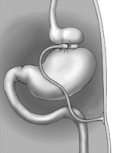
The surgical treatment for extreme obesity that is portrayed in this illustration is __________ surgery. 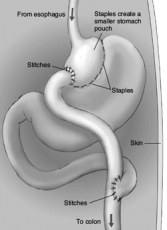
(Short Answer)
4.8/5 (74)
(74) Although __________ agonists are effective in the treatment of obesity, they are currently not in wide use because they tend to have dangerous side effects.
(Multiple Choice)
4.9/5 (78)
(78) Small amounts of food eaten prior to a meal __________ hunger. This is called __________.
(Multiple Choice)
4.9/5 (67)
(67) Set-point negative-feedback systems are one way of maintaining
(Multiple Choice)
4.8/5 (85)
(85) Hunger and eating can be induced in satiated mammals by decreasing blood glucose levels with large injections of insulin. However, such large decreases
(Multiple Choice)
4.9/5 (92)
(92) The conclusion of the 1912 study illustrated here was that stomach contractions are associated with 
(Multiple Choice)
4.8/5 (85)
(85) Describe two explanations for why we get hungry at our regular meal times. Discuss relevant evidence. Which of the two explanations does the evidence support?
(Essay)
4.9/5 (80)
(80) According to the text, obesity is now prevalent in industrialized countries because
(Multiple Choice)
4.8/5 (86)
(86) Food in the stomach stimulates the release of __________ from the stomach wall.
(Multiple Choice)
4.8/5 (83)
(83) Animals with a sodium deficiency, tend to favor diets rich in sodium because
(Multiple Choice)
4.8/5 (72)
(72) The transition between the absorptive and fasting phase occurs when
(Multiple Choice)
4.9/5 (73)
(73) During the fasting phase, the body (excluding the brain) cannot use glucose as a metabolic fuel because
(Multiple Choice)
4.8/5 (81)
(81) 
Filters
- Essay(0)
- Multiple Choice(0)
- Short Answer(0)
- True False(0)
- Matching(0)