



 Chat with AI
Exam 11: Liquids,solids,and Intermolecular Forces

Exam 1: Matter, measurement, and Problem Solving170 Questions
Exam 2: Atoms and Elements157 Questions
Exam 3: Molecules,compounds,and Chemical Equations175 Questions
Exam 4: Chemical Quantities and Aqueous Reactions239 Questions
Exam 5: Gases182 Questions
Exam 6: Thermochemistry143 Questions
Exam 7: The Quantum-Mechanical Model of the Atom134 Questions
Exam 8: Periodic Properties of the Elements147 Questions
Exam 9: Chemical Bonding I: Lewis Theory166 Questions
Exam 10: Chemical Bonding Ii: Molecular Shapes,valence Bond Theory,144 Questions
Exam 11: Liquids,solids,and Intermolecular Forces128 Questions
Exam 12: Solids and Modern Materials81 Questions
Exam 13: Solutions157 Questions
Exam 14: Chemical Kinetics154 Questions
Exam 15: Chemical Equilibrium141 Questions
Exam 16: Acids and Bases160 Questions
Exam 17: Aqueous Ionic Equilibrium187 Questions
Exam 18: Free Energy and Thermodynamics130 Questions
Exam 19: Electrochemistry151 Questions
Exam 20: Radioactivity and Nuclear Chemistry135 Questions
Exam 21: Organic Chemistry104 Questions
Exam 22: Biochemistry68 Questions
Exam 23: Chemistry of the Nonmetals66 Questions
Exam 24: Metals and Metallurgy60 Questions
Exam 25: Transition Metals and Coordination Compounds73 Questions
Select questions type


Give the change in condition to go from a liquid to a gas.
(Multiple Choice)
4.9/5  (104)
(104) Which of the following substances would you predict to have the highest ΔHvap?
(Multiple Choice)
4.8/5 (81)
(81) Choose the pair of substances that are most likely to form a homogeneous solution.
(Multiple Choice)
4.8/5 (77)
(77) Choose the pair of substances that are most likely to form a homogeneous solution.
(Multiple Choice)
4.9/5 (86)
(86) How much energy is required to vaporize 48.7 g of dichloromethane (CH2Cl2)at its boiling point,if its ΔHvap is 31.6 kJ/mol?
(Multiple Choice)
4.8/5 (99)
(99) The enthalpy change for converting 1.00 mol of ice at -25.0°C to water at 60.0°C is  The specific heats of ice,water,and steam are 2.09 J/gK,4.18 J/gK,and 1.84 J/gK,respectively.For H2O,ΔHfus = 6.01 kJ/mol,and ΔHvap = 40.67 kJ/mol.
 (Multiple Choice)
4.7/5 (70)
(70) Ethanol ( 
 OH)melts at -114°C.The enthalpy of fusion is 5.02 kJ/mol.The specific heats of solid and liquid ethanol are 0.97 J/gK and 2.3 J/gK,respectively.How much heat (kJ)is needed to convert 25.0 g of solid ethanol at -125°C to liquid ethanol at -80°C?
 (Multiple Choice)
4.8/5 (77)
(77) Which of the following compounds exhibits dipole-dipole forces as its strongest attraction between molecules?
(Multiple Choice)
4.9/5 (88)
(88) Choose the substance with the highest vapor pressure at a given temperature.
(Multiple Choice)
4.8/5 (75)
(75) 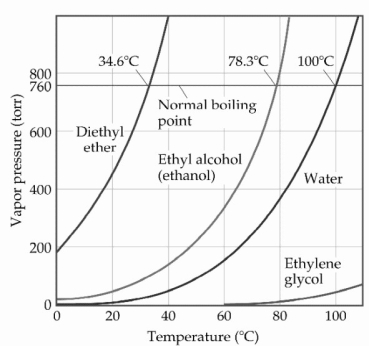 Based on the figure above,the boiling point of ethyl alcohol under an external pressure of 0.197 atm is ________°C.
 (Multiple Choice)
4.9/5 (75)
(75) Identify the term used to describe the ability of a liquid to flow against gravity up a narrow tube.
(Multiple Choice)
4.9/5 (87)
(87) Sketch the phase diagram of benzene.Make sure to label the axes and the different phases of benzene.Use the physical data provided below.
melting point = 279 K
boiling point = 353 K
Tc = 562 K
Pc = 48.4 atm
Triple Point = 0.05 atm,279 K
(Essay)
4.9/5 (89)
(89) 
Filters
- Essay(0)
- Multiple Choice(0)
- Short Answer(0)
- True False(0)
- Matching(0)