



 Chat with AI
Exam 3: Interdependence and the Gains From Trade

Exam 1: Ten Principles of Economics216 Questions
Exam 2: Thinking Like an Economist234 Questions
Exam 3: Interdependence and the Gains From Trade206 Questions
Exam 4: The Market Forces of Supply and Demand349 Questions
Exam 5: Measuring a Nations Income169 Questions
Exam 6: Measuring the Cost of Living181 Questions
Exam 7: Production and Growth191 Questions
Exam 8: Saving, investment, and the Financial System213 Questions
Exam 9: Unemployment and Its Natural Rate197 Questions
Exam 10: The Monetary System204 Questions
Exam 11: Money Growth and Inflation195 Questions
Exam 12: Open-Economy Macroeconomics: Basic Concepts220 Questions
Exam 13: A Macroeconomic Theory of the Small Open Economy196 Questions
Exam 14: Aggregate Demand and Aggregate Supply257 Questions
Exam 15: The Influence of Monetary and Fiscal Policy on Aggregate Demand222 Questions
Exam 16: The Short-Run Tradeoff Between Inflation and Unemployment207 Questions
Exam 17: Five Debates Over Macroeconomic Policy119 Questions
Select questions type


International trade may make some individuals in a nation better off,while other individuals are made worse off.
(True/False)
4.7/5  (84)
(84) Figure 3-6
These figures illustrate the production possibilities available to Barney and Betty with eight hours of labour in their bakery.  -Refer to Figure 3-6.What is the opportunity cost of one loaf of bread for Barney?
 (Multiple Choice)
4.9/5 (82)
(82) Jonathan can make a birdhouse in three hours.He can make a bird feeder in three hours.The opportunity cost to Jonathan of making a birdhouse is 1 / 3 bird feeder.
(True/False)
4.8/5 (68)
(68) Figure 3-3
Ice cream and cones are measured in kilograms. 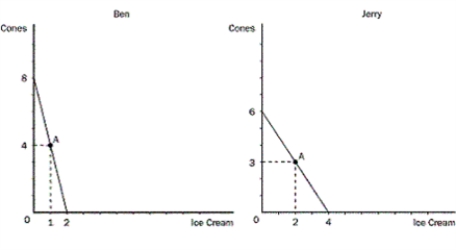 -Refer to Figure 3-3.Suppose Ben and Jerry were both producing at point A on their production possibilities frontier and then Ben decided he would be willing to trade 4 kg of cones to get 2 kg of ice cream from Jerry.If both decided to specialize in what they had a comparative advantage in and trade,what would be the gains from trade?
 (Multiple Choice)
4.8/5 (91)
(91) Suppose that the country of Xenophobia chose to isolate itself from the rest of the world.Its ruler proclaimed that Xenophobia should become self-sufficient and so would not engage in foreign trade.From an economic perspective,when would this idea make sense?
(Multiple Choice)
4.9/5 (80)
(80) Figure 3-1  -Refer to Figure 3-1.What do the two producers have an absolute advantage in?
 (Multiple Choice)
4.9/5 (79)
(79) For two people who are planning to trade two different goods,when will there NOT be a comparative advantage for either?
(Multiple Choice)
4.7/5 (94)
(94) Table 3-5 
-Refer to Table 3-5.What is the opportunity cost of one car for Japan?
-Refer to Table 3-5.What is the opportunity cost of one car for Japan? (Multiple Choice)
4.8/5 (80)
(80) Table 3-2 
-Refer to Table 3-2.What does each producer have a comparative advantage in?
-Refer to Table 3-2.What does each producer have a comparative advantage in? (Multiple Choice)
4.9/5 (77)
(77) Table 3-3 
-Refer to Table 3-3.What is the opportunity cost of one sweater for Kevin?
-Refer to Table 3-3.What is the opportunity cost of one sweater for Kevin? (Multiple Choice)
4.8/5 (86)
(86) When can a country's consumption possibilities frontier be outside its production possibilities frontier?
(Multiple Choice)
4.9/5 (77)
(77) Table 3-3
-Refer to Table 3-3.What does each of the two producers have a comparative advantage in?
-Refer to Table 3-3.What does each of the two producers have a comparative advantage in? (Multiple Choice)
4.8/5 (73)
(73) Unless two people who are producing two goods have exactly the same opportunity costs,each will have a comparative advantage in a different good.
(True/False)
4.9/5 (88)
(88) Suppose that a worker in Boatland can produce either 5 units of wheat or 25 units of fish per year,and a worker in Farmland can produce either 25 units of wheat or 5 units of fish per year.There are 10 workers in each country.No trade occurs between the two countries.Boatland produces and consumes 25 units of wheat and 125 units of fish per year,while Farmland produces and consumes 125 units of wheat and 25 units of fish per year.If trade were to occur,Boatland would trade 100 units of fish to Farmland in exchange for 100 units of wheat.If Boatland no longer grew any of its own wheat,how many units of fish could it now consume along with the 100 units of imported wheat?
(Multiple Choice)
4.8/5 (79)
(79) If there is no trade,which of the following is most likely?
(Multiple Choice)
4.7/5 (79)
(79) Table 3-5
-Refer to Table 3-5.If Canada and Japan trade based on the principle of comparative advantage,what could Japan gain from importing an airplane?
-Refer to Table 3-5.If Canada and Japan trade based on the principle of comparative advantage,what could Japan gain from importing an airplane? (Multiple Choice)
4.9/5 (80)
(80) Suppose a producer requires a smaller quantity of inputs to produce carrots than to produce onions.Is this information sufficient to determine in which good the producer has a comparative advantage?
(Multiple Choice)
4.7/5 (88)
(88) Goods produced abroad and sold domestically are called exports and goods produced domestically and sold abroad are called imports.
(True/False)
4.8/5 (81)
(81) 
Filters
- Essay(0)
- Multiple Choice(0)
- Short Answer(0)
- True False(0)
- Matching(0)