



 Chat with AI
Exam 12: Aggregate Expenditure and Output in the Short Run

Exam 1: Economics: Foundations and Models211 Questions
Exam 2: Trade-Offs,comparative Advantage,and the Market System239 Questions
Exam 3: Where Prices Come From: the Interaction of Demand and Supply233 Questions
Exam 4: Economic Efficiency, government Price Setting, and Taxes211 Questions
Exam 5: The Economics of Health Care164 Questions
Exam 6: Firms,the Stock Market,and Corporate Governance276 Questions
Exam 7: Comparative Advantage and the Gains From International Trade190 Questions
Exam 8: GDP: Measuring Total Production and Income266 Questions
Exam 9: Unemployment and Inflation292 Questions
Exam 10: Economic Growth, the Financial System, and Business Cycles257 Questions
Exam 11: Long-Run Economic Growth: Sources and Policies268 Questions
Exam 12: Aggregate Expenditure and Output in the Short Run306 Questions
Exam 13: Aggregate Demand and Aggregate Supply Analysis284 Questions
Exam 14: Money, banks, and the Federal Reserve System280 Questions
Exam 15: Monetary Policy277 Questions
Exam 16: Fiscal Policy303 Questions
Exam 17: Inflation, unemployment, and Federal Reserve Policy257 Questions
Exam 18: Macroeconomics in an Open Economy278 Questions
Exam 19: The International Financial System262 Questions
Select questions type


Figure 12-4 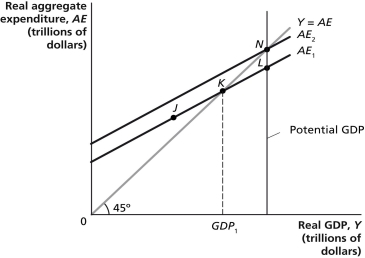 -Refer to Figure 12-4.Potential GDP equals $500 billion.The economy is currently producing GDP1 which is equal to $450 billion.If the MPC is 0.8,then how much must autonomous spending change for the economy to move to potential GDP?
 (Multiple Choice)
5.0/5  (80)
(80) A stock market boom which causes stock prices to rise should cause
(Multiple Choice)
4.9/5 (87)
(87) A rising price level decreases consumption by decreasing the real value of household wealth.
(True/False)
4.9/5 (75)
(75) ________ is equal to consumption spending plus planned investment spending plus government purchases plus net exports.
(Multiple Choice)
4.9/5 (70)
(70) The five most important variables that determine the level of consumption are
(Multiple Choice)
4.8/5 (85)
(85) Table 12-10
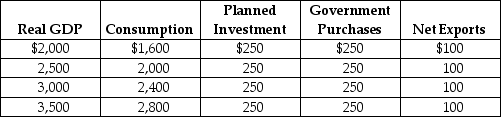 -Refer to Table 12-10.Using the table above,calculate the unplanned change in inventories for each level of GDP,and explain what will happen to GDP?
 (Essay)
4.7/5 (77)
(77) What is the difference between aggregate expenditure and aggregate demand?
(Essay)
4.8/5 (64)
(64) The ratio of the increase in ________ to the increase in ________ is called the multiplier.
(Multiple Choice)
4.9/5 (73)
(73) ________ describes the relationship between consumption spending and disposable income.
(Multiple Choice)
4.9/5 (101)
(101) The ratio of the increase in equilibrium real GDP to the increase in autonomous expenditure is called the
(Multiple Choice)
5.0/5 (78)
(78) If the consumption function is defined as C = 7,250 + 0.8Y,what is the marginal propensity to save?
(Multiple Choice)
4.9/5 (74)
(74) The multiplier is calculated as the change in ________ / change in ________.
(Multiple Choice)
4.8/5 (79)
(79) Firms in a small economy anticipated that inventories would grow over the past year by $750,000,and over that year,inventories grew by exactly $750,000.This implies that
(Multiple Choice)
4.8/5 (91)
(91) When Jack's income increases by $1,000,he spends an additional $850 dollars.This implies that his marginal propensity to save is 0.85.
(True/False)
4.8/5 (79)
(79) In a small economy in 2013,aggregate expenditure was $850 million while GDP that year was $800 million.Which of the following can explain the difference between aggregate expenditure and GDP that year?
(Multiple Choice)
4.8/5 (65)
(65) If an increase in investment spending of $50 million results in a $400 million increase in equilibrium real GDP,then
(Multiple Choice)
4.9/5 (78)
(78) The marginal propensity to consume measures the average amount of wealth that a consumer spends in a given period of time.
(True/False)
4.9/5 (77)
(77) 
Filters
- Essay(0)
- Multiple Choice(0)
- Short Answer(0)
- True False(0)
- Matching(0)