



 Chat with AI
Exam 12: Firms in Perfectly Competitive Markets

Exam 1: Economics: Foundations and Models146 Questions
Exam 2: Trade-Offs, comparative Advantage, and the Market System153 Questions
Exam 3: Where Prices Come From: the Interaction of Demand and Supply147 Questions
Exam 4: Economic Efficiency, government Price Setting, and Taxes138 Questions
Exam 5: Externalities, environmental Policy, and Public Goods133 Questions
Exam 6: Elasticity: the Responsiveness of Demand and Supply150 Questions
Exam 7: The Economics of Health Care115 Questions
Exam 8: Firms, the Stock Market, and Corporate Governance141 Questions
Exam 9: Comparative Advantage and the Gains From International Trade123 Questions
Exam 10: Consumer Choice and Behavioral Economics154 Questions
Exam 11: Technology, production, and Costs165 Questions
Exam 12: Firms in Perfectly Competitive Markets151 Questions
Exam 13: Monopolistic Competition: the Competitive Model in a More Realistic Setting143 Questions
Exam 14: Oligopoly: Firms in Less Competitive Markets135 Questions
Exam 15: Monopoly and Antitrust Policy134 Questions
Exam 16: Pricing Strategy134 Questions
Exam 17: The Markets for Labor and Other Factors of Production147 Questions
Exam 18: Public Choice, taxes, and the Distribution of Income139 Questions
Select questions type


A perfectly competitive firm will maximize its profit at the rate of output where the vertical distance between its total revenue and total cost is the largest.This is the same rate of output where
(Multiple Choice)
4.9/5  (79)
(79) Suppose Veronica sells teapots in the perfectly competitive teapot market.Her output per day and her costs are as follows:
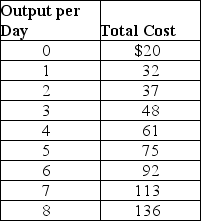 Suppose the current equilibrium price in the teapot market is $10.To maximize profit,how many teapots will Veronica produce,what price will she charge,and how much profit (or loss)will she make? Draw a graph to illustrate your answer.Your graph should include Veronica's demand,ATC,AVC,MC,and MR curves,the price she is charging,the quantity she is producing,and the area representing her profit (or loss).
 (Essay)
4.8/5 (85)
(85) The delivery of first-class mail by the U.S.Postal Service is an example of
(Multiple Choice)
4.9/5 (74)
(74) What assumptions are necessary for a market to be perfectly competitive? Explain why each of these assumptions is important.
(Essay)
4.7/5 (97)
(97) Figure 12-4  -Refer to Figure 12-4.Suppose the firm produces 4,000 units.What does the shaded area labeled B represent?
 (Multiple Choice)
4.8/5 (90)
(90) Table 12-3
 Table 12-3 shows the short-run cost data of a perfectly competitive firm.Assume that output can only be increased in batches of 20 units.
-Refer to Table 12-3.If the market price is $45,the firm
Table 12-3 shows the short-run cost data of a perfectly competitive firm.Assume that output can only be increased in batches of 20 units.
-Refer to Table 12-3.If the market price is $45,the firm (Multiple Choice)
4.7/5 (73)
(73) If,as a perfectly competitive industry expands,it can supply larger quantities at the same long-run market price,it is
(Multiple Choice)
4.8/5 (70)
(70) Suppose the equilibrium price in a perfectly competitive industry is $10 and a firm in the industry charges $12.Which of the following will happen?
(Multiple Choice)
4.9/5 (74)
(74) In a perfectly competitive industry,in the long-run equilibrium
(Multiple Choice)
4.8/5 (77)
(77) In the early 2000s,some entrepreneurs took advantage of a reduction in the price of computed tomography (CT)scanning equipment by offering apparently healthy people preventive body scans to provide early detection of diseases.This effort failed to earn the entrepreneurs a profit.Which of the following is one reason for this failure?
(Multiple Choice)
4.8/5 (88)
(88) Figure 12-7  The graphs in Figure 12-7 represent the perfectly competitive market demand and supply curves for the apple industry and demand and cost curves for a typical firm in the industry.
-Refer to Figure 12-7.Which of the following statements is true?
The graphs in Figure 12-7 represent the perfectly competitive market demand and supply curves for the apple industry and demand and cost curves for a typical firm in the industry.
-Refer to Figure 12-7.Which of the following statements is true? (Multiple Choice)
4.9/5 (99)
(99) 
Filters
- Essay(0)
- Multiple Choice(0)
- Short Answer(0)
- True False(0)
- Matching(0)