



 Chat with AI
Exam 2: Trade-Offs, comparative Advantage, and the Market System

Exam 1: Economics: Foundations and Models146 Questions
Exam 2: Trade-Offs, comparative Advantage, and the Market System153 Questions
Exam 3: Where Prices Come From: the Interaction of Demand and Supply147 Questions
Exam 4: Economic Efficiency, government Price Setting, and Taxes138 Questions
Exam 5: Externalities, environmental Policy, and Public Goods133 Questions
Exam 6: Elasticity: the Responsiveness of Demand and Supply150 Questions
Exam 7: The Economics of Health Care115 Questions
Exam 8: Firms, the Stock Market, and Corporate Governance141 Questions
Exam 9: Comparative Advantage and the Gains From International Trade123 Questions
Exam 10: Consumer Choice and Behavioral Economics154 Questions
Exam 11: Technology, production, and Costs165 Questions
Exam 12: Firms in Perfectly Competitive Markets151 Questions
Exam 13: Monopolistic Competition: the Competitive Model in a More Realistic Setting143 Questions
Exam 14: Oligopoly: Firms in Less Competitive Markets135 Questions
Exam 15: Monopoly and Antitrust Policy134 Questions
Exam 16: Pricing Strategy134 Questions
Exam 17: The Markets for Labor and Other Factors of Production147 Questions
Exam 18: Public Choice, taxes, and the Distribution of Income139 Questions
Select questions type


Table 2-5
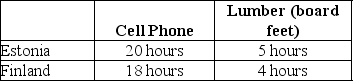 -Refer to Table 2-5.This table shows the number of labor hours required to produce a cell phone and a board foot of lumber in Estonia and Finland.
a.Which country has an absolute advantage in the production of cell phones?
b.Which country has an absolute advantage in the production of lumber?
c.What is Estonia's opportunity cost of producing one cell phone?
d.What is Finland's opportunity cost of producing one cell phone?
e.What is Estonia's opportunity cost of producing one board foot of lumber?
f.What is Finland's opportunity cost of producing one board foot of lumber?
g.If each country specializes in the production of the product in which it has a comparative advantage,who should produce cell phones?
h.If each country specializes in the production of the product in which it has a comparative advantage,who should produce lumber?
-Refer to Table 2-5.This table shows the number of labor hours required to produce a cell phone and a board foot of lumber in Estonia and Finland.
a.Which country has an absolute advantage in the production of cell phones?
b.Which country has an absolute advantage in the production of lumber?
c.What is Estonia's opportunity cost of producing one cell phone?
d.What is Finland's opportunity cost of producing one cell phone?
e.What is Estonia's opportunity cost of producing one board foot of lumber?
f.What is Finland's opportunity cost of producing one board foot of lumber?
g.If each country specializes in the production of the product in which it has a comparative advantage,who should produce cell phones?
h.If each country specializes in the production of the product in which it has a comparative advantage,who should produce lumber? (Essay)
4.9/5  (67)
(67) Table 2-4
 Table 2-4 shows the number of labor hours required to produce a cell phone and a board foot of lumber in Estonia and Finland.
-Refer to Table 2-4.Does either Estonia or Finland have an absolute advantage and if so,in what product?
Table 2-4 shows the number of labor hours required to produce a cell phone and a board foot of lumber in Estonia and Finland.
-Refer to Table 2-4.Does either Estonia or Finland have an absolute advantage and if so,in what product? (Multiple Choice)
4.9/5 (86)
(86) Table 2-4
Table 2-4 shows the number of labor hours required to produce a cell phone and a board foot of lumber in Estonia and Finland.
-Refer to Table 2-4.If the two countries specialize and trade,who should export lumber?
Table 2-4 shows the number of labor hours required to produce a cell phone and a board foot of lumber in Estonia and Finland.
-Refer to Table 2-4.If the two countries specialize and trade,who should export lumber? (Multiple Choice)
4.9/5 (87)
(87) In a free market there are virtually no restrictions,or at best few restrictions,on how a good or service can be produced or sold.
(True/False)
4.8/5 (60)
(60) Figure 2-7  Figure 2-7 shows the production possibilities frontiers for Costa Rica and Guatemala.Each country produces two goods,pineapples and coconuts.
-Refer to Figure 2-7.Which country has a comparative advantage in the production of coconuts?
Figure 2-7 shows the production possibilities frontiers for Costa Rica and Guatemala.Each country produces two goods,pineapples and coconuts.
-Refer to Figure 2-7.Which country has a comparative advantage in the production of coconuts? (Multiple Choice)
4.7/5 (89)
(89) Specializing in the production of a good or service in which one has a comparative advantage enables a country to do which of the following?
(Multiple Choice)
4.9/5 (76)
(76) Which of the following are represented by the same flow in the circular flow model?
(Multiple Choice)
4.7/5 (90)
(90) If additional units of a good could be produced at a constant opportunity cost,the production possibility frontier would be linear.
(True/False)
4.9/5 (74)
(74) A critical function of the government in facilitating the operation of a market economy is
(Multiple Choice)
4.7/5 (80)
(80) ________ exists because unlimited wants exceed the limited resources available to fulfill those wants.
(Multiple Choice)
4.8/5 (83)
(83) ________ a nation's production possibilities frontier represents economic growth.
(Multiple Choice)
4.9/5 (87)
(87) Which of the following statements about an entrepreneur is true?
(Multiple Choice)
4.7/5 (87)
(87) Suppose your expenses for this term are as follows: tuition: $5,000,room and board: $3,000,books and other educational supplies: $500.Further,during the term,you can only work part-time and earn $4,000 instead of your full-time salary of $10,000.What is the opportunity cost of going to college this term,assuming that your room and board expenses would be the same even if you did not go to college?
(Multiple Choice)
4.8/5 (76)
(76) Table 2-4
Table 2-4 shows the number of labor hours required to produce a cell phone and a board foot of lumber in Estonia and Finland.
-Refer to Table 2-4.If the two countries specialize and trade,who should export cell phones?
Table 2-4 shows the number of labor hours required to produce a cell phone and a board foot of lumber in Estonia and Finland.
-Refer to Table 2-4.If the two countries specialize and trade,who should export cell phones? (Multiple Choice)
4.8/5 (80)
(80) Figure 2-4  Figure 2-4 shows various points on three different production possibilities frontiers for a nation.
-Refer to Figure 2-4.A movement from ________ is the result of advancements in plastic production technology.
Figure 2-4 shows various points on three different production possibilities frontiers for a nation.
-Refer to Figure 2-4.A movement from ________ is the result of advancements in plastic production technology. (Multiple Choice)
4.7/5 (78)
(78) Figure 2-2  Figure 2-2 above shows the production possibilities frontier for Vidalia,a nation that produces two goods,roses and orchids.
-Refer to Figure 2-2.What is the opportunity cost of one dozen roses?
Figure 2-2 above shows the production possibilities frontier for Vidalia,a nation that produces two goods,roses and orchids.
-Refer to Figure 2-2.What is the opportunity cost of one dozen roses? (Multiple Choice)
4.9/5 (71)
(71) Figure 2-7 Figure 2-7 shows the production possibilities frontiers for Costa Rica and Guatemala.Each country produces two goods,pineapples and coconuts.
-Refer to Figure 2-7.What is the opportunity cost of producing 1 ton of coconuts in Costa Rica?
Figure 2-7 shows the production possibilities frontiers for Costa Rica and Guatemala.Each country produces two goods,pineapples and coconuts.
-Refer to Figure 2-7.What is the opportunity cost of producing 1 ton of coconuts in Costa Rica? (Multiple Choice)
4.7/5 (83)
(83) 
Filters
- Essay(0)
- Multiple Choice(0)
- Short Answer(0)
- True False(0)
- Matching(0)