



 Chat with AI
Exam 5: Externalities, environmental Policy, and Public Goods

Exam 1: Economics: Foundations and Models146 Questions
Exam 2: Trade-Offs, comparative Advantage, and the Market System153 Questions
Exam 3: Where Prices Come From: the Interaction of Demand and Supply147 Questions
Exam 4: Economic Efficiency, government Price Setting, and Taxes138 Questions
Exam 5: Externalities, environmental Policy, and Public Goods133 Questions
Exam 6: Elasticity: the Responsiveness of Demand and Supply150 Questions
Exam 7: The Economics of Health Care115 Questions
Exam 8: Firms, the Stock Market, and Corporate Governance141 Questions
Exam 9: Comparative Advantage and the Gains From International Trade123 Questions
Exam 10: Consumer Choice and Behavioral Economics154 Questions
Exam 11: Technology, production, and Costs165 Questions
Exam 12: Firms in Perfectly Competitive Markets151 Questions
Exam 13: Monopolistic Competition: the Competitive Model in a More Realistic Setting143 Questions
Exam 14: Oligopoly: Firms in Less Competitive Markets135 Questions
Exam 15: Monopoly and Antitrust Policy134 Questions
Exam 16: Pricing Strategy134 Questions
Exam 17: The Markets for Labor and Other Factors of Production147 Questions
Exam 18: Public Choice, taxes, and the Distribution of Income139 Questions
Select questions type


When production generates a negative externality,the true cost of production is the
(Multiple Choice)
4.8/5  (74)
(74) Figure 5-6 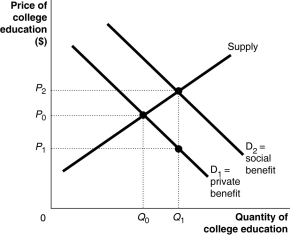 College education benefits society by producing a more employable workforce,reducing crime and creating a better informed citizenry.Thus,the social benefits of college education exceed the private benefits for any level of college education.This is illustrated in Figure 5-6.
-Refer to Figure 5-6.One way to obtain the economically efficient amount of college education is for governments to subsidize college education.What is the size of the per-student Pigovian subsidy that the government must provide to internalize the external benefits? (Note that the subsidy can be granted to the education institutions or to the students directly or indirectly; for example,through low-interest student loans.)
College education benefits society by producing a more employable workforce,reducing crime and creating a better informed citizenry.Thus,the social benefits of college education exceed the private benefits for any level of college education.This is illustrated in Figure 5-6.
-Refer to Figure 5-6.One way to obtain the economically efficient amount of college education is for governments to subsidize college education.What is the size of the per-student Pigovian subsidy that the government must provide to internalize the external benefits? (Note that the subsidy can be granted to the education institutions or to the students directly or indirectly; for example,through low-interest student loans.) (Multiple Choice)
4.9/5 (71)
(71) Figure 5-4 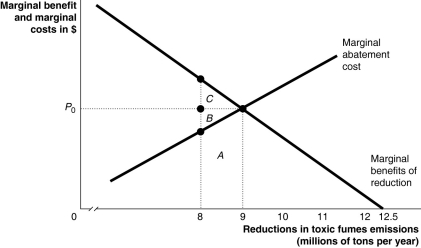 Consider a chemical plant that discharges toxic fumes over a nearby community.To reduce the emissions of toxic fumes the firm can install pollution abatement devices.Figure 5-4 shows the marginal benefit and the marginal cost from reducing the toxic fumes emissions.
-Refer to Figure 5-4.Suppose the emissions reduction target is currently established at 8 million tons.Should society undertake to reduce an additional 1 million tons so that the total reduction is 9 million tons?
Consider a chemical plant that discharges toxic fumes over a nearby community.To reduce the emissions of toxic fumes the firm can install pollution abatement devices.Figure 5-4 shows the marginal benefit and the marginal cost from reducing the toxic fumes emissions.
-Refer to Figure 5-4.Suppose the emissions reduction target is currently established at 8 million tons.Should society undertake to reduce an additional 1 million tons so that the total reduction is 9 million tons? (Multiple Choice)
4.9/5 (72)
(72) Figure 5-8  Amit and Bree are the only two homeowners on an isolated private road.Both agree that installing street lights along the road would be beneficial and want to do so.Figure 5-8 shows their willingness to pay for different quantities of street lights,the market demand for street lights and the marginal cost of installing the street lights.
-Refer to Figure 5-8.How much is Amit willing to pay to have 4 street lights installed?
Amit and Bree are the only two homeowners on an isolated private road.Both agree that installing street lights along the road would be beneficial and want to do so.Figure 5-8 shows their willingness to pay for different quantities of street lights,the market demand for street lights and the marginal cost of installing the street lights.
-Refer to Figure 5-8.How much is Amit willing to pay to have 4 street lights installed? (Multiple Choice)
4.8/5 (78)
(78) Figure 5-3 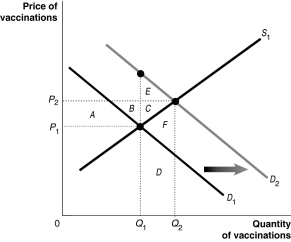 Figure 5-3 shows the market for measles vaccinations,a product whose use generates positive externalities.
-Refer to Figure 5-3.What is the market equilibrium output level?
Figure 5-3 shows the market for measles vaccinations,a product whose use generates positive externalities.
-Refer to Figure 5-3.What is the market equilibrium output level? (Multiple Choice)
4.8/5 (77)
(77) Some environmentalists have criticized tradable emissions allowances on the grounds that they give permit holders a license to pollute.Furthermore,environmentalists argue that those who sell their permits receive a monetary benefit from their contribution to polluting the environment.Use economic reasoning to evaluate this criticism.
(Essay)
5.0/5 (73)
(73) Ronald Coase was awarded the 1991 Nobel Prize in Economics primarily for addressing problems related to externalities.Which of the following describes Coase's work?
(Multiple Choice)
5.0/5 (67)
(67) Economists generally favor the use of tradable emissions allowances to reduce pollution.However,the use of these allowances has been criticized by some environmentalists.Which of the following describes this criticism?
(Multiple Choice)
4.8/5 (71)
(71) Define the tragedy of the commons.Give three examples of common resources.Briefly explain why common property resources are subject to overuse.
(Essay)
4.9/5 (81)
(81) Figure 5-8 Amit and Bree are the only two homeowners on an isolated private road.Both agree that installing street lights along the road would be beneficial and want to do so.Figure 5-8 shows their willingness to pay for different quantities of street lights,the market demand for street lights and the marginal cost of installing the street lights.
-Refer to Figure 5-8.What is the optimal quantity of street lights to install?
Amit and Bree are the only two homeowners on an isolated private road.Both agree that installing street lights along the road would be beneficial and want to do so.Figure 5-8 shows their willingness to pay for different quantities of street lights,the market demand for street lights and the marginal cost of installing the street lights.
-Refer to Figure 5-8.What is the optimal quantity of street lights to install? (Multiple Choice)
4.8/5 (63)
(63) "A competitive market achieves economic efficiency by maximizing the sum of consumer surplus and producer surplus." This statement
(Multiple Choice)
4.9/5 (91)
(91) When there is a negative externality,the private cost of production ________ the social cost of production.
(Multiple Choice)
4.9/5 (88)
(88) Ronald Coase is famous for the Coase Theorem,which is based on the premise that there is an economically efficient level of pollution reduction.Many economists believe that the tradable emissions allowance program that has been used to deal with the problem of acid rain has been successful in reducing emissions of sulfur dioxide in an economically efficient manner.Why isn't this program an example of the Coase Theorem?
(Essay)
4.8/5 (71)
(71) 
Filters
- Essay(0)
- Multiple Choice(0)
- Short Answer(0)
- True False(0)
- Matching(0)