



 Chat with AI
Exam 1: The Investment Setting

Exam 1: The Investment Setting72 Questions
Exam 1: The Investment Setting: Part A6 Questions
Exam 2: Asset Allocation and Security Selection77 Questions
Exam 2: Asset Allocation and Security Selection: Part A3 Questions
Exam 3: Organization and Functioning of Securities Markets87 Questions
Exam 4: Security Market Indexes and Index Funds89 Questions
Exam 5: Efficient Capital Markets, Behavioral Finance, and Technical Analysis162 Questions
Exam 6: An Introduction to Portfolio Management114 Questions
Exam 6: An Introduction to Portfolio Management: Part A2 Questions
Exam 6: An Introduction to Portfolio Management: Part B2 Questions
Exam 7: Asset Pricing Models152 Questions
Exam 8: Equity Valuation83 Questions
Exam 9: The Top-Down Approach to Market, Industry, and Company Analysis216 Questions
Exam 10: The Practice of Fundamental Investing60 Questions
Exam 11: Equity Portfolio Management Strategies65 Questions
Exam 12: Bond Fundamentals and Valuation138 Questions
Exam 13: Bond Analysis and Portfolio Management Strategies125 Questions
Exam 14: An Introduction to Derivative Markets and Securities102 Questions
Exam 15: Forward, Futures, and Swap Contracts148 Questions
Exam 16: Option Contracts122 Questions
Exam 17: Professional Money Management, Alternative Assets, and Industry Ethics109 Questions
Exam 18: Evaluation of Portfolio Performance111 Questions
Select questions type


USE THE INFORMATION BELOW FOR THE FOLLOWING PROBLEM(S)
The annual rates of return of Stock Z for the last four years are 0.10, 0.15, -0.05, and 0.20, respectively.
-Refer to Exhibit 1.8. Compute the geometric mean rate of return for Stock Z.
(Multiple Choice)
4.9/5  (71)
(71) USE THE INFORMATION BELOW FOR THE FOLLOWING PROBLEM(S)
Consider the following information
Nominal annual return on U.S. government T-bills for year 2018 = 3.5%
Nominal annual return on U.S. government long-term bonds for year 2018 = 4.75%
Nominal annual return on U.S. large-cap stocks for year 2018= 8.75%
Consumer price index January 1, 2018 = 165
Consumer price index December 31, 2018 = 169
-Refer to Exhibit 1.10. Calculate the annual real rate of return for U.S. large-cap stocks.
(Multiple Choice)
4.8/5 (61)
(61) Which of the following is not a component of the required rate of return?
(Multiple Choice)
4.8/5 (71)
(71) USE THE INFORMATION BELOW FOR THE FOLLOWING PROBLEM(S)
Assume that you hold a two-stock portfolio. You are provided with the following information on your holdings:
 -Refer to Exhibit 1.6. Calculate the HPY for the portfolio.
 (Multiple Choice)
4.7/5 (75)
(75) USE THE INFORMATION BELOW FOR THE FOLLOWING PROBLEM(S)
The common stock of XMen Inc. had the following historic prices.
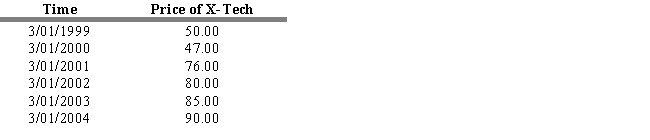 -Refer to Exhibit 1.3. What was your geometric mean annual yield for the investment in XMen?
 (Multiple Choice)
4.9/5 (89)
(89) An investment is the current commitment of dollars over time to derive future payments to compensate the investor for the time funds are committed, the expected rate of inflation, and the uncertainty of future payments.
(True/False)
4.9/5 (68)
(68) The two most common calculations investors use to measure return performance are arithmetic means and geometric means.
(True/False)
4.9/5 (78)
(78) USE THE INFORMATION BELOW FOR THE FOLLOWING PROBLEM(S)
You are provided with the following information:
Nominal return on risk-free asset = 4.5%
Expected return for asset i = 12.75%
Expected return on the market portfolio = 9.25%
-Refer to Exhibit 1.9. Calculate the risk premium for the market portfolio.
(Multiple Choice)
4.8/5 (73)
(73) USE THE INFORMATION BELOW FOR THE FOLLOWING PROBLEM(S)
The common stock of XMen Inc. had the following historic prices.
-Refer to Exhibit 1.3. What was your annual holding period yield (Annual HPY)?
-Refer to Exhibit 1.3. What was your annual holding period yield (Annual HPY)? (Multiple Choice)
4.8/5 (70)
(70) USE THE INFORMATION BELOW FOR THE FOLLOWING PROBLEM(S)
You purchased 100 shares of GE common stock on January 1, for $29 a share. A year later you received $1.25 in dividends per share and you sold it for $28 a share.
-Refer to Exhibit 1.7. Calculate your holding period yield (HPY) for this investment in GE stock.
(Multiple Choice)
4.8/5 (94)
(94) An individual who selects the investment that offers greater certainty when everything else is the same is known as a risk averse investor.
(True/False)
4.8/5 (80)
(80) The security market line (SML) graphs the expected relationship between
(Multiple Choice)
4.9/5 (82)
(82) USE THE INFORMATION BELOW FOR THE FOLLOWING PROBLEM(S)
Assume you bought 100 shares of NewTech common stock on January 15, 2003 at $50.00 per share and sold it on January 15, 2004 for $40.00 per share.
-Refer to Exhibit 1.1. What was your holding period return?
(Multiple Choice)
4.7/5 (94)
(94) USE THE INFORMATION BELOW FOR THE FOLLOWING PROBLEM(S)
The common stock of XMen Inc. had the following historic prices.
-Refer to Exhibit 1.3. What was your holding period return for the time period of 3/1/1999 to 3/1/2004?
-Refer to Exhibit 1.3. What was your holding period return for the time period of 3/1/1999 to 3/1/2004? (Multiple Choice)
4.9/5 (76)
(76) If over the past 20 years the annual returns on the S&P 500 market index averaged 12 percent with a standard deviation of 18 percent, what was the coefficient of variation?
(Multiple Choice)
4.9/5 (82)
(82) The uncertainty of investment returns associated with how a firm finances its investments is known as
(Multiple Choice)
4.9/5 (86)
(86) USE THE INFORMATION BELOW FOR THE FOLLOWING PROBLEM(S)
Assume that you hold a two-stock portfolio. You are provided with the following information on your holdings:
-Refer to Exhibit 1.6. Calculate the HPY for stock 2.
-Refer to Exhibit 1.6. Calculate the HPY for stock 2. (Multiple Choice)
4.9/5 (81)
(81) 
Filters
- Essay(0)
- Multiple Choice(0)
- Short Answer(0)
- True False(0)
- Matching(0)