



 Chat with AI
Exam 19: General Equilibrium Analysis and Economic Efficiency

Exam 1: An Introduction to Microeconomics72 Questions
Exam 2: Supply and Demand97 Questions
Exam 3: The Theory of Consumer Choice97 Questions
Exam 4: Individual and Market Demand99 Questions
Exam 5: Using Consumer Choice Theory75 Questions
Exam 6: Exchange, Efficiency, and Prices82 Questions
Exam 7: Production112 Questions
Exam 8: The Cost of Production121 Questions
Exam 9: Profit Maximization in Perfectly Competitive Markets99 Questions
Exam 10: Using the Competitive Model82 Questions
Exam 11: Monopoly115 Questions
Exam 12: Product Pricing With Monopoly Power88 Questions
Exam 13: Monopolistic Competition and Oligopoly98 Questions
Exam 14: Game Theory and the Economics of Information88 Questions
Exam 15: Using Noncompetitive Market Models77 Questions
Exam 16: Employment and Pricing of Inputs100 Questions
Exam 17: Wages, Rent, Interest, and Profit92 Questions
Exam 18: Using Input Market Analysis83 Questions
Exam 19: General Equilibrium Analysis and Economic Efficiency93 Questions
Exam 20: Public Goods and Externalities101 Questions
Select questions type


A comparison between the resource allocation at different points on the welfare frontier is difficult because:
(Multiple Choice)
4.7/5  (77)
(77) Suppose wine production is capital intensive and corn production is labor intensive.An increase in the demand for wine will cause:
(Multiple Choice)
4.8/5 (84)
(84) If perfect competition prevails in a two good (X and Y)and two input (L and K)economy,all of the following conditions are satisfied,except that:
(Multiple Choice)
4.9/5 (89)
(89) An exchange of goods between two individuals,Frank and Linda,will be mutually beneficial:
(Multiple Choice)
4.9/5 (72)
(72) Any two goods are said to be efficiently distributed among the consumers if:
(Multiple Choice)
4.7/5 (67)
(67) Which of the following is not a necessary condition for economic efficiency in competitive markets?
(Multiple Choice)
4.9/5 (86)
(86) Perfect competition in product and factor markets results in:
(Multiple Choice)
4.9/5 (89)
(89) Use the following figure to answer the question : Figure 19-1 :
,the curve TT shows how the allocation of a resource affects the well-being of two individuals,Hank and Monica. 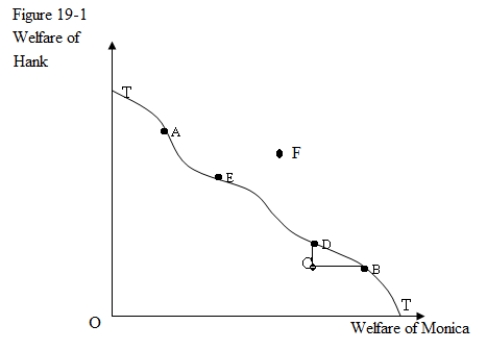 -In Figure 19-1,point C:
 (Multiple Choice)
4.9/5 (70)
(70) In an Edgeworth production box with isoquants,the contract curve reflects:
(Multiple Choice)
4.7/5 (74)
(74) Assume that Jeff and Jane both consume only two goods: burgers and soft drinks.Jeff would be willing to trade three soft drinks for one more burger,while Jane is willing to trade only two soft drinks for one more burger.Under these conditions,if Jeff and Jane are going to trade,then:
(Multiple Choice)
4.8/5 (77)
(77) If an Edgeworth production box for two industries,with land and labor as the inputs,has a contract curve that is same as the diagonal of the box,we can infer that:
(Multiple Choice)
4.8/5 (83)
(83) 
Filters
- Essay(0)
- Multiple Choice(0)
- Short Answer(0)
- True False(0)
- Matching(0)