



 Chat with AI
Exam 12: Product Pricing With Monopoly Power

Exam 1: An Introduction to Microeconomics72 Questions
Exam 2: Supply and Demand97 Questions
Exam 3: The Theory of Consumer Choice97 Questions
Exam 4: Individual and Market Demand99 Questions
Exam 5: Using Consumer Choice Theory75 Questions
Exam 6: Exchange, Efficiency, and Prices82 Questions
Exam 7: Production112 Questions
Exam 8: The Cost of Production121 Questions
Exam 9: Profit Maximization in Perfectly Competitive Markets99 Questions
Exam 10: Using the Competitive Model82 Questions
Exam 11: Monopoly115 Questions
Exam 12: Product Pricing With Monopoly Power88 Questions
Exam 13: Monopolistic Competition and Oligopoly98 Questions
Exam 14: Game Theory and the Economics of Information88 Questions
Exam 15: Using Noncompetitive Market Models77 Questions
Exam 16: Employment and Pricing of Inputs100 Questions
Exam 17: Wages, Rent, Interest, and Profit92 Questions
Exam 18: Using Input Market Analysis83 Questions
Exam 19: General Equilibrium Analysis and Economic Efficiency93 Questions
Exam 20: Public Goods and Externalities101 Questions
Select questions type


Which of the following consumer segments are benefited by price discrimination?

Free
(Multiple Choice)
4.8/5  (86)
(86) Correct Answer: Verified
C
The local zoo has a pricing policy in which senior citizens pay a lower price than younger adults.This policy is:
Free
(Multiple Choice)
4.9/5 (80)
(80) Correct Answer:Verified
VerifiedB
Which of the following price discrimination strategies allows a monopolist to distribute a product/service most efficiently between two periods of time?
Free
(Multiple Choice)
4.8/5 (80)
(80) Correct Answer:Verified
VerifiedB
When airlines charge different fares for seats on the same flight depending on how far in advance an airline ticket has been purchased,it is using a(n)_____ strategy.
(Multiple Choice)
4.7/5 (87)
(87) Which of the following is the closest example of perfect price discrimination?
(Multiple Choice)
4.9/5 (77)
(77) Use the following figure to answer the question : Figure 12-1 : shows the downward sloping demand and marginal revenue [MR] curves of a monopolist. The MR curve intersects the marginal cost [MC] curve at point B. MC is constant at the P1.
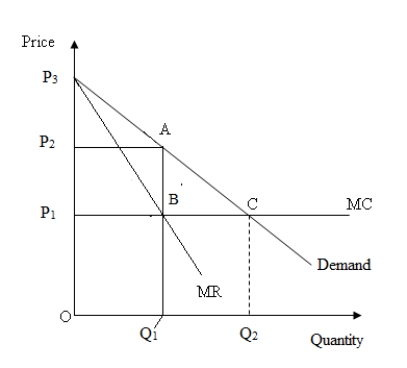 -Refer to Figure 12-1. If the monopolist cannot price discriminate, deadweight loss will be equal to:
 (Multiple Choice)
4.8/5 (79)
(79) Use the following figure to answer the question : Figure 12-3 : shows the indifference curves U1 and U2 of a consumer choosing between hours devoted at a tennis club and other goods.All consumers in this market have identical demand curves.IZ is the original budget line of a representative consumer,which shifts to AB when the club begins to charge an entry fee.
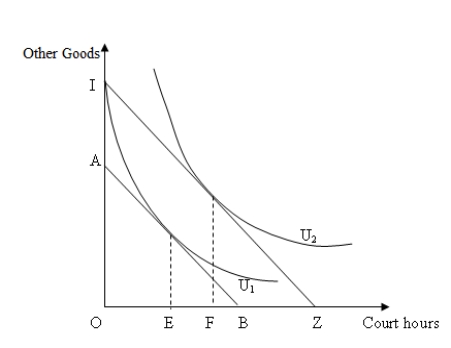 -Refer to Figure 12-3.The price of a court hour to the consumer,in terms of other goods,is:
 (Multiple Choice)
4.8/5 (81)
(81) Which of the following is true of the comparison between a non-price discriminating monopoly and a perfectly price discriminating monopoly?
(Multiple Choice)
4.8/5 (73)
(73) Use the following figure to answer the question : Figure 12-1 : shows the downward sloping demand and marginal revenue [MR] curves of a monopolist. The MR curve intersects the marginal cost [MC] curve at point B. MC is constant at the P1.
-Refer to Figure 12-1. If the monopolist cannot price discriminate, profit will be equal to:
-Refer to Figure 12-1. If the monopolist cannot price discriminate, profit will be equal to: (Multiple Choice)
4.9/5 (66)
(66) Which of the following is not an example of price discrimination?
(Multiple Choice)
4.9/5 (76)
(76) Use the following figure to answer the question : Figure 12-2 : shows the downward sloping demand and marginal revenue [MR] curves and the upward sloping marginal cost [MC] curve of a monopolist. 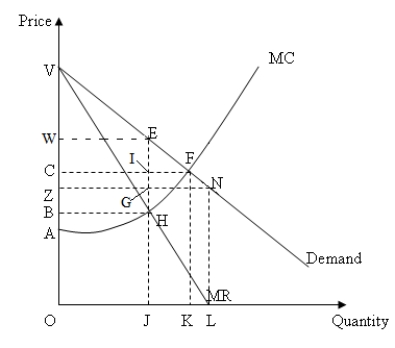 -Refer to Figure 12-2.With perfect price discrimination,the monopolist will receive producer surplus equal to the area:
 (Multiple Choice)
4.9/5 (82)
(82) Which of the following is needed for successful price discrimination?
(Multiple Choice)
4.8/5 (73)
(73) Price discrimination is more common for firms selling services than for manufacturing firms because:
(Multiple Choice)
4.8/5 (79)
(79) Derive the first-order conditions for profit maximization for a monopolist practicing price-discrimination.
(Essay)
4.9/5 (63)
(63) The following figure shows the downward sloping demand and marginal revenue [MR] curves and the upward sloping marginal cost [MC] curve of a monopolist. 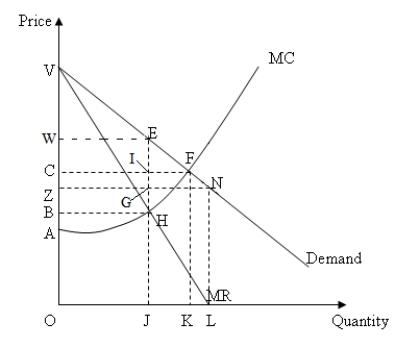 Refer to Figure 12-2.A monopolist practicing first-degree price discrimination will sell _____ quantity of output.
 (Multiple Choice)
4.8/5 (83)
(83) Comparing a price-discriminating monopoly firm with a single-price monopoly,one tends to find that price discrimination:
(Multiple Choice)
4.9/5 (84)
(84) 
Filters
- Essay(0)
- Multiple Choice(0)
- Short Answer(0)
- True False(0)
- Matching(0)