



 Chat with AI
Exam 11: Monopoly

Exam 1: An Introduction to Microeconomics72 Questions
Exam 2: Supply and Demand97 Questions
Exam 3: The Theory of Consumer Choice97 Questions
Exam 4: Individual and Market Demand99 Questions
Exam 5: Using Consumer Choice Theory75 Questions
Exam 6: Exchange, Efficiency, and Prices82 Questions
Exam 7: Production112 Questions
Exam 8: The Cost of Production121 Questions
Exam 9: Profit Maximization in Perfectly Competitive Markets99 Questions
Exam 10: Using the Competitive Model82 Questions
Exam 11: Monopoly115 Questions
Exam 12: Product Pricing With Monopoly Power88 Questions
Exam 13: Monopolistic Competition and Oligopoly98 Questions
Exam 14: Game Theory and the Economics of Information88 Questions
Exam 15: Using Noncompetitive Market Models77 Questions
Exam 16: Employment and Pricing of Inputs100 Questions
Exam 17: Wages, Rent, Interest, and Profit92 Questions
Exam 18: Using Input Market Analysis83 Questions
Exam 19: General Equilibrium Analysis and Economic Efficiency93 Questions
Exam 20: Public Goods and Externalities101 Questions
Select questions type


Use the following figure to answer the question : Figure 11-1 : shows the downward-sloping demand curve [D] and marginal revenue [MR] curve and the upward-sloping marginal cost [MC] curve for a monopolist.  -Based on Figure 11-1,competitive firms will receive producer surplus equal to area:
 (Multiple Choice)
4.7/5  (89)
(89) If total revenue falls by $5 when a monopolist sells an additional unit,you can conclude that the monopolist:
(Multiple Choice)
4.8/5 (96)
(96) Use the following figure to answer the question : Figure 11-5 : shows the demand curve and the marginal revenue curve of a monopolist.On the horizontal axis,OG = GF. 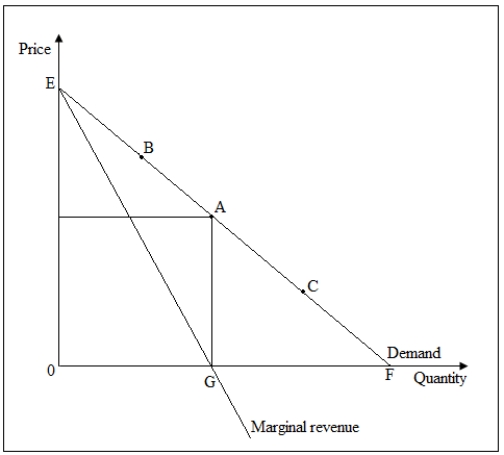 -Refer to Figure 11-5.The absolute value of the slope of the marginal revenue curve equals:
 (Multiple Choice)
5.0/5 (78)
(78) A monopolist faces the following conditions: Q = 500 -.5 P and TC = 1000 + Q + Q2.What is the monopolist's profit maximizing output?
(Multiple Choice)
4.7/5 (85)
(85) Which of the following statements is true regarding a monopolist?
(Multiple Choice)
4.8/5 (69)
(69) The following table shows the total revenue and total cost for a monopolist at various levels of output.
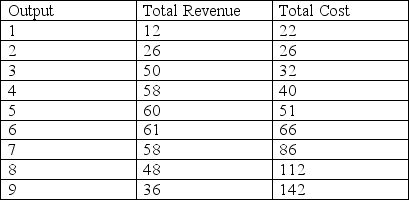 Refer to Table 11-2.At the profit-maximizing output,the price elasticity of demand _____.
 (Multiple Choice)
4.9/5 (68)
(68) Which of the following statements about the long-run equilibrium of a monopoly firm is incorrect?
(Multiple Choice)
4.8/5 (90)
(90) The following figure shows the marginal cost [MC],average cost [AC],marginal revenue [MR],and demand curves for a profit-maximizing monopolist. 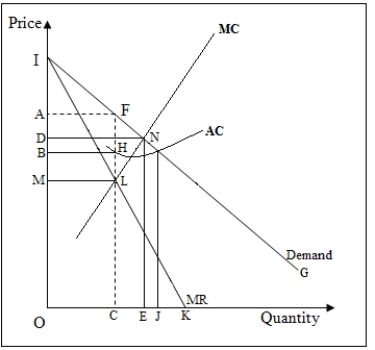 Refer to Figure 11-2.The profit earned by the monopolist is given by the area _____.
 (Multiple Choice)
4.9/5 (86)
(86) Use the following figure to answer the question : Figure 11-5 : shows the demand curve and the marginal revenue curve of a monopolist.On the horizontal axis,OG = GF.
-Refer to Figure 11-5.Total revenue is equal to zero at point(s)_____.
-Refer to Figure 11-5.Total revenue is equal to zero at point(s)_____. (Multiple Choice)
4.8/5 (76)
(76) All of the following are sources of monopoly power,except _____.
(Multiple Choice)
4.9/5 (78)
(78) Use the following figure to answer the question : Figure 11-5 : shows the demand curve and the marginal revenue curve of a monopolist.On the horizontal axis,OG = GF.
-Refer to Figure 11-5.Between points E and A on the demand curve,the price elasticity of demand:
-Refer to Figure 11-5.Between points E and A on the demand curve,the price elasticity of demand: (Multiple Choice)
4.8/5 (82)
(82) Explain why a profit-maximizing monopolist will always sell at a price where demand is elastic.
(Essay)
4.8/5 (76)
(76) For a profit-maximizing monopoly firm,the relationship between price [P],marginal revenue [MR],and the absolute value of the price elasticity of demand [ ] is given by:
(Multiple Choice)
4.8/5 (65)
(65) 
Filters
- Essay(0)
- Multiple Choice(0)
- Short Answer(0)
- True False(0)
- Matching(0)