



 Chat with AI
Exam 8: The Cost of Production

Exam 1: An Introduction to Microeconomics72 Questions
Exam 2: Supply and Demand97 Questions
Exam 3: The Theory of Consumer Choice97 Questions
Exam 4: Individual and Market Demand99 Questions
Exam 5: Using Consumer Choice Theory75 Questions
Exam 6: Exchange, Efficiency, and Prices82 Questions
Exam 7: Production112 Questions
Exam 8: The Cost of Production121 Questions
Exam 9: Profit Maximization in Perfectly Competitive Markets99 Questions
Exam 10: Using the Competitive Model82 Questions
Exam 11: Monopoly115 Questions
Exam 12: Product Pricing With Monopoly Power88 Questions
Exam 13: Monopolistic Competition and Oligopoly98 Questions
Exam 14: Game Theory and the Economics of Information88 Questions
Exam 15: Using Noncompetitive Market Models77 Questions
Exam 16: Employment and Pricing of Inputs100 Questions
Exam 17: Wages, Rent, Interest, and Profit92 Questions
Exam 18: Using Input Market Analysis83 Questions
Exam 19: General Equilibrium Analysis and Economic Efficiency93 Questions
Exam 20: Public Goods and Externalities101 Questions
Select questions type


Consider the cost function C0 = 20L + 30K and production function Q = L0.3K0.7 of a firm.Derive the first order conditions if the firm is maximizing its output subject to the given cost constraint.
(Essay)
4.9/5  (80)
(80) Suppose a firm has two plants producing the same good.Each plant is producing 200 units of the good.In plant A,the short run average cost of production is $20 and in plant B it is $30.If the firm wants to produce a total of 400 units at the lowest cost in the long run,it should:
(Multiple Choice)
4.9/5 (69)
(69) If fixed costs are $1,000 and variable costs are constant at $1.00 per unit over the relevant range of output,what will the average total cost be when 2,000 units are produced?
(Multiple Choice)
4.9/5 (84)
(84) If the marginal product of the variable input rises and then falls,the MC curve will:
(Multiple Choice)
4.8/5 (77)
(77) The technological relationships reflected in the firms' long run cost curves are an important factor in determining the market structure of an industry because:
(Multiple Choice)
4.8/5 (82)
(82) Consider a firm that uses labor and capital as the only inputs.Suppose labor is on the horizontal axis and capital is on the vertical axis.Further,the expansion path has shifted down and average cost curves have shifted up.Which of following provides the most likely explanation for what has happened?
(Multiple Choice)
4.8/5 (72)
(72) Which of the following depicts the change in per-unit cost of production resulting from a decrease in the input prices,given the output produced by the firm is constant?
(Multiple Choice)
4.7/5 (67)
(67) Consider the cubic total cost function TC = a + bQ + cQ2 + dQ3,where a = 0,b = 25,c = -10,and d = 1.The firm's minimum efficient scale would be an output of _____ units.
(Multiple Choice)
4.8/5 (79)
(79) A firm employs 100 units of labor and 50 units of capital to produce 200 widgets.Labor costs $10 per unit and capital costs $21 per unit.For the quantities of inputs employed,MPL = 3 and MPK = 3.In this situation,the firm:
(Multiple Choice)
4.8/5 (71)
(71) Use the following figure to answer the question : figure 8-1: shows the curves F,C,and G denote the total cost,the total variable cost,and the total fixed cost of a firm.
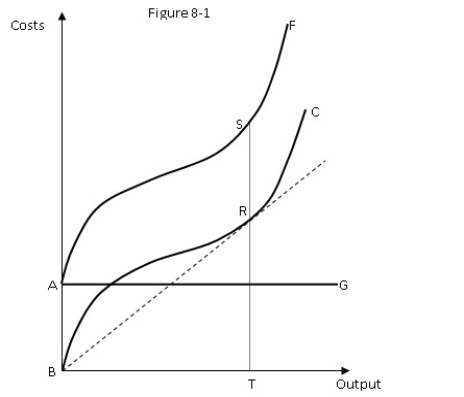 -Refer to Figure 8-1.The total fixed costs of the firm are identified by the distance:
 (Multiple Choice)
4.8/5 (88)
(88) A firm uses labor as an input in production.For the range of output where the average product of labor is increasing:
(Multiple Choice)
4.8/5 (70)
(70) At 30 units of output,the slope of a firm's average cost curve is recorded as +1.20.Calculate the firm's marginal cost at this output level if its average cost is $300.
(Multiple Choice)
4.8/5 (82)
(82) Assume that with 20L and 30K a given firm can produce 100 units of output and with 40L and 60K it can produce 175 units (where L and K denote the labor and capital inputs).Based on this information,we can conclude that:
(Multiple Choice)
4.9/5 (92)
(92) Assume that the long run average cost for a representative firm in an industry is minimized at $10 per unit of output.Further assume that total industry output is X at a price of $10,and that each firm in this industry produces 0.2X at an average cost of $10.Under these conditions we would expect the market to have:
(Multiple Choice)
4.9/5 (86)
(86) Which of the following changes shift the long-run AC curve?
(Multiple Choice)
4.7/5 (78)
(78) Explain why the long-run average cost curve is usually U-shaped although all inputs are variable in the long run?
(Essay)
4.8/5 (85)
(85) 
Filters
- Essay(0)
- Multiple Choice(0)
- Short Answer(0)
- True False(0)
- Matching(0)