



 Chat with AI
Exam 7: Production

Exam 1: An Introduction to Microeconomics72 Questions
Exam 2: Supply and Demand97 Questions
Exam 3: The Theory of Consumer Choice97 Questions
Exam 4: Individual and Market Demand99 Questions
Exam 5: Using Consumer Choice Theory75 Questions
Exam 6: Exchange, Efficiency, and Prices82 Questions
Exam 7: Production112 Questions
Exam 8: The Cost of Production121 Questions
Exam 9: Profit Maximization in Perfectly Competitive Markets99 Questions
Exam 10: Using the Competitive Model82 Questions
Exam 11: Monopoly115 Questions
Exam 12: Product Pricing With Monopoly Power88 Questions
Exam 13: Monopolistic Competition and Oligopoly98 Questions
Exam 14: Game Theory and the Economics of Information88 Questions
Exam 15: Using Noncompetitive Market Models77 Questions
Exam 16: Employment and Pricing of Inputs100 Questions
Exam 17: Wages, Rent, Interest, and Profit92 Questions
Exam 18: Using Input Market Analysis83 Questions
Exam 19: General Equilibrium Analysis and Economic Efficiency93 Questions
Exam 20: Public Goods and Externalities101 Questions
Select questions type


Use the following figure to answer the questions : Figure 7-1 shows the total product curve for different levels of a variable input,labor.
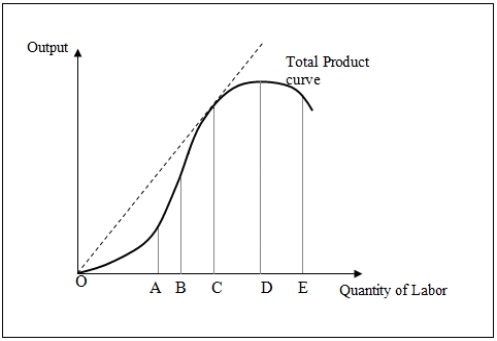 -In Figure 7-1,marginal product of labor is positive but lesser than the average product of labor after point _____.
 (Multiple Choice)
4.7/5  (87)
(87) If a firm doubles its usage of all inputs,and output more than doubles,the production function is said to exhibit:
(Multiple Choice)
4.8/5 (83)
(83) The ratio of total product to the total quantity of the input being used is _____.
(Multiple Choice)
4.9/5 (64)
(64) Consider the following Cobb-Douglas production function,T = aLbKcEd,where T is t-shirts produced,L is labor input,K is capital,and E is energy input.Mathematically show how the returns to scale of the production function depends upon the parameters a,b,c,and d.
(Essay)
4.8/5 (78)
(78) The fact that a large-scale operation can take advantage of specialization of labor often gives rise to _____.
(Multiple Choice)
4.9/5 (76)
(76) For the production function Q = Q(L),the average product of labor is given as APL = Q(L)/L.Taking the deriviative with respect to L,we have dAPL/dL = 1/L(dQ/dL - Q/L),implying that:
(Multiple Choice)
4.7/5 (80)
(80) The duration of the short run varies by industry because _____.
(Multiple Choice)
4.8/5 (84)
(84) If a firm doubles its usage of all inputs and output less than doubles,the production function
Is said to exhibit:
(Multiple Choice)
4.8/5 (76)
(76) Suppose that at a point on an isoquant,the following information is true: L increases by 5;K falls by 3;MPL = 4,then MPK must be:
(Multiple Choice)
4.8/5 (69)
(69) Returns to scale can be evaluated by looking at how output changes along _____.
(Multiple Choice)
4.8/5 (89)
(89) If the sum of the powers associated with the inputs in a Cobb-Douglas production function
Exceeds 1,the production function is characterized by:
(Multiple Choice)
4.8/5 (70)
(70) If the marginal product of a variable input is declining,then:
(Multiple Choice)
5.0/5 (79)
(79) Which of the following contributes to the increasing returns to scale in production as a firm expands capacity?
(Multiple Choice)
4.9/5 (72)
(72) A carpenter hammers nails each day at work.During the first hour she can hammer 120 nails,the second hour 100 nails,the third hour 90 nails,the fourth hour 60 nails,and the fifth hour 10 nails.The average product of five hours work is _____ nails.
(Multiple Choice)
4.9/5 (85)
(85) Use the following figure to answer the questions :
Figure 7-2 shows the total product curve for different levels of a variable input,labor. 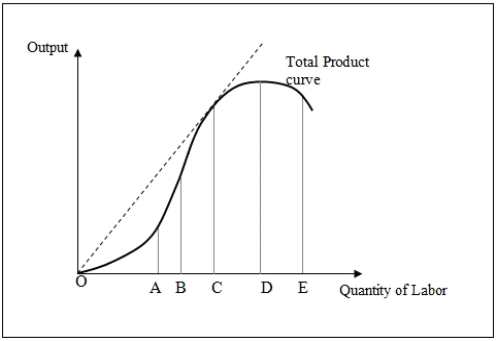 -In Figure 7.2,the law of diminishing marginal returns comes into play beyond point _____.
 (Multiple Choice)
4.8/5 (73)
(73) 
Filters
- Essay(0)
- Multiple Choice(0)
- Short Answer(0)
- True False(0)
- Matching(0)