



 Chat with AI
Exam 15: Monetary Policy

Exam 1: What Economics Is About159 Questions
Exam 2: Production Possibilities Frontier Framework132 Questions
Exam 3: Supply and Demand: Theory197 Questions
Exam 4: Prices: Free, controlled, and Relative95 Questions
Exam 5: Supply,demand,and Price: Applications66 Questions
Exam 6: Macroeconomic Measurements, part I: Prices and Unemployment103 Questions
Exam 7: Macroeconomic Measurements, part II: GDP and Real GDP115 Questions
Exam 8: Aggregate Demand and Aggregate Supply203 Questions
Exam 9: Classical Macroeconomics and the Self-Regulating Economy159 Questions
Exam 10: Keynesian Macroeconomics and Economic Instability: a Critique of the Self-Regulating Economy183 Questions
Exam 11: Fiscal Policy and the Federal Budget162 Questions
Exam 12: Money,banking,and the Financial System121 Questions
Exam 13: The Federal Reserve System178 Questions
Exam 14: Money and the Economy123 Questions
Exam 15: Monetary Policy174 Questions
Exam 16: Expectations Theory and the Economy132 Questions
Exam 17: Economic Growth: Resources, technology, ideas, and Institutions79 Questions
Exam 18: The Financial Crisis of 2007-200971 Questions
Exam 19: Debates in Macroeconomics Over the Role and Effects of Government119 Questions
Exam 20: Public Choice and Special-Interest-Group Politics56 Questions
Exam 21: Building Theories to Explain Everyday Life: From Observations to Questions to Theories to Predictions120 Questions
Exam 22: International Trade121 Questions
Exam 23: International Finance137 Questions
Exam 24: Globalization and International Impacts on the Economy77 Questions
Exam 25: The Economic Case for and Against Government: Five Topics Considered92 Questions
Exam 26: Stocks, bonds, futures, and Options149 Questions
Select questions type


A decrease in the money supply will shift the aggregate __________ curve to the __________.
(Multiple Choice)
4.9/5  (83)
(83) Explain how,according to the theory of PSST (patterns of specialization and sustainable trade),economic activity can decline in the face of unchanged aggregate demand.Give a hypothetical example to help support your answer.
(Essay)
4.9/5 (60)
(60) According to the Keynesian transmission mechanism,an increase in the money supply causes a(n)__________ in the interest rate and a(n)__________ in investment,which in turn causes a(n)__________ in total expenditures and aggregate demand.
(Multiple Choice)
4.8/5 (83)
(83) Suppose the economy is experiencing an inflationary gap.Based on available data,the Fed starts implementing contractionary monetary policy,but this moves the economy into a recessionary gap.The most probable explanation is that,because of the total lag in monetary policy,the government did not realize that the economy was already healing itself,i.e. ,that the
(Multiple Choice)
4.7/5 (77)
(77) The Taylor Rule specifies that the federal funds rate target should be equal to
(Multiple Choice)
4.9/5 (94)
(94) Compared to the Keynesian transmission mechanism,the monetarist transmission mechanism is
(Multiple Choice)
4.9/5 (84)
(84) The economy is in the horizontal portion of the AS curve,there is no liquidity trap and investment is sensitive to changes in the interest rate.According to the Keynesian transmission mechanism,if the money supply increases the interest rate will __________,investment spending will __________,the AD curve will shift to the __________,and Real GDP will __________.
(Multiple Choice)
4.8/5 (89)
(89) Economists who favor activist monetary policy often argue that
(Multiple Choice)
5.0/5 (74)
(74) Equilibrium in the money market exists when the quantity demanded of money equals the quantity supplied of money.
(True/False)
4.9/5 (85)
(85) Describe the monetary policy known as inflation targeting.What are the three major issues that surround this practice?
(Essay)
5.0/5 (75)
(75) Exhibit 15-5 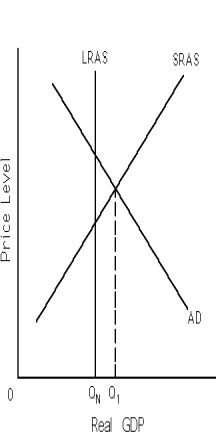 -Refer to Exhibit 15-5.Assume that the economy starts out in short-run equilibrium.An economist who believes that the economy is not self-regulating would assert that the government should use _________________ fiscal policy to close the existing ___________________ gap.
 (Multiple Choice)
4.8/5 (84)
(84) The money supply decreased and the AD curve shifted to the left.This is consistent with the
(Multiple Choice)
4.9/5 (84)
(84) If the interest rate falls,the opportunity cost of holding money __________ and the quantity demanded of money __________.
(Multiple Choice)
4.8/5 (89)
(89) 
Filters
- Essay(0)
- Multiple Choice(0)
- Short Answer(0)
- True False(0)
- Matching(0)