



 Chat with AI
Exam 15: Monetary Policy

Exam 1: What Economics Is About159 Questions
Exam 2: Production Possibilities Frontier Framework132 Questions
Exam 3: Supply and Demand: Theory197 Questions
Exam 4: Prices: Free, controlled, and Relative95 Questions
Exam 5: Supply,demand,and Price: Applications66 Questions
Exam 6: Macroeconomic Measurements, part I: Prices and Unemployment103 Questions
Exam 7: Macroeconomic Measurements, part II: GDP and Real GDP115 Questions
Exam 8: Aggregate Demand and Aggregate Supply203 Questions
Exam 9: Classical Macroeconomics and the Self-Regulating Economy159 Questions
Exam 10: Keynesian Macroeconomics and Economic Instability: a Critique of the Self-Regulating Economy183 Questions
Exam 11: Fiscal Policy and the Federal Budget162 Questions
Exam 12: Money,banking,and the Financial System121 Questions
Exam 13: The Federal Reserve System178 Questions
Exam 14: Money and the Economy123 Questions
Exam 15: Monetary Policy174 Questions
Exam 16: Expectations Theory and the Economy132 Questions
Exam 17: Economic Growth: Resources, technology, ideas, and Institutions79 Questions
Exam 18: The Financial Crisis of 2007-200971 Questions
Exam 19: Debates in Macroeconomics Over the Role and Effects of Government119 Questions
Exam 20: Public Choice and Special-Interest-Group Politics56 Questions
Exam 21: Building Theories to Explain Everyday Life: From Observations to Questions to Theories to Predictions120 Questions
Exam 22: International Trade121 Questions
Exam 23: International Finance137 Questions
Exam 24: Globalization and International Impacts on the Economy77 Questions
Exam 25: The Economic Case for and Against Government: Five Topics Considered92 Questions
Exam 26: Stocks, bonds, futures, and Options149 Questions
Select questions type


Exhibit 15-2 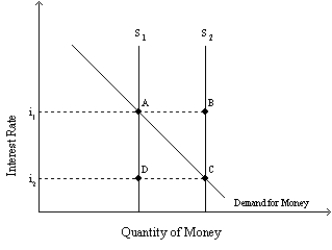 -Refer to Exhibit 15-2.A(n)__________ in the money supply from S1 to S2 would have a tendency to __________ the opportunity cost of holding money.
 (Multiple Choice)
4.9/5  (83)
(83) According to the Keynesian transmission mechanism (and assuming there is no liquidity trap and investment is not interest insensitive),if the money supply increases,the interest rate __________,investment spending __________ and the AD curve shifts to the __________.
(Multiple Choice)
4.8/5 (86)
(86) The routes or channels that ripple effects created in the money market travel to impact the goods-and-services market are known as
(Multiple Choice)
4.7/5 (66)
(66) Under a gold standard,if the market price of gold is below the official price of gold (set by the monetary authority),people will be more likely to sell gold __________________,which will cause the money supply to _______________ and the price level.to _______________.
(Multiple Choice)
4.8/5 (70)
(70) To eliminate a recessionary gap the Fed typically uses __________ monetary policy,and to eliminate an inflationary gap the Fed typically uses __________ monetary policy.
(Multiple Choice)
4.7/5 (86)
(86) In the monetarist transmission mechanism,changes in the money market directly affect aggregate demand.
(True/False)
4.7/5 (71)
(71) Economists who propose a constant-money-growth-rate rule often argue that setting the annual growth rate in the money supply equal to the average annual growth rate in Real GDP
(Multiple Choice)
4.8/5 (75)
(75) If people have only two ways of holding their wealth,money or bonds,a surplus in the money market implies a surplus in the bond market.
(True/False)
4.9/5 (93)
(93) Persons who argue that monetary and fiscal policy should be deliberately used to smooth out the business cycle are called
(Multiple Choice)
4.9/5 (73)
(73) As the interest rate __________,the quantity supplied of money __________ and the quantity demanded of money __________.
(Multiple Choice)
4.8/5 (77)
(77) Describe the Keynesian transmission mechanism for a decrease in the money supply.Assuming that no liquidity trap exists,that investment is interest-sensitive,and that the economy is in the horizontal portion of the AS curve,what happens to Real GDP and the price level? How can you tell if this is a direct transmission mechanism or an indirect one?
(Essay)
4.8/5 (70)
(70) Economist Smith favors an activist monetary policy.He says that if the economy is going to be stabilized over time,it is necessary to fine-tune the money supply to the particular economic conditions that exist.What would economist Jones,who favors rules-based monetary policy,say to economist Smith?
(Multiple Choice)
4.9/5 (74)
(74) According to the Keynesian transmission mechanism,an increase in the money supply will __________ the interest rate,causing a __________ in investment,which then __________ Real GDP.
(Multiple Choice)
4.7/5 (80)
(80) If the money market is in the liquidity trap,it is operating in the __________ segment of the __________ demand curve.
(Multiple Choice)
4.7/5 (86)
(86) Economists who believe that the economy is self-regulating are more likely to be nonactivists than activists.
(True/False)
4.8/5 (70)
(70) Assume the Keynesian transmission mechanism is operational and the economy is currently operating in the horizontal portion of the AS curve.If the money supply increases and the demand for money curve is downward sloping and investment is interest ____________,then Real GDP will ___________________.
(Multiple Choice)
4.8/5 (79)
(79) Last year,Danielle bought a bond for $10,000 that promises to pay $1,150 a year.This year,a person who buys a bond for $10,000 receives $1,210 a year.If Danielle were to sell her (old)bond,its price would be approximately
(Multiple Choice)
4.9/5 (84)
(84) A general definition of the "transmission mechanism" is: the routes or channels that ripple effects created in the
(Multiple Choice)
4.7/5 (80)
(80) 
Filters
- Essay(0)
- Multiple Choice(0)
- Short Answer(0)
- True False(0)
- Matching(0)