



 Chat with AI
Exam 14: Money and the Economy

Exam 1: What Economics Is About159 Questions
Exam 2: Production Possibilities Frontier Framework132 Questions
Exam 3: Supply and Demand: Theory197 Questions
Exam 4: Prices: Free, controlled, and Relative95 Questions
Exam 5: Supply,demand,and Price: Applications66 Questions
Exam 6: Macroeconomic Measurements, part I: Prices and Unemployment103 Questions
Exam 7: Macroeconomic Measurements, part II: GDP and Real GDP115 Questions
Exam 8: Aggregate Demand and Aggregate Supply203 Questions
Exam 9: Classical Macroeconomics and the Self-Regulating Economy159 Questions
Exam 10: Keynesian Macroeconomics and Economic Instability: a Critique of the Self-Regulating Economy183 Questions
Exam 11: Fiscal Policy and the Federal Budget162 Questions
Exam 12: Money,banking,and the Financial System121 Questions
Exam 13: The Federal Reserve System178 Questions
Exam 14: Money and the Economy123 Questions
Exam 15: Monetary Policy174 Questions
Exam 16: Expectations Theory and the Economy132 Questions
Exam 17: Economic Growth: Resources, technology, ideas, and Institutions79 Questions
Exam 18: The Financial Crisis of 2007-200971 Questions
Exam 19: Debates in Macroeconomics Over the Role and Effects of Government119 Questions
Exam 20: Public Choice and Special-Interest-Group Politics56 Questions
Exam 21: Building Theories to Explain Everyday Life: From Observations to Questions to Theories to Predictions120 Questions
Exam 22: International Trade121 Questions
Exam 23: International Finance137 Questions
Exam 24: Globalization and International Impacts on the Economy77 Questions
Exam 25: The Economic Case for and Against Government: Five Topics Considered92 Questions
Exam 26: Stocks, bonds, futures, and Options149 Questions
Select questions type


Ceteris paribus,the greater the increase in the money supply,the __________ the inflation rate,the __________ the expected inflation rate,and the __________ the interest rate.
(Multiple Choice)
4.9/5  (68)
(68) Monetarists believe that an increase in the money supply will raise both Real GDP and the price level in the short run,and will only raise Real GDP in the long run.
(True/False)
4.7/5 (86)
(86) The economy is initially in long-run equilibrium.The AD curve shifts to the right and the price level rises.Assuming that the economy is self-regulating,the SRAS curve will shift to the left and the price level will rise even further.If the price level now remains constant,what have we witnessed?
(Multiple Choice)
4.9/5 (80)
(80) Suppose the economy starts off producing Natural Real GDP.Next,aggregate demand rises,ceteris paribus.As a result,the price level rises in the short run.In the long run,when the economy has moved back to producing Natural Real GDP,the price level will be
(Multiple Choice)
4.9/5 (71)
(71) Suppose the Fed buys government securities from the public.The liquidity effect of this is that the interest rate will
(Multiple Choice)
4.7/5 (80)
(80) The assumption made about Real GDP in the simple quantity theory of money produces a ____________________ curve in the AD-AS version of the theory.
(Multiple Choice)
4.9/5 (82)
(82) If the money supply is $6,000,velocity is 5,and Real GDP is 10,000 units of output,then the price level is _____________.If the money supply doubled over a short time period to $12,000,the simple quantity theory of money would predict that _____________________.
(Multiple Choice)
4.8/5 (74)
(74) When the Fed conducts open market operations,the impact of the buying or selling of bonds will include changes in
(Multiple Choice)
4.8/5 (74)
(74) What is the only factor that can continually increase in such a way as to bring about continued increases in aggregate demand,and thus bring about continued inflation? Give two reasons why government purchases cannot continually increase,and so cannot be the cause of continued inflation.
(Essay)
4.7/5 (94)
(94) If the money supply is $3,000,velocity is 4 and the price level is $2,then Real GDP is _____________ units of output.If the money supply doubled over a short time period to $6,000,the simple quantity theory of money would predict that ______________________.
(Multiple Choice)
4.9/5 (70)
(70) Exhibit 14-1  -Refer to Exhibit 14-1.What sequence of points shows the short- and long-run consequences of a fall in velocity under monetarist assumptions?
 (Multiple Choice)
4.9/5 (88)
(88) Exhibit 14-2 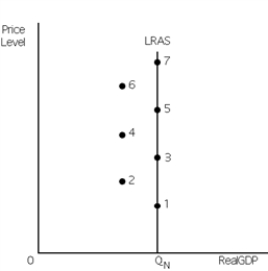 -Refer to Exhibit 14-2.The economy moves from point 1 to 2 to 3 to 4 to 5 to 6 to 7.Is this consistent with one-shot declines originating on the supply-side of the economy combined with continued increases in aggregate demand?
 (Multiple Choice)
4.9/5 (79)
(79) The spread (difference)between the yield on conventional bonds and the yield on indexed bonds with the same maturities is an indication of the expected inflation rate.
(True/False)
5.0/5 (81)
(81) 
Filters
- Essay(0)
- Multiple Choice(0)
- Short Answer(0)
- True False(0)
- Matching(0)