



 Chat with AI
Exam 14: Money and the Economy

Exam 1: What Economics Is About159 Questions
Exam 2: Production Possibilities Frontier Framework132 Questions
Exam 3: Supply and Demand: Theory197 Questions
Exam 4: Prices: Free, controlled, and Relative95 Questions
Exam 5: Supply,demand,and Price: Applications66 Questions
Exam 6: Macroeconomic Measurements, part I: Prices and Unemployment103 Questions
Exam 7: Macroeconomic Measurements, part II: GDP and Real GDP115 Questions
Exam 8: Aggregate Demand and Aggregate Supply203 Questions
Exam 9: Classical Macroeconomics and the Self-Regulating Economy159 Questions
Exam 10: Keynesian Macroeconomics and Economic Instability: a Critique of the Self-Regulating Economy183 Questions
Exam 11: Fiscal Policy and the Federal Budget162 Questions
Exam 12: Money,banking,and the Financial System121 Questions
Exam 13: The Federal Reserve System178 Questions
Exam 14: Money and the Economy123 Questions
Exam 15: Monetary Policy174 Questions
Exam 16: Expectations Theory and the Economy132 Questions
Exam 17: Economic Growth: Resources, technology, ideas, and Institutions79 Questions
Exam 18: The Financial Crisis of 2007-200971 Questions
Exam 19: Debates in Macroeconomics Over the Role and Effects of Government119 Questions
Exam 20: Public Choice and Special-Interest-Group Politics56 Questions
Exam 21: Building Theories to Explain Everyday Life: From Observations to Questions to Theories to Predictions120 Questions
Exam 22: International Trade121 Questions
Exam 23: International Finance137 Questions
Exam 24: Globalization and International Impacts on the Economy77 Questions
Exam 25: The Economic Case for and Against Government: Five Topics Considered92 Questions
Exam 26: Stocks, bonds, futures, and Options149 Questions
Select questions type


If the nominal interest rate is 4 percent and the expected inflation rate is 1 percent,the real interest rate is
(Multiple Choice)
4.9/5  (83)
(83) Exhibit 14-1  -Refer to Exhibit 14-1.What sequence of points shows the short- and long-run consequences of a rise in the money supply under monetarist assumptions?
 (Multiple Choice)
4.8/5 (68)
(68) One example of one-shot inflation occurs when the SRAS curve shifts leftward.
(True/False)
5.0/5 (83)
(83) Monetarists can be described as a group of macroeconomists who
(Multiple Choice)
4.8/5 (72)
(72) In seeking to explain what determines GDP,monetarists focus on the money supply while Keynesians focus on the spending components of total expenditures.
(True/False)
4.7/5 (85)
(85) The aggregate supply curve is depicted as vertical in the simple quantity theory of money.
(True/False)
4.8/5 (79)
(79) Exhibit 14-2 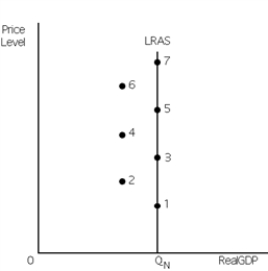 -Refer to Exhibit 14-2.The economy moves from point 1 to 2 to 3 to 4 to 5 to 6 to 7.What explains this?
 (Multiple Choice)
4.9/5 (75)
(75) When a country imposes and maintains price controls,inflation
(Multiple Choice)
5.0/5 (81)
(81) In the monetarist version of the AD-AS framework,starting from long-run equilibrium,an increase in the money supply produces
(Multiple Choice)
4.8/5 (86)
(86) According to Milton Friedman,continued inflation is always and everywhere
(Multiple Choice)
4.9/5 (69)
(69) The change in the interest rate brought on by a change in Real GDP is referred to as the __________ effect.
(Multiple Choice)
4.8/5 (71)
(71) The velocity of money is the __________ number of times a dollar is spent to buy final goods and services in a year.
(Multiple Choice)
4.8/5 (76)
(76) If the money supply is $900,velocity is 6,then in the equation of exchange,PQ is
(Multiple Choice)
4.7/5 (86)
(86) Can a one-time increase in the supply of money cause one-shot inflation?
(Multiple Choice)
4.7/5 (60)
(60) Exhibit 14-1
-Refer to Exhibit 14-1.What sequence of points shows the short- and long-run consequences of a rise in velocity under monetarist assumptions?
-Refer to Exhibit 14-1.What sequence of points shows the short- and long-run consequences of a rise in velocity under monetarist assumptions? (Multiple Choice)
4.8/5 (83)
(83) 
Filters
- Essay(0)
- Multiple Choice(0)
- Short Answer(0)
- True False(0)
- Matching(0)