



 Chat with AI
Exam 6: Process Costing Systems

Exam 1: The Role of Accounting Information in Management Decision Making81 Questions
Exam 2: Cost Concepts, Behaviour and Estimation88 Questions
Exam 3: A Costing Framework and Cost Allocation45 Questions
Exam 4: Cost-Volume-Profit Cvp Analysis93 Questions
Exam 5: Job Costing Systems45 Questions
Exam 6: Process Costing Systems93 Questions
Exam 7: Absorption, Variable and Throughput Costing102 Questions
Exam 8: Activity Analysis: Costing and Management96 Questions
Exam 9: Relevant Costs for Decision Making122 Questions
Exam 10: Standard Costs, Flexible Budgets and Variance Analysis104 Questions
Exam 11: Operational Budgets87 Questions
Exam 12: Strategy and Control35 Questions
Exam 13: Planning and Budgeting for Strategic Success45 Questions
Exam 14: Capital Budgeting and Strategic Investment Decisions93 Questions
Exam 15: The Strategic Management of Costs and Revenues109 Questions
Exam 16: Strategic Management Control: a Lean Perspective46 Questions
Exam 17: Responsibility Accounting, Performance Evaluation and Transfer Pricing63 Questions
Exam 18: The Balanced Scorecard and Strategy Maps83 Questions
Exam 19: Rewards, Incentives and Risk Management45 Questions
Exam 20: Sustainability Management Accounting45 Questions
Select questions type


Miramar Ltd uses a weighted-average process costing system which recognises normal spoilage as 5% of good output. During the current period, 14,000 units were started and 10,000 units completed. Materials are added at the beginning of the process, conversion costs occur uniformly, and the inspection point is at the 70% point. Beginning work in process was 6,000 units, 40% complete, and ending work in process 9,000 units, 80% complete. The cost per equivalent unit for material was $1.00 and for conversion costs $3.00. The cost of ending work in process was
(Multiple Choice)
4.8/5  (79)
(79) Assume a company's beginning work in process consists of 20,000 units, 40% complete. Materials are added at the beginning of the process. During the month, 90,000 units are transferred in. The ending work in process consists of 10,000 units, 50% complete. Under the standard cost method, the equivalent units of production are 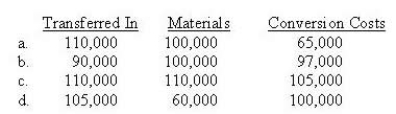
(Multiple Choice)
4.8/5 (95)
(95) Hendrix Ltd employs a process costing system. Direct materials are added at the beginning of the process. Here is information about July's activities: Using the weighted average method, the cost of the goods completed and transferred out was
(Multiple Choice)
4.8/5 (75)
(75) In the weighted average method, cost per equivalent unit is often calculated separately for materials costs and conversion costs.
(True/False)
4.9/5 (92)
(92) Beginning work in process consists of 7,000 units, 55% complete. 50,000 units were started and ending work in process is 5,000 units, 25% complete. Normal spoilage is equal to 10% of the units inspected. The inspection point occurs at the 20% point and 7,000 units were rejected. Direct materials are added at the 50% point, direct labor at 30% and overhead is applied uniformly. The costs per equivalent unit are: direct material $1.00; direct labor $1.50; overhead $2.00. The number of units completed is
(Multiple Choice)
4.7/5 (74)
(74) Macey Ltd uses a weighted-average process costing system. Beginning inventory consists of 6,000 units, 40% complete. Units started are 14,000, completed are 10,000, and ending inventories are 9,000 units, 70% complete. Normal spoilage is 5% of the units inspected. Direct material is added at the 75% point and spoilage inspection occurs at the 80% point. The cost per equivalent unit for materials was $1.00 and $3.00 for conversion costs. The loss from abnormal spoilage was
(Multiple Choice)
4.8/5 (84)
(84) On 1st September, Kelita Ltd had 20,000 units in process, which were 30% completed. Materials are added at the beginning of the process. During the month 160,000 units were started and 170,000 completed. Ending work in process was 50% complete. By what amount would the equivalent units of materials differ if weighted average were used instead of FIFO?
(Multiple Choice)
4.9/5 (85)
(85) Assume a company's beginning work in process consists of 20,000 units, 40% complete. Materials are added at the beginning of the process. During the month, 90,000 units are transferred in. The ending work in process consists of 10,000 units, 50% complete. Using the FIFO method, the equivalent units of production are 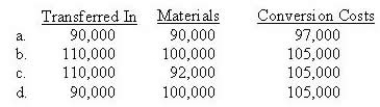
(Multiple Choice)
4.9/5 (76)
(76) Zuniga Ltd uses a process costing system. During May, 1,200 units were transferred into Department 2 at a cost of $38,040. Direct materials are added at the beginning of the process. Additionally: Using the weighted average method, the cost of the ending work in process inventory was
(Multiple Choice)
4.9/5 (79)
(79) Equivalent units measure the resources used in partially completed units relative to the resources needed to complete the units.
(True/False)
4.8/5 (88)
(88) Standard cost equivalent units are calculated the same way as FIFO equivalent units.
(True/False)
4.9/5 (78)
(78) Beginning work in process consists of 7,000 units, 55% complete. 50,000 units were started and ending work in process is 5,000 units, 25% complete. Normal spoilage is equal to 10% of the units inspected. The inspection point occurs at the 20% point and 7,000 units were rejected. Direct materials are added at the 50% point, direct labor at 30% and overhead is applied uniformly. The costs per equivalent unit are: direct material $1.00; direct labor $1.50; overhead $2.00. The cost of abnormal spoilage is
(Multiple Choice)
4.7/5 (76)
(76) 
Filters
- Essay(0)
- Multiple Choice(0)
- Short Answer(0)
- True False(0)
- Matching(0)