



 Chat with AI
Exam 12: Pricing Decisions, Product Profitability Decisions, and Cost Management

Exam 1: The Accountants Vital Role in Decision Making141 Questions
Exam 2: An Introduction to Cost Terms and Purposes165 Questions
Exam 3: Cost-Volume-Profit Analysis139 Questions
Exam 4: Job Costing138 Questions
Exam 5: Activity-Based Costing and Management133 Questions
Exam 6: Master Budget and Responsibility Accounting150 Questions
Exam 7: Flexible Budgets, Variances, and Management Control: I146 Questions
Exam 8: Flexible Budgets, Variances, and Management Control: II137 Questions
Exam 9: Income Effects of Denominator Level on Inventory Valuation154 Questions
Exam 10: Quantitative Analyses of Cost Functions114 Questions
Exam 11: Decision Making and Relevant Information146 Questions
Exam 12: Pricing Decisions, Product Profitability Decisions, and Cost Management135 Questions
Exam 13: Strategy, Balanced Scorecard, and Profitability Analysis140 Questions
Exam 14: Period Cost Allocation153 Questions
Exam 15: Cost Allocation: Joint Products and Byproducts149 Questions
Exam 16: Revenue and Customer Profitability Analysis137 Questions
Exam 17: Process Costing128 Questions
Exam 18: Spoilage, Rework, and Scrap121 Questions
Exam 19: Cost Management: Quality, Time, and the Theory of Constraints158 Questions
Exam 20: Inventory Cost Management Strategies136 Questions
Exam 21: Capital Budgeting: Methods of Investment Analysis128 Questions
Exam 22: Capital Budgeting: a Closer Look120 Questions
Exam 23: Transfer Pricing and Multinational Management Control Systems141 Questions
Exam 24: Multinational Performance Measurement and Compensation139 Questions
Select questions type


Dumping occurs when a company is trying to get rid of out-of-style products and substantially reduces their prices.
(True/False)
4.8/5  (92)
(92) Central Dental Company manufactures dental chairs. Its most popular model, Deluxe, sells for $2,500. It has variable costs totaling $1,400 and fixed costs of $500 per unit based on an average production run of 5,000 units. It normally has four production runs a year with $200,000 setup costs each time. Plant capacity can handle up to six runs a year for a total of 30,000 chairs.
A competitor is introducing a new dental chair similar to Deluxe that will sell for $2,000. Management believes it must lower the price in order to compete. Marketing believes that the new price will increase sales by 25 percent a year. The plant manager thinks that production can increase by 25 percent with the same level of fixed costs. The company currently sells all the Deluxe chairs it can produce.
Required:
What is the target cost per unit for the new price if target profit is 20 percent of sales?
(Short Answer)
4.9/5 (67)
(67) Use the information below to answer the following question(s).
Pershing Company budgeted the following costs for the production of its one and only product, blades, for the next fiscal year:
 Pershing has a target profit of $150,000.
-What is the target cost if target operating income is 25% of sales?
Pershing has a target profit of $150,000.
-What is the target cost if target operating income is 25% of sales? (Multiple Choice)
4.9/5 (76)
(76) Which of the following is true concerning value-engineering?
(Multiple Choice)
4.8/5 (83)
(83) Value engineering is a time-and-motion system that can result in: improvements in product designs, changes in material specifications, or modifications in process methods.
(True/False)
4.8/5 (70)
(70) Answer the following question(s) using the information below.
Gerry's Generator Supply is approached by Mr. Gladstone, a new customer, to fulfill a large one-time-only special order for a product similar to one offered to regular customers. Gerry's Generator Supply has excess capacity. The following per unit data apply for sales to regular customers:
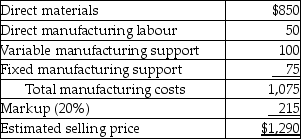 -If Mr. Gladstone wanted a long-term commitment for supplying this product, what price would most likely be quoted to him?
 (Multiple Choice)
4.7/5 (84)
(84) Explain the difference between locked in costs and costs incurred. Which of these types of costs does a traditional accounting system emphasize? At which stage of the value chain are most costs locked-in? At which stage of the value chain are most costs incurred? What implication does this have for good cost management?
(Essay)
4.9/5 (79)
(79) The three major influences on pricing decisions are: costs, competitors, and customers.
(True/False)
4.9/5 (76)
(76) Answer the following question(s) using the information below.
Welch Manufacturing is approached by a European customer to fulfill a one-time-only special order for a product similar to one offered to domestic customers. Welch Manufacturing has a policy of adding a 10% markup to full costs and currently has excess capacity. The following per unit data apply for sales to regular customers:
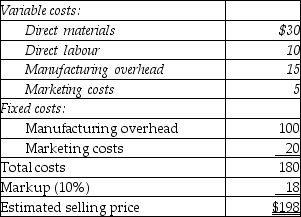 -If the European customer wanted a long-term commitment for supplying this product, what price would most likely be quoted?
 (Multiple Choice)
4.8/5 (80)
(80) Most of a product's life-cycle costs are locked in by decisions made during the ________ business function of the value chain.
(Multiple Choice)
4.8/5 (79)
(79) Schlickau Company manufactures basketball backboards. The following information pertains to the
company's normal operations per month:

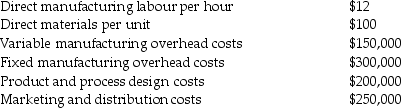 Required:
a. For long-run pricing, what is the full-cost base per unit?
b. Schlickau Company is approached by an overseas city to fulfill a one-time-only special order for 1,000 units. All cost relationships remain the same except for an additional one-time setup charge of $40,000. No additional design, marketing, or distribution costs will be incurred. What is the minimum acceptable bid per unit on this one-time-only special order?
Required:
a. For long-run pricing, what is the full-cost base per unit?
b. Schlickau Company is approached by an overseas city to fulfill a one-time-only special order for 1,000 units. All cost relationships remain the same except for an additional one-time setup charge of $40,000. No additional design, marketing, or distribution costs will be incurred. What is the minimum acceptable bid per unit on this one-time-only special order? (Essay)
4.7/5 (73)
(73) Which of the following is true of products with a long life cycle?
(Multiple Choice)
4.9/5 (74)
(74) Peak-load pricing focuses on direct costs when setting prices for peak and nonpeak periods.
(True/False)
4.8/5 (88)
(88) Use the information below to answer the following question(s).
Pershing Company budgeted the following costs for the production of its one and only product, blades, for the next fiscal year:
Pershing has a target profit of $150,000.
-The target pricing approach is easier when
Pershing has a target profit of $150,000.
-The target pricing approach is easier when (Multiple Choice)
4.9/5 (87)
(87) Customer life-cycle costs focus on the total costs to a customer of acquiring and using a product or service until it is replaced.
(True/False)
4.9/5 (91)
(91) An airline charges business and pleasure travellers different amounts. This is an example of
(Multiple Choice)
4.9/5 (73)
(73) Life-cycle costing, from an environmental sustainability perspective, considers the end of a products life-cycle to include disposal and recycling costs.
(True/False)
4.7/5 (90)
(90) 
Filters
- Essay(0)
- Multiple Choice(0)
- Short Answer(0)
- True False(0)
- Matching(0)