



 Chat with AI
Exam 9: Income Effects of Denominator Level on Inventory Valuation

Exam 1: The Accountants Vital Role in Decision Making141 Questions
Exam 2: An Introduction to Cost Terms and Purposes165 Questions
Exam 3: Cost-Volume-Profit Analysis139 Questions
Exam 4: Job Costing138 Questions
Exam 5: Activity-Based Costing and Management133 Questions
Exam 6: Master Budget and Responsibility Accounting150 Questions
Exam 7: Flexible Budgets, Variances, and Management Control: I146 Questions
Exam 8: Flexible Budgets, Variances, and Management Control: II137 Questions
Exam 9: Income Effects of Denominator Level on Inventory Valuation154 Questions
Exam 10: Quantitative Analyses of Cost Functions114 Questions
Exam 11: Decision Making and Relevant Information146 Questions
Exam 12: Pricing Decisions, Product Profitability Decisions, and Cost Management135 Questions
Exam 13: Strategy, Balanced Scorecard, and Profitability Analysis140 Questions
Exam 14: Period Cost Allocation153 Questions
Exam 15: Cost Allocation: Joint Products and Byproducts149 Questions
Exam 16: Revenue and Customer Profitability Analysis137 Questions
Exam 17: Process Costing128 Questions
Exam 18: Spoilage, Rework, and Scrap121 Questions
Exam 19: Cost Management: Quality, Time, and the Theory of Constraints158 Questions
Exam 20: Inventory Cost Management Strategies136 Questions
Exam 21: Capital Budgeting: Methods of Investment Analysis128 Questions
Exam 22: Capital Budgeting: a Closer Look120 Questions
Exam 23: Transfer Pricing and Multinational Management Control Systems141 Questions
Exam 24: Multinational Performance Measurement and Compensation139 Questions
Select questions type


The denominator-level concept based on capacity utilization for the anticipated level of output that will satisfy customer demand for a single operating cycle, and complies with the Canada Revenue Agency for tax purposes, is the
(Multiple Choice)
4.7/5  (69)
(69) When the distinction between variable and fixed costs is one of the important elements in the preparation of the income statement, the method used should be the
(Multiple Choice)
4.8/5 (82)
(82) The break-even point under absorption costing depends on the: fixed costs, contribution margin per unit, unit level sales, unit level of production, and overhead cost rate.
(True/False)
4.8/5 (68)
(68) Answer the following question(s) using the information below.
Heinrich Corporation budgeted fixed manufacturing costs of $6,000 during 2012. Other information for 2012 includes:
 The company uses absorption costing and the fixed manufacturing cost rate is based on the budgeted denominator level. Manufacturing variances are closed to cost of goods sold.
-Which of the following is a weakness particular to the absorption costing method?
The company uses absorption costing and the fixed manufacturing cost rate is based on the budgeted denominator level. Manufacturing variances are closed to cost of goods sold.
-Which of the following is a weakness particular to the absorption costing method? (Multiple Choice)
4.9/5 (79)
(79) Holding fixed cost and unit contribution margin constant, operating income rises as the level of sales
rises.
(True/False)
4.9/5 (81)
(81) The difference between variable costing and absorption costing centres on accounting for variable costs.
(True/False)
4.9/5 (66)
(66) Full product costs under absorption costing include only inventoriable costs and upstream costs.
(True/False)
5.0/5 (63)
(63) One of the biggest reasons variable costing is controversial involves
(Multiple Choice)
4.8/5 (78)
(78) Generally Accepted Accounting Principles require that ________ costing is/are the inventory method(s) to be used in Canada for financial reporting.
(Multiple Choice)
4.9/5 (84)
(84) Stoll Bottling Works manufactures glass bottles. January and February operations were identical in every way except for the planned production. January had a production denominator of 35,000 units. February had a production denominator of 36,000 units. Fixed manufacturing costs totalled $126,000. Sales for both months totalled 45,000 units with variable manufacturing costs of $4 per unit. Selling and administrative costs were $0.40 per unit variable and $60,000 fixed. The selling price was $10 per unit.
Required:
Compute the operating income for both months using absorption costing.
(Essay)
4.9/5 (73)
(73) Answer the following question(s) using the information below.
Stober Company produces a specialty item. Management has provided the following information:
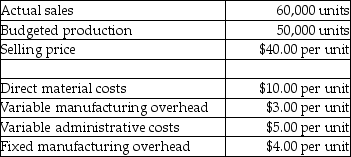 -What is the cost per statue if throughput costing is used?
 (Multiple Choice)
5.0/5 (83)
(83) Normal capacity utilization is not the same as master-budget capacity utilization.
(True/False)
4.7/5 (72)
(72) The main difference between variable costing and absorption costing is the way in which fixed manufacturing costs are accounted.
(True/False)
4.9/5 (81)
(81) Absorption costing defers the fixed manufacturing costs in ending inventory to a future period, but variable costing expenses these costs in the current period.
(True/False)
4.9/5 (88)
(88) For Consumer Lumber what would be the total difference between operating incomes under absorption costing and variable costing? 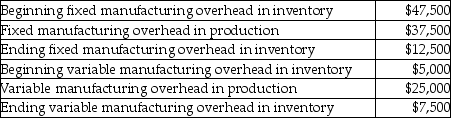
(Multiple Choice)
4.8/5 (81)
(81) a. Explain the difference between the variable and absorption costing methods.
b. Which method(s) are required for external reporting? For internal reporting?
(Essay)
4.9/5 (87)
(87) Theoretical capacity is based on which of the following assumptions?
(Multiple Choice)
4.8/5 (83)
(83) 
Filters
- Essay(0)
- Multiple Choice(0)
- Short Answer(0)
- True False(0)
- Matching(0)