



 Chat with AI
Exam 4: Job Costing

Exam 1: The Accountants Vital Role in Decision Making141 Questions
Exam 2: An Introduction to Cost Terms and Purposes165 Questions
Exam 3: Cost-Volume-Profit Analysis139 Questions
Exam 4: Job Costing138 Questions
Exam 5: Activity-Based Costing and Management133 Questions
Exam 6: Master Budget and Responsibility Accounting150 Questions
Exam 7: Flexible Budgets, Variances, and Management Control: I146 Questions
Exam 8: Flexible Budgets, Variances, and Management Control: II137 Questions
Exam 9: Income Effects of Denominator Level on Inventory Valuation154 Questions
Exam 10: Quantitative Analyses of Cost Functions114 Questions
Exam 11: Decision Making and Relevant Information146 Questions
Exam 12: Pricing Decisions, Product Profitability Decisions, and Cost Management135 Questions
Exam 13: Strategy, Balanced Scorecard, and Profitability Analysis140 Questions
Exam 14: Period Cost Allocation153 Questions
Exam 15: Cost Allocation: Joint Products and Byproducts149 Questions
Exam 16: Revenue and Customer Profitability Analysis137 Questions
Exam 17: Process Costing128 Questions
Exam 18: Spoilage, Rework, and Scrap121 Questions
Exam 19: Cost Management: Quality, Time, and the Theory of Constraints158 Questions
Exam 20: Inventory Cost Management Strategies136 Questions
Exam 21: Capital Budgeting: Methods of Investment Analysis128 Questions
Exam 22: Capital Budgeting: a Closer Look120 Questions
Exam 23: Transfer Pricing and Multinational Management Control Systems141 Questions
Exam 24: Multinational Performance Measurement and Compensation139 Questions
Select questions type


Use the information below to answer the following question(s).
Because the Abernathy Company used a budgeted indirect cost allocation rate for its manufacturing operations, the amount allocated ($200,000) was different from the actual amount incurred ($225,000).
Before disposition of under/overallocated overhead, the following information was available:
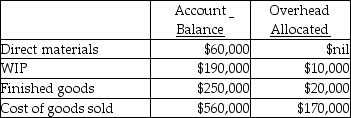 -What is the journal entry used to write-off the difference between allocated and actual overhead directly to cost of goods sold?
 (Multiple Choice)
4.9/5  (87)
(87) The difference between the actual costing and normal costing methods is that actual costing uses a budgeted indirect cost rate while normal costing uses an actual indirect cost rate.
(True/False)
4.9/5 (91)
(91) A local attorney employs ten full-time professionals. The budgeted compensation per employee is $75,000. The maximum billable hours for each client are 200. Clients always receive their full amount of time. All professional labour costs are included in a single direct cost category and are traced to jobs on a per-hour basis. Any other costs are included in a single indirect cost pool, allocated according to professional labour-hours. Budgeted indirect costs for the year are $1,000,000 and the firm had 20 clients.
Required:
a. What is the direct labour budgeted cost rate per hour?
b. What is the indirect cost pool budgeted cost rate per hour?
(Essay)
4.8/5 (89)
(89) Hill Manufacturing uses departmental cost driver rates to apply manufacturing overhead costs to products. Manufacturing overhead costs are applied on the basis of machine hours in the Machining Department and on the basis of direct labour hours in the Assembly Department. At the beginning of 2012, the following estimates were provided for the coming year:
 The accounting records of the company show the following data for Job #846:
 Required:
a. Compute the manufacturing indirect cost allocation rate for each department.
b. Compute the total cost of Job #846.
c. Provide possible reasons why Hill Manufacturing uses two different cost allocation rates.
The accounting records of the company show the following data for Job #846:
Required:
a. Compute the manufacturing indirect cost allocation rate for each department.
b. Compute the total cost of Job #846.
c. Provide possible reasons why Hill Manufacturing uses two different cost allocation rates. (Essay)
4.7/5 (70)
(70) Based on the following data, calculate the actual indirect cost rate, using direct labour hours as the allocation base. 
(Multiple Choice)
4.9/5 (78)
(78) What is the budgeted direct cost rate per hour for professional partner labour?
(Multiple Choice)
4.9/5 (84)
(84) A machine shop has direct materials cost of $1,800,000 direct labour of $4,200,000 (direct labour rate is $50 per hour) and budgeted indirect manufacturing costs of $850,000. Management believes that indirect manufacturing costs increase with direct labour hours. What is the budgeted indirect manufacturing cost rate?
(Multiple Choice)
4.9/5 (87)
(87) Use the information below to answer the following question(s).
Jim's Computer Products manufactures keyboards for computers. In June, the two production departments had budgeted allocation bases of 10,000 machine hours in Department 1 and 5,000 direct manufacturing labour hours in Department 2. The budgeted manufacturing overheads for the month were $34,500 and $37,500, respectively. For Job 501, the actual costs incurred in the two departments were as follows:
 Job 501 incurred 1,000 machine hours in Department 1 and 300 manufacturing labour hours in Department 2. The company uses a budgeted departmental overhead rate for applying overhead to production.
-The difference between actual costing and normal costing is
Job 501 incurred 1,000 machine hours in Department 1 and 300 manufacturing labour hours in Department 2. The company uses a budgeted departmental overhead rate for applying overhead to production.
-The difference between actual costing and normal costing is (Multiple Choice)
5.0/5 (74)
(74) Which of the following is one of the steps used in assigning manufacturing overhead costs to individual jobs?
(Multiple Choice)
4.8/5 (82)
(82) The Work-in-Process Control account tracks job costs from the time jobs are started until they are completed.
(True/False)
4.9/5 (67)
(67) A cost allocation base is only financial in nature, and is usually the cost driver of the particular costs being measured.
(True/False)
4.9/5 (89)
(89) Which of the following would be appropriately costed using a process costing system?
(Multiple Choice)
5.0/5 (78)
(78) The cost driver of an indirect cost is often used as the cost allocation base.
(True/False)
4.9/5 (82)
(82) A local financial consulting firm employs 30 full-time employees. The budgeted compensation per employee is $50,000. The annual maximum chargeable time to each client is 1,000 hours. Clients always receive their full amount of time. All labour costs are included in a single direct-cost category and are traced to jobs on a per-hour basis. Any other costs are included in a single indirect-cost pool, allocated according to professional labour-hours. Budgeted indirect costs for the year are $1,050,000, and the firm expects to have 60 clients during the coming year.
What is the budgeted indirect-cost rate per hour?
(Multiple Choice)
4.9/5 (86)
(86) Which method for dealing with under/over allocated overhead provides the most accurate individual job cost records?
(Multiple Choice)
4.7/5 (62)
(62) A company's manufacturing overhead control account balance at the fiscal period end is a $905,000 debit, its work-in-process control is $75,000, and the manufacturing overhead allocated is $850,000. Direct manufacturing labour was 10,000 hours, and the budget rate is $85 per hour.
Required:
Calculate the total amount of over or underallocated overhead to be adjusted and specify whether the manufacturing overhead control account should be debited or credited for the adjustment.
(Essay)
4.9/5 (73)
(73) Normandeau Company's actual indirect cost pool amounted to $1,400,000 and the direct labour pool was $5,400,000. Overhead is allocated on the basis of direct labour hours. Actual and budgeted direct labour hours were 25,000 and 30,000 for the period. What is the manufacturing overhead cost allocation rate using actual direct labour hours as the cost allocation base?
(Multiple Choice)
4.8/5 (78)
(78) Last week Job # WPP 298 was charged: DM of $4,606; DL of $1,579; and, MOH of $3,960 based on machine hours. The materials requisition record for this week showed an additional purchase of 10 brackets at a unit cost of $16; the direct labour costs were the same as the first week; and, the total machine hours for both weeks are now 140 hours at $45 per machine hour. Calculate the revised total job cost. (direct materials + direct labour + manufacturing overhead).
(Multiple Choice)
4.9/5 (78)
(78) 
Filters
- Essay(0)
- Multiple Choice(0)
- Short Answer(0)
- True False(0)
- Matching(0)