



 Chat with AI
Exam 18: Spoilage, Rework, and Scrap

Exam 1: The Accountants Role in the Organization195 Questions
Exam 2: An Introduction to Cost Terms and Purposes224 Questions
Exam 3: Cost-Volume-Profit Analysis207 Questions
Exam 4: Job Costing199 Questions
Exam 5: Activity-Based Costing and Activity-Based Management175 Questions
Exam 6: Master Budget and Responsibility Accounting229 Questions
Exam 7: Flexible Budgets, Direct-Cost Variances, and Management Control180 Questions
Exam 8: Flexible Budgets, Overhead Cost Variances, and Management Control171 Questions
Exam 9: Inventory Costing and Capacity Analysis208 Questions
Exam 10: Determining How Costs Behave182 Questions
Exam 11: Decision Making and Relevant Information220 Questions
Exam 12: Pricing Decisions and Cost Management210 Questions
Exam 13: Strategy, Balanced Scorecard, and Strategic Profitability Analysis171 Questions
Exam 14: Cost Allocation, Customer-Profitability Analysis, and Sales-Variance Analysis170 Questions
Exam 15: Allocation of Support-Department Costs, Common Costs, and Revenues144 Questions
Exam 16: Cost Allocation: Joint Products and Byproducts125 Questions
Exam 17: Process Costing126 Questions
Exam 18: Spoilage, Rework, and Scrap125 Questions
Exam 19: Balanced Scorecard: Quality, Time, and the Theory of Constraints124 Questions
Exam 20: Inventory Management, Just-In-Time, and Simplified Costing Methods125 Questions
Exam 21: Capital Budgeting and Cost Analysis130 Questions
Exam 22: Management Control Systems, Transfer Pricing, and Multinational Considerations123 Questions
Exam 23: Performance Measurement, Compensation, and Multinational Considerations139 Questions
Select questions type


Distinguish among spoilage, reworked units, and scrap. Give an example of each.
(Essay)
4.7/5  (78)
(78) Answer the following questions using the information below:
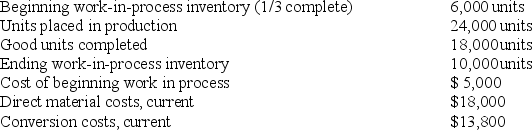
Cartwright Custom Carpentry manufactures chairs in its Processing Department. Direct materials are included at the inception of the production cycle and must be bundled in single kits for each unit. Conversion costs are incurred evenly throughout the production cycle. Inspection takes place as units are placed into production. After inspection, some units are spoiled due to nondetectible material defects. Spoiled units generally constitute 3% of the good units. Data provided for March 20X5 are as follows:


 Costs:
 -What costs are allocated to the ending work-in-process inventory for direct materials and conversion costs, respectively, using the FIFO method of process costing?
Costs:
-What costs are allocated to the ending work-in-process inventory for direct materials and conversion costs, respectively, using the FIFO method of process costing? (Multiple Choice)
4.7/5 (86)
(86) For each of the following (actual real-world examples), develop products that can be sold from the listed scrap.
a. The Federal Reserve Banks destroy old money. Burning this money is usually forbidden under the environmental laws of most municipalities.
b. A manufacturer of cotton undergarments for prisoners has much cotton left over. The manufacturer is located in a very rural area of Alabama.
c. A hog renderer has hog bristles as a result of the slaughtering process.
(Essay)
4.8/5 (85)
(85) Managers often cite reductions in the costs of spoilage as a(n):
(Multiple Choice)
4.8/5 (70)
(70) Normal spoilage is spoilage that is NOT considered to be inherent in a production process.
(True/False)
4.9/5 (90)
(90) Harriet has been reviewing the accounting system for her company and she is very concerned about the accounting for spoilage. It appears that spoilage is accounted for only at the end of the processing cycle. While this concept is acceptable in general, Harriet believes that a better method can be found to properly account for the spoilage when it occurs. She believes that there must be something better than the weighted-average method of accounting for spoilage. She would like the company to use a method that provides closer tracking of the spoilage with the accounting for the spoilage.
Required:
Discuss the problems Harriet is having with the accounting system.
(Essay)
4.8/5 (74)
(74) Unacceptable units of production that are subsequently repaired and sold as acceptable finished goods are:
(Multiple Choice)
4.8/5 (74)
(74) You are the chief financial officer of a lumber mill, and you are becoming quite concerned about the spoilage, scrap, and reworked items associated with your production processes. Your firm produces mainly products for the building industry.
Required:
Discuss the problems associated with these items and the methods your company can use to reduce spoilage, scrap, and reworked items.
(Essay)
4.8/5 (74)
(74) The costs of normal spoilage are allocated to the units in ending work-in-process inventory, in addition to completed units if the units:
(Multiple Choice)
4.9/5 (80)
(80) Answer the following questions using the information below:
Samantha's Office Supplies manufactures desk organizers in its Processing Department. Direct materials are included at the inception of the production cycle and must be bundled in single kits for each unit. Conversion costs are incurred evenly throughout the production cycle. Inspection takes place as units are placed into production. After inspection, some units are spoiled due to nondetectible material defects. Spoiled units generally constitute 4% of the good units. Data provided for February 2012 are as follows:


 Costs:
 -What are the total costs of all the units that were started during February and subsequently shipped before the end of the period?
Costs:
-What are the total costs of all the units that were started during February and subsequently shipped before the end of the period? (Multiple Choice)
4.8/5 (73)
(73) Answer the following questions using the information below:
Fish Fillet Incorporated obtains fish and then processes them into frozen fillets and then prepares the frozen fish fillets for distribution to its retail sales department. Direct materials are added at the initiation of the cycle. Conversion costs are incurred evenly throughout the production cycle. Before inspection, some fillets are spoiled due to nondetectible defects. Inspection occurs when units are 50% converted. Spoiled fillets generally constitute 3.5% of the good fillets. Data for April 2012 are as follows:
 Costs for April:
 -What is the total cost per equivalent unit using the weighted-average method of process costing?
Costs for April:
-What is the total cost per equivalent unit using the weighted-average method of process costing? (Multiple Choice)
4.9/5 (85)
(85) Answer the following questions using the information below:
Samantha's Office Supplies manufactures desk organizers in its Processing Department. Direct materials are included at the inception of the production cycle and must be bundled in single kits for each unit. Conversion costs are incurred evenly throughout the production cycle. Inspection takes place as units are placed into production. After inspection, some units are spoiled due to nondetectible material defects. Spoiled units generally constitute 4% of the good units. Data provided for February 2012 are as follows:
Costs:
-What are the normal and abnormal spoilage units, respectively, for February when using FIFO?
Costs:
-What are the normal and abnormal spoilage units, respectively, for February when using FIFO? (Multiple Choice)
4.9/5 (75)
(75) New Image Sports uses a process-costing system. For March, the company had the following activities:
 Direct materials are placed into production at the beginning of the process. All spoilage is normal and is detected at the end of the process. Ending WIP is 50% completed as to conversion.
Required:
Prepare a production cost worksheet using the FIFO method.
Direct materials are placed into production at the beginning of the process. All spoilage is normal and is detected at the end of the process. Ending WIP is 50% completed as to conversion.
Required:
Prepare a production cost worksheet using the FIFO method. (Essay)
4.9/5 (81)
(81) Spoilage is typically assumed to occur at the stage of completion where inspection takes place.
(True/False)
4.7/5 (87)
(87) Answer the following questions using the information below:
Fish Fillet Incorporated obtains fish and then processes them into frozen fillets and then prepares the frozen fish fillets for distribution to its retail sales department. Direct materials are added at the initiation of the cycle. Conversion costs are incurred evenly throughout the production cycle. Before inspection, some fillets are spoiled due to nondetectible defects. Inspection occurs when units are 50% converted. Spoiled fillets generally constitute 3.5% of the good fillets. Data for April 2012 are as follows:
Costs for April:
-What cost is allocated to abnormal spoilage using the weighted-average process-costing method?
Costs for April:
-What cost is allocated to abnormal spoilage using the weighted-average process-costing method? (Multiple Choice)
4.8/5 (84)
(84) Answer the following questions using the information below:
Samantha's Office Supplies manufactures desk organizers in its Processing Department. Direct materials are included at the inception of the production cycle and must be bundled in single kits for each unit. Conversion costs are incurred evenly throughout the production cycle. Inspection takes place as units are placed into production. After inspection, some units are spoiled due to nondetectible material defects. Spoiled units generally constitute 4% of the good units. Data provided for February 2012 are as follows:
Costs:
-What are the total costs of all the units that were initially in the beginning work-in-process inventory and were subsequently shipped? Take into account the costs related to the completion of the conversion of the units during the month. Use the FIFO method of process costing.
Costs:
-What are the total costs of all the units that were initially in the beginning work-in-process inventory and were subsequently shipped? Take into account the costs related to the completion of the conversion of the units during the month. Use the FIFO method of process costing. (Multiple Choice)
4.8/5 (90)
(90) Normal spoilage is computed on the basis of the number of:
(Multiple Choice)
4.9/5 (85)
(85) 
Filters
- Essay(0)
- Multiple Choice(0)
- Short Answer(0)
- True False(0)
- Matching(0)