



 Chat with AI
Exam 13: Strategy, Balanced Scorecard, and Strategic Profitability Analysis

Exam 1: The Accountants Role in the Organization195 Questions
Exam 2: An Introduction to Cost Terms and Purposes224 Questions
Exam 3: Cost-Volume-Profit Analysis207 Questions
Exam 4: Job Costing199 Questions
Exam 5: Activity-Based Costing and Activity-Based Management175 Questions
Exam 6: Master Budget and Responsibility Accounting229 Questions
Exam 7: Flexible Budgets, Direct-Cost Variances, and Management Control180 Questions
Exam 8: Flexible Budgets, Overhead Cost Variances, and Management Control171 Questions
Exam 9: Inventory Costing and Capacity Analysis208 Questions
Exam 10: Determining How Costs Behave182 Questions
Exam 11: Decision Making and Relevant Information220 Questions
Exam 12: Pricing Decisions and Cost Management210 Questions
Exam 13: Strategy, Balanced Scorecard, and Strategic Profitability Analysis171 Questions
Exam 14: Cost Allocation, Customer-Profitability Analysis, and Sales-Variance Analysis170 Questions
Exam 15: Allocation of Support-Department Costs, Common Costs, and Revenues144 Questions
Exam 16: Cost Allocation: Joint Products and Byproducts125 Questions
Exam 17: Process Costing126 Questions
Exam 18: Spoilage, Rework, and Scrap125 Questions
Exam 19: Balanced Scorecard: Quality, Time, and the Theory of Constraints124 Questions
Exam 20: Inventory Management, Just-In-Time, and Simplified Costing Methods125 Questions
Exam 21: Capital Budgeting and Cost Analysis130 Questions
Exam 22: Management Control Systems, Transfer Pricing, and Multinational Considerations123 Questions
Exam 23: Performance Measurement, Compensation, and Multinational Considerations139 Questions
Select questions type


When analyzing the change in operating income, the strategy component of productivity will increase when:
(Multiple Choice)
4.9/5  (74)
(74) Which of the following is NOT true of the balanced scorecard?
(Multiple Choice)
4.8/5 (84)
(84) Which component of strategy measures the reduction in costs attributable to a reduction in the quantity of inputs used in Year 2 relative to the quantity of inputs that would have been used in Year 1 to produce the Year 2 output?
(Multiple Choice)
4.8/5 (80)
(80) Identify the best description of the balanced scorecard's financial perspective. To achieve our firm's vision and strategy:
(Multiple Choice)
4.8/5 (94)
(94) Answer the following questions using the information below:
Meale Company makes a household appliance with model number X500. The goal for 2012 is to reduce direct materials usage per unit. No defective units are currently produced. Manufacturing conversion costs depend on production capacity defined in terms of X500 units that can be produced. The industry market size for appliances increased 10% from 2011 to 2012. The following additional data are available for 2011 and 2012:
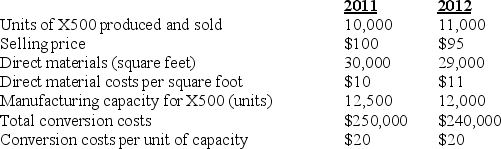 -Which strategy is Meale's Corporation pursuing?
 (Multiple Choice)
4.9/5 (82)
(82) Answer the following questions using the information below:
Wingard Company makes a household appliance with model number X200. The goal for 2012 is to reduce direct materials usage per unit. No defective units are currently produced. Manufacturing conversion costs depend on production capacity defined in terms of X200 units that can be produced. The industry market size for appliances increased 10% from 2011 to 2012. The following additional data are available for 2011 and 2012:
 -Overall, was Wingard's strategy successful for 2012?
 (Multiple Choice)
4.8/5 (74)
(74) The customer perspective of the balanced scorecard evaluates the profitability of the strategy.
(True/False)
4.9/5 (81)
(81) Successful implementation of a product differentiation strategy will result in:
(Multiple Choice)
4.8/5 (65)
(65) Michael Company provided the following information: 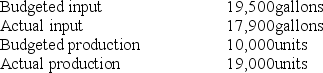 What is the partial productivity ratio?
 (Multiple Choice)
4.7/5 (81)
(81) In general, profit potential increases with greater competition, stronger potential entrants, products that are similar, and tougher customers and suppliers.
(True/False)
5.0/5 (76)
(76) Can a company identify unused capacity and, if so, how can unused capacity be managed?
(Essay)
4.7/5 (71)
(71) To evaluate the success of its strategy, a company can subdivide the change in operating income into growth, price-recovery, and productivity components.
(True/False)
4.8/5 (66)
(66) Answer the following questions using the information below:
Merrill Company makes a household appliance with model number X800. The goal for 2012 is to reduce direct materials usage per unit. No defective units are currently produced. Manufacturing conversion costs depend on production capacity defined in terms of X800 units that can be produced. The industry market size for appliances increased 5% from 2011 to 2012. The following additional data are available for 2011 and 2012:
 -What is the revenue effect of the growth component?
 (Multiple Choice)
4.8/5 (81)
(81) Answer the following questions using the information below:
Following a strategy of product differentiation, Loftus Company makes a high-end Appliance, AP15. Loftus Company presents the following data for the years 2011 and 2012:
 Loftus Company produces no defective units but it wants to reduce direct materials usage per unit of AP15 in 2012. Manufacturing conversion costs in each year depend on production capacity defined in terms of AP15 units that can be produced. Selling and customer-service costs depend on the number of customers that the customer and service functions are designed to support. Loftus Company has 46 customers in 2011 and 50 customers in 2012. The industry market size for high-end appliances increased 5% from 2011 to 2012.
-What is the net effect on operating income as a result of the growth component?
Loftus Company produces no defective units but it wants to reduce direct materials usage per unit of AP15 in 2012. Manufacturing conversion costs in each year depend on production capacity defined in terms of AP15 units that can be produced. Selling and customer-service costs depend on the number of customers that the customer and service functions are designed to support. Loftus Company has 46 customers in 2011 and 50 customers in 2012. The industry market size for high-end appliances increased 5% from 2011 to 2012.
-What is the net effect on operating income as a result of the growth component? (Multiple Choice)
4.7/5 (86)
(86) The price-recovery component measures the increase in operating income from selling more units of a product.
(True/False)
4.8/5 (81)
(81) Answer the following questions using the information below:
Following a strategy of product differentiation, Loftus Company makes a high-end Appliance, AP15. Loftus Company presents the following data for the years 2011 and 2012:
Loftus Company produces no defective units but it wants to reduce direct materials usage per unit of AP15 in 2012. Manufacturing conversion costs in each year depend on production capacity defined in terms of AP15 units that can be produced. Selling and customer-service costs depend on the number of customers that the customer and service functions are designed to support. Loftus Company has 46 customers in 2011 and 50 customers in 2012. The industry market size for high-end appliances increased 5% from 2011 to 2012.
-What is the net effect on operating income as a result of the productivity component?
Loftus Company produces no defective units but it wants to reduce direct materials usage per unit of AP15 in 2012. Manufacturing conversion costs in each year depend on production capacity defined in terms of AP15 units that can be produced. Selling and customer-service costs depend on the number of customers that the customer and service functions are designed to support. Loftus Company has 46 customers in 2011 and 50 customers in 2012. The industry market size for high-end appliances increased 5% from 2011 to 2012.
-What is the net effect on operating income as a result of the productivity component? (Multiple Choice)
4.9/5 (84)
(84) The internal business processes perspective of the balanced scorecard comprises three subprocesses that address all of the following EXCEPT:
(Multiple Choice)
4.9/5 (85)
(85) Reengineering benefits are most significant when they focus on one business function rather than crossing functional lines of the business process.
(True/False)
5.0/5 (87)
(87) 
Filters
- Essay(0)
- Multiple Choice(0)
- Short Answer(0)
- True False(0)
- Matching(0)