



 Chat with AI
Exam 3: Cost-Volume-Profit Analysis

Exam 1: The Accountants Role in the Organization195 Questions
Exam 2: An Introduction to Cost Terms and Purposes224 Questions
Exam 3: Cost-Volume-Profit Analysis207 Questions
Exam 4: Job Costing199 Questions
Exam 5: Activity-Based Costing and Activity-Based Management175 Questions
Exam 6: Master Budget and Responsibility Accounting229 Questions
Exam 7: Flexible Budgets, Direct-Cost Variances, and Management Control180 Questions
Exam 8: Flexible Budgets, Overhead Cost Variances, and Management Control171 Questions
Exam 9: Inventory Costing and Capacity Analysis208 Questions
Exam 10: Determining How Costs Behave182 Questions
Exam 11: Decision Making and Relevant Information220 Questions
Exam 12: Pricing Decisions and Cost Management210 Questions
Exam 13: Strategy, Balanced Scorecard, and Strategic Profitability Analysis171 Questions
Exam 14: Cost Allocation, Customer-Profitability Analysis, and Sales-Variance Analysis170 Questions
Exam 15: Allocation of Support-Department Costs, Common Costs, and Revenues144 Questions
Exam 16: Cost Allocation: Joint Products and Byproducts125 Questions
Exam 17: Process Costing126 Questions
Exam 18: Spoilage, Rework, and Scrap125 Questions
Exam 19: Balanced Scorecard: Quality, Time, and the Theory of Constraints124 Questions
Exam 20: Inventory Management, Just-In-Time, and Simplified Costing Methods125 Questions
Exam 21: Capital Budgeting and Cost Analysis130 Questions
Exam 22: Management Control Systems, Transfer Pricing, and Multinational Considerations123 Questions
Exam 23: Performance Measurement, Compensation, and Multinational Considerations139 Questions
Select questions type


The selling price per unit less the variable cost per unit is the:
(Multiple Choice)
4.8/5  (62)
(62) Sensitivity analysis helps to evaluate the risk associated with decisions.
(True/False)
4.7/5 (91)
(91) ________ is the process of varying key estimates to identify those estimates that are the most critical to a decision.
(Multiple Choice)
4.9/5 (78)
(78) If a company increases fixed costs, then the breakeven point will be lower.
(True/False)
4.8/5 (86)
(86) If the selling price per unit of a product is $50, variable costs per unit are $40, and total fixed costs are $50,000, a company must sell 6,000 units to make a target operating income of $10,000.
(True/False)
4.8/5 (78)
(78) To perform cost-volume-profit analysis, a company must be able to separate costs into fixed and variable components.
(True/False)
4.8/5 (65)
(65) Sales total $200,000 when variable costs total $150,000 and fixed costs total $30,000. The breakeven point in sales dollars is:
(Multiple Choice)
4.7/5 (100)
(100) Answer the following questions using the information below:
Bush Manufacturing produces a single product that sells for $100. Variable costs per unit equal $25. The company expects total fixed costs to be $60,000 for the next month at the projected sales level of 1,000 units. In an attempt to improve performance, management is considering a number of alternative actions. Each situation is to be evaluated separately.
-Suppose that management believes that a 20% reduction in the selling price will result in a 20% increase in sales. If this proposed reduction in selling price is implemented:
(Multiple Choice)
4.8/5 (74)
(74) Berhannan's Cellular sells phones for $100. The unit variable cost per phone is $50 plus a selling commission of 10%. Fixed manufacturing costs total $1,250 per month, while fixed selling and administrative costs total $2,500.
Required:
a. What is the contribution margin per phone?
b. What is the breakeven point in phones?
c. How many phones must be sold to earn pretax income of $7,500?
(Essay)
4.9/5 (74)
(74) What is meant by the term breakeven point? Why should a manager be concerned about the breakeven point?
(Essay)
4.9/5 (84)
(84) Freddie's company has mostly fixed costs and Valerie's company has mostly variable costs. Which company has the greatest risk of a net loss? Explain why
(Essay)
4.9/5 (87)
(87) To calculate the breakeven point in a multiproduct situation, one must assume that the sales mix of the various products remains constant.
(True/False)
4.9/5 (89)
(89) Answer the following questions using the information below:
Northenscold Company sells several products. Information of average revenue and costs is as follows:
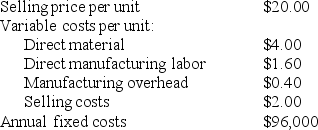 -All of the following are assumed in the above analysis EXCEPT:
 (Multiple Choice)
4.7/5 (89)
(89) Assume there is a reduction in the selling price and all other CVP parameters remain constant. This change will:
(Multiple Choice)
4.8/5 (79)
(79) Answer the following questions using the information below:
Northenscold Company sells several products. Information of average revenue and costs is as follows:
-The contribution margin per unit is:
-The contribution margin per unit is: (Multiple Choice)
5.0/5 (75)
(75) Explain when a manager would use cost-volume-profit analysis and sensitivity analysis.
(Essay)
4.7/5 (86)
(86) Dolph and Evan started the DE Restaurant in 20X3. They rented a building, bought equipment, and hired two employees to work full time at a fixed monthly salary. Utilities and other operating charges remain fairly constant during each month.
During the past two years, the business has grown with average sales increasing 1% a month. This situation pleases both Dolph and Evan, but they do not understand how sales can grow by 1% a month while profits are increasing at an even faster pace. They are afraid that one day they will wake up to increasing sales but decreasing profits.
Required:
Explain why the profits have increased at a faster rate than sales. Use the terms variable costs and fixed costs in your response.
(Essay)
4.8/5 (68)
(68) Answer the following questions using the information below:
The following information is for Nichols Company:
 -The number of units that Nichols Company must sell to reach targeted operating income of $30,000 is:
 (Multiple Choice)
4.8/5 (76)
(76) 
Filters
- Essay(0)
- Multiple Choice(0)
- Short Answer(0)
- True False(0)
- Matching(0)