



 Chat with AI
Exam 9: Accounting for Receivables

Exam 1: Accounting in Business298 Questions
Exam 2: Analyzing and Recording Transactions253 Questions
Exam 3: Adjusting Accounts and Preparing Financial Statements247 Questions
Exam 4: Completing the Accounting Cycle186 Questions
Exam 5: Accounting for Merchandising Operations258 Questions
Exam 6: Inventories and Cost of Sales232 Questions
Exam 7: Accounting Information Systems177 Questions
Exam 8: Cash and Internal Controls220 Questions
Exam 9: Accounting for Receivables217 Questions
Exam 10: Plant Assets Natural Resoures and Intangibles245 Questions
Exam 11: Current Liabilities and Payroll Accounting210 Questions
Exam 12: Accounting for Partnerships172 Questions
Exam 13: Accounting for Corporations228 Questions
Exam 14: Long-Term Liabilities234 Questions
Exam 15: Investments220 Questions
Exam 16: Reporting the Statement of Cash Flows237 Questions
Exam 17: Analysis of Financial Statements235 Questions
Exam 18: Managerial Accounting Concepts and Principles246 Questions
Exam 19: Job Order Costing213 Questions
Exam 20: Process Costing230 Questions
Exam 21: Cost-Volume-Profit Analysis244 Questions
Exam 22: Master Budgets and Planning216 Questions
Exam 23: Flexible Budgets and Standard Costs223 Questions
Exam 24: Performance Measurement and Responsibility Accounting208 Questions
Exam 25: Capital Budgeting and Managerial Decisions190 Questions
Exam 26: Present and Future Values in Accounting84 Questions
Exam 27: Activity-Based Costing70 Questions
Select questions type


The expense recognition (matching) principle requires that accrued interest on outstanding notes receivable be recorded at the end of each accounting period.
(True/False)
4.8/5  (70)
(70) A company received a $15,000, 90-day, 10% note receivable. The journal entry to record receipt of the note includes a debit to Notes Receivable.
(True/False)
4.7/5 (87)
(87) Morgan had net sales of $310,000 and average accounts receivable of $75,600. Its competitor, Stanley, had net sales of $290,000 and average accounts receivables of $61,350. Calculate the accounts receivable turnover for both companies. Which company is doing a better job of managing its accounts receivables?
(Essay)
5.0/5 (86)
(86) White Company allows customers to make purchases on credit. The terms of all credit sales are 2/10, n/30, and all sales are recorded at the gross price. Other customers can use a bank credit card where the bank deducts a 4% service charge for credit card sales and credits the bank account of White immediately when credit card receipts are deposited. White uses the perpetual inventory method. Prepare journal entries to record the following selected transactions and events.
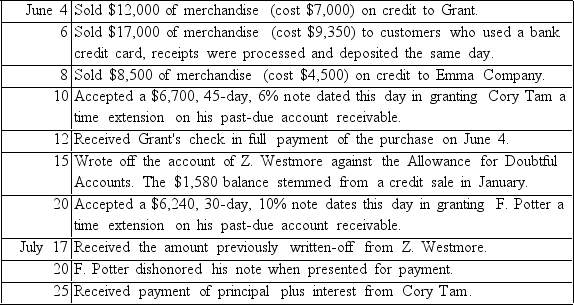
(Essay)
4.8/5 (72)
(72) Flax had net sales of $7,875 and its average accounts receivables is $1,250. Calculate Flax's accounts receivable turnover:
(Essay)
4.9/5 (85)
(85) Reporting the details of notes is consistent with which accounting principle that requires financial statements (including footnotes) to report all relevant information?
(Multiple Choice)
4.7/5 (71)
(71) The banker's rule simplifies interest computations by treating a year as having 365 days.
(True/False)
4.9/5 (79)
(79) Federal laws prohibit the selling of accounts receivables to factors.
(True/False)
4.8/5 (91)
(91) A method of estimating bad debts expense that involves a detailed examination of outstanding accounts and the length of time past due is the:
(Multiple Choice)
4.8/5 (71)
(71) Each December 31, Kimura Company ages its accounts receivable to determine the amount of its adjustment for bad debts. At the end of the current year, management estimated that $16,900 of the accounts receivable balances would be uncollectible. The Allowance for Doubtful Accounts account had a debit balance of $1,200 before any year-end adjustment for bad debts. Prepare the adjusting journal entry that Kimura Company should make on December 31, of the current year, to estimate bad debts expense.
(Essay)
4.8/5 (62)
(62) The advantage of the allowance method of accounting for bad debts is that it identifies the specific customers who will not pay their bills.
(True/False)
4.8/5 (74)
(74) If a 90-day note receivable is dated July 12, what is the maturity date of the note?
(Essay)
4.8/5 (77)
(77) The ________ of a note is the day the principle plus interest of a note must be repaid.
(Short Answer)
4.9/5 (72)
(72) A ________ is a signed agreement to pay a specified amount of money either on demand or at a definite future date.
(Short Answer)
4.8/5 (85)
(85) The Branson Company uses the percent of sales method of accounting for uncollectible accounts receivable. During the current year, the following transactions occurred:
Mar 7 Branson Company determined that the $2,000 account receivable of the Bing Company was uncollectible, and wrote it off.
Jun 9 Bing Company paid $1,500 of the amount owed to the Branson Company. Branson Company does not expect further collections from the Bing Company.
Dec 31 Branson Company estimates that 1.5% of its $900,000 of credit sales will be uncollectible.
Prepare the general journal entries to record these transactions.
(Essay)
4.8/5 (77)
(77) Craigmont uses the allowance method to account for uncollectible accounts. Its year-end unadjusted trial balance shows Accounts Receivable of $104,500, allowance for doubtful accounts of $665 (credit) and sales of $925,000. If uncollectible accounts are estimated to be 0.5% of sales, what is the amount of the bad debts expense adjusting entry?
(Multiple Choice)
4.9/5 (79)
(79) A company factored $30,000 of its accounts receivable and was charged a 2% factoring fee. The journal entry to record this transaction would include a debit to Cash of $30,000, a debit to Factoring Fee Expense of $600, and credit to Accounts Receivable of $30,600.
(True/False)
4.9/5 (67)
(67) Jervis sells $75,000 of its accounts receivable to Northern Bank in order to obtain necessary cash. Northern Bank charges a 5% factoring fee. What entry should Jervis make to record the transaction?
(Multiple Choice)
4.8/5 (80)
(80) The aging of accounts receivable involves classifying each account receivable by how long it is past its due date and estimating the percent of each uncollectible class.
(True/False)
4.7/5 (79)
(79) Winkler Company borrows $85,000 and pledges its receivables as security. The journal entry to record this transaction would be:
(Multiple Choice)
4.9/5 (77)
(77) 
Filters
- Essay(0)
- Multiple Choice(0)
- Short Answer(0)
- True False(0)
- Matching(0)