



 Chat with AI
Exam 20: Process Costing

Exam 1: Accounting in Business298 Questions
Exam 2: Analyzing and Recording Transactions253 Questions
Exam 3: Adjusting Accounts and Preparing Financial Statements247 Questions
Exam 4: Completing the Accounting Cycle186 Questions
Exam 5: Accounting for Merchandising Operations258 Questions
Exam 6: Inventories and Cost of Sales232 Questions
Exam 7: Accounting Information Systems177 Questions
Exam 8: Cash and Internal Controls220 Questions
Exam 9: Accounting for Receivables217 Questions
Exam 10: Plant Assets Natural Resoures and Intangibles245 Questions
Exam 11: Current Liabilities and Payroll Accounting210 Questions
Exam 12: Accounting for Partnerships172 Questions
Exam 13: Accounting for Corporations228 Questions
Exam 14: Long-Term Liabilities234 Questions
Exam 15: Investments220 Questions
Exam 16: Reporting the Statement of Cash Flows237 Questions
Exam 17: Analysis of Financial Statements235 Questions
Exam 18: Managerial Accounting Concepts and Principles246 Questions
Exam 19: Job Order Costing213 Questions
Exam 20: Process Costing230 Questions
Exam 21: Cost-Volume-Profit Analysis244 Questions
Exam 22: Master Budgets and Planning216 Questions
Exam 23: Flexible Budgets and Standard Costs223 Questions
Exam 24: Performance Measurement and Responsibility Accounting208 Questions
Exam 25: Capital Budgeting and Managerial Decisions190 Questions
Exam 26: Present and Future Values in Accounting84 Questions
Exam 27: Activity-Based Costing70 Questions
Select questions type


A company uses a process costing system and the weighted average method for inventory costs. The following information is available regarding conversion activities for the current year:
Work in Process, January 1 5,500 units, 80\% complete Work in Process, December 31 7,800 units, 50\% complete
Units completed and transferred to finished goods 46,900 units
Calculate the equivalent units of production for direct labor for the year.
(Essay)
4.7/5  (81)
(81) Direct labor and indirect labor are recorded, respectively, to:
(Multiple Choice)
5.0/5 (79)
(79) A process cost summary shows the cost of a particular job manufactured in the reporting period.
(True/False)
4.8/5 (89)
(89) A system of accounting in which costs are accumulated and then measured per unit at the end of a period by combining costs per equivalent unit from various departments is a:
(Multiple Choice)
4.9/5 (78)
(78) In a process operation, the direct labor of a production department includes:
(Multiple Choice)
4.9/5 (77)
(77) Conversion cost per equivalent unit is the combined costs of direct materials and factory overhead.
(True/False)
4.8/5 (78)
(78) Refer to the following information about the Finishing Department in the Davidson Factory for the month of June. Davidson Factory uses the FIFO method of inventory costing.
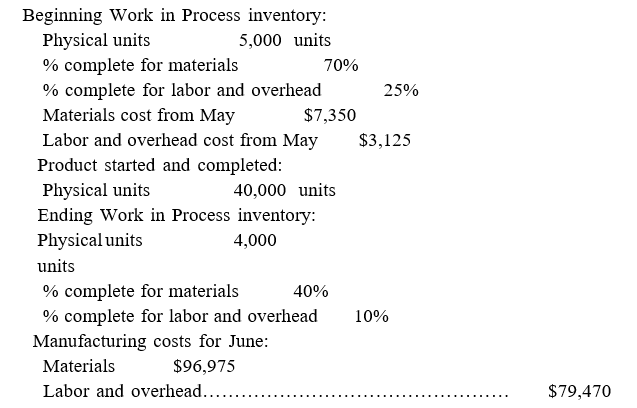 Compute the total cost of all units that were completed and transferred to finished goods during June. Compute the total cost of the ending Work in Process inventory.
 (Essay)
4.8/5 (84)
(84) During the year, LT Corp. introduced 132,000 units into production and 144,000 units were completed and transferred to finished goods. At the end of the year, the company had 13,600 units in process that were 80% complete. Determine how many units the company had in Work in Process at the beginning of the year.
(Essay)
4.9/5 (83)
(83) Richards Corporation uses the FIFO method of process costing. The following information is available for October in its Fabricating Department: Units:
Beginning Inventory: 80,000 units, 60% complete as to materials and 20% complete as to conversion.
Units started and completed: 250,000.
Units completed and transferred out: 330,000.
Ending Inventory: 30,000 units, 40% complete as to materials and 10% complete as to conversion.
Costs:
Costs in beginning Work in Process - Direct Materials: $37,200. Costs in beginning Work in Process - Conversion: $79,700.
Costs incurred in October - Direct Materials: $646,800. Costs incurred in October - Conversion: $919,300.
-
Calculate the cost per equivalent unit of conversion.
(Multiple Choice)
4.8/5 (93)
(93) Process costing systems are commonly used by companies that manufacture standardized products by passing them through a series of manufacturing steps.
(True/False)
4.9/5 (97)
(97) The following journal entry would be made to record the use of $6,100 of direct labor in a production department during the reporting period:
Factory Payroll. 6,100 Goods in Process Inventory 6,100
(True/False)
4.8/5 (75)
(75) The Finishing Department transferred out completed units with a cost of $74,000. This transfer should be recorded with the following entry:

(True/False)
4.8/5 (76)
(76) Wilturner Company incurs $74,000 of labor related directly to the product in the Assembly Department, $23,000 of labor not directly related to the product but related to the Assembly Department as a whole, and $10,000 of labor for services that help production in both the Assembly and Finishing departments. The journal entries to record the labor would include:
(Multiple Choice)
5.0/5 (77)
(77) Following is a partial process cost summary for Mitchell Manufacturing's Canning Department. 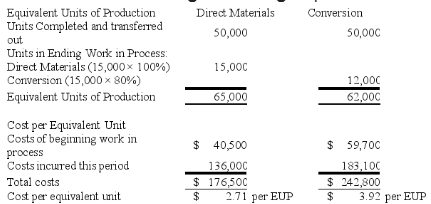 -
If the units completed were transferred to the Labeling Department, what is the appropriate journal entry to transfer the direct materials?
-
If the units completed were transferred to the Labeling Department, what is the appropriate journal entry to transfer the direct materials? (Multiple Choice)
4.9/5 (92)
(92) The following refers to units processed by a breakfast cereal maker in August. Compute the total equivalent units of production with respect to conversion for August using the weighted-average inventory method. Units of Product Percent of Conversion Added Beginning Work in Process 230,000 60\% Units started 570,000 100\% Units completed 620,000 100\% Ending Work in Process 180,000 70\%
(Multiple Choice)
4.7/5 (80)
(80) Equivalent units of production is an engineering term used to describe the process by which one company attempts to manufacture units of a product that are equivalent to the product manufactured by a competitor.
(True/False)
4.8/5 (77)
(77) Sparky Corporation uses the FIFO method of process costing. The following information is available for February in its Molding Department: Units:
Beginning Inventory: 25,000 units, 100% complete as to materials and 55% complete as to conversion.
Units started and completed: 110,000.
Units completed and transferred out: 135,000.
Ending Inventory: 30,000 units, 100% complete as to materials and 30% complete as to conversion.
Costs:
Costs in beginning Work in Process - Direct Materials: $43,000. Costs in beginning Work in Process - Conversion: $48,850.
Costs incurred in February - Direct Materials: $287,000. Costs incurred in February - Conversion: $599,150.
-
Calculate the equivalent units of materials.
(Multiple Choice)
4.8/5 (84)
(84) In a process costing system, the purchase of raw materials is credited to the Raw Materials Inventory.
(True/False)
4.9/5 (76)
(76) Richards Corporation uses the weighted-average method of process costing. The following information is available for October in its Fabricating Department: Units:
Beginning Inventory: 80,000 units, 60% complete as to materials and 20% complete as to conversion.
Units started and completed: 250,000.
Units completed and transferred out: 330,000.
Ending Inventory: 30,000 units, 40% complete as to materials and 10% complete as to conversion.
Costs:
Costs in beginning Work in Process - Direct Materials: $37,200. Costs in beginning Work in Process - Conversion: $79,700.
Costs incurred in October - Direct Materials: $646,800. Costs incurred in October - Conversion: $919,300.
-
Calculate the equivalent units of materials.
(Multiple Choice)
4.9/5 (72)
(72) The following data is available for Donaldson Corp. for the current year: Beginning inventory of Work in Process 12,000 units, 60% completed Ending inventory of Work in Process 18,000 units, 30% completed Units completed and transferred to
finished goods during the year 144,000 units
Calculate the equivalent units of production for the year using the weighted average method.
(Essay)
4.9/5 (83)
(83) 
Filters
- Essay(0)
- Multiple Choice(0)
- Short Answer(0)
- True False(0)
- Matching(0)