



 Chat with AI
Exam 20: Process Costing

Exam 1: Accounting in Business298 Questions
Exam 2: Analyzing and Recording Transactions253 Questions
Exam 3: Adjusting Accounts and Preparing Financial Statements247 Questions
Exam 4: Completing the Accounting Cycle186 Questions
Exam 5: Accounting for Merchandising Operations258 Questions
Exam 6: Inventories and Cost of Sales232 Questions
Exam 7: Accounting Information Systems177 Questions
Exam 8: Cash and Internal Controls220 Questions
Exam 9: Accounting for Receivables217 Questions
Exam 10: Plant Assets Natural Resoures and Intangibles245 Questions
Exam 11: Current Liabilities and Payroll Accounting210 Questions
Exam 12: Accounting for Partnerships172 Questions
Exam 13: Accounting for Corporations228 Questions
Exam 14: Long-Term Liabilities234 Questions
Exam 15: Investments220 Questions
Exam 16: Reporting the Statement of Cash Flows237 Questions
Exam 17: Analysis of Financial Statements235 Questions
Exam 18: Managerial Accounting Concepts and Principles246 Questions
Exam 19: Job Order Costing213 Questions
Exam 20: Process Costing230 Questions
Exam 21: Cost-Volume-Profit Analysis244 Questions
Exam 22: Master Budgets and Planning216 Questions
Exam 23: Flexible Budgets and Standard Costs223 Questions
Exam 24: Performance Measurement and Responsibility Accounting208 Questions
Exam 25: Capital Budgeting and Managerial Decisions190 Questions
Exam 26: Present and Future Values in Accounting84 Questions
Exam 27: Activity-Based Costing70 Questions
Select questions type


During March, the production department of a process operations system completed and transferred to finished goods 25,000 units that were in process at the beginning of March and 110,000 that were started and completed in March. March's beginning inventory units were 100% complete with respect to materials and 55% complete with respect to conversion. At the end of March, 30,000 additional units were in process in the production department and were 100% complete with respect to materials and 30% complete with respect to conversion. Compute the number of equivalent units with respect to both materials and conversion respectively for March using the FIFO method.
(Multiple Choice)
4.9/5  (83)
(83) Process costing is applied to operations with repetitive production and customized products.
(True/False)
4.9/5 (72)
(72) A company uses a process costing system. Its Weaving Department completed and transferred out 120,000 units during the current period. The ending inventory in the Weaving Department consists of 40,000 units (20% complete with respect to direct materials and 60% complete with respect to conversion costs). Determine the equivalent units of production for the Weaving Department for direct materials and conversion costs assuming the weighted average method.
(Multiple Choice)
4.9/5 (96)
(96) Materials and labor costs that are clearly associated with a specific process or department are known as _ . Those costs that are not clearly associated with a specific process or department are called _ _.
(Short Answer)
4.8/5 (75)
(75) The third step in accounting for production activity in a period, before assigning and reconciling costs, is to compute the ________.
(Short Answer)
4.9/5 (74)
(74) Following is a partial process cost summary for Mitchell Manufacturing's Canning Department. 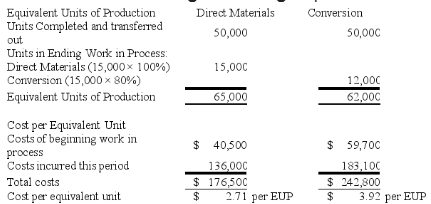 -
The total materials costs transferred out of the Canning Department equals:
-
The total materials costs transferred out of the Canning Department equals: (Multiple Choice)
4.9/5 (83)
(83) The following data are available for a company's manufacturing activities: Beginning Work in Process inventory 5,000 units 75\% completed as to Units started and completed 15,000 conversion Ending Work in Process inventory 6,000 units 50\% completed as to conversion
If materials are added when the production process begins and conversion costs are applied uniformly throughout the process, what are the equivalent units for direct materials and for conversion, respectively using the FIFO method of process costing?
(Multiple Choice)
4.8/5 (87)
(87) If a department that uses process costing starts the reporting period with 100,000 physical units that were 20% complete with respect to direct labor, the equivalent units of direct labor in beginning Work in Process are 20,000.
(True/False)
4.9/5 (73)
(73) Dazzle, Inc. produces beads for jewelry making use. The following information summarizes production operations for June. The journal entry to record June production activities for overhead allocation is: Direct materials used \ 87,000 Direct labor used 160,000 Predetermined overhead rate (based on direct labor) 155\% Goods transferred to finished goods 432,000 Cost of goods sold 444,000 Credit sales 810,000
(Multiple Choice)
4.8/5 (71)
(71) Process costing systems are used only by companies that manufacture physical products; companies that provide services do not use process costing.
(True/False)
4.9/5 (70)
(70) Which of the following is the best explanation for why it is necessary to calculate equivalent units of production in a process costing environment?
(Multiple Choice)
4.9/5 (92)
(92) Refer to the following information about the Finishing Department in the Davidson Factory for the month of June. Davidson Factory uses the FIFO method of inventory costing.
Beginning Work in Process inventory:
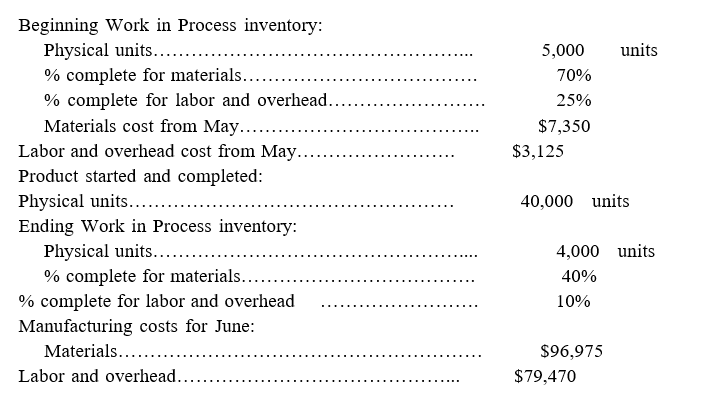 Compute equivalent units for direct materials, direct labor and overhead for June.
 (Essay)
4.9/5 (80)
(80) Richards Corporation uses the weighted-average method of process costing. The following information is available for October in its Fabricating Department: Units:
Beginning Inventory: 80,000 units, 60% complete as to materials and 20% complete as to conversion.
Units started and completed: 250,000.
Units completed and transferred out: 330,000.
Ending Inventory: 30,000 units, 40% complete as to materials and 10% complete as to conversion.
Costs:
Costs in beginning Work in Process - Direct Materials: $37,200. Costs in beginning Work in Process - Conversion: $79,700.
Costs incurred in October - Direct Materials: $646,800. Costs incurred in October - Conversion: $919,300.
-
Calculate the cost per equivalent unit of materials.
(Multiple Choice)
4.8/5 (65)
(65) When the completed goods are sold, the cost of the completed goods are transferred to ________.
(Short Answer)
4.8/5 (85)
(85) If indirect materials costing $37,500 that were not clearly linked with any specific production process or department were used during a reporting period, the following journal entry would be recorded in the process costing system:
Factory Overhead 37,500 Raw Materials Inventory 37,500
(True/False)
4.9/5 (79)
(79) What is meant by equivalent units of production, and why are they important when a process costing system is used?
(Essay)
4.9/5 (92)
(92) A production department's output for the most recent month consisted of 8,000 units completed and transferred to the next stage of production and 5,000 units in ending Work in Process inventory. The units in ending Work in Process inventory were 50% complete with respect to both direct materials and conversion costs. Calculate the equivalent units of production for the month, assuming the company uses the weighted average method.
(Multiple Choice)
4.7/5 (79)
(79) In process costing, indirect materials are always classified as factory overhead, even if they are linked with a specific production process or department.
(True/False)
4.8/5 (85)
(85) Equivalent units of production are always the same as the total number of physical units finished during the period.
(True/False)
4.9/5 (88)
(88) After posting all actual factory overhead and applying factory overhead to production departments in a process costing system,
(Multiple Choice)
4.9/5 (76)
(76) 
Filters
- Essay(0)
- Multiple Choice(0)
- Short Answer(0)
- True False(0)
- Matching(0)