



 Chat with AI
Exam 22: Master Budgets and Planning

Exam 1: Accounting in Business298 Questions
Exam 2: Analyzing and Recording Transactions253 Questions
Exam 3: Adjusting Accounts and Preparing Financial Statements247 Questions
Exam 4: Completing the Accounting Cycle186 Questions
Exam 5: Accounting for Merchandising Operations258 Questions
Exam 6: Inventories and Cost of Sales232 Questions
Exam 7: Accounting Information Systems177 Questions
Exam 8: Cash and Internal Controls220 Questions
Exam 9: Accounting for Receivables217 Questions
Exam 10: Plant Assets Natural Resoures and Intangibles245 Questions
Exam 11: Current Liabilities and Payroll Accounting210 Questions
Exam 12: Accounting for Partnerships172 Questions
Exam 13: Accounting for Corporations228 Questions
Exam 14: Long-Term Liabilities234 Questions
Exam 15: Investments220 Questions
Exam 16: Reporting the Statement of Cash Flows237 Questions
Exam 17: Analysis of Financial Statements235 Questions
Exam 18: Managerial Accounting Concepts and Principles246 Questions
Exam 19: Job Order Costing213 Questions
Exam 20: Process Costing230 Questions
Exam 21: Cost-Volume-Profit Analysis244 Questions
Exam 22: Master Budgets and Planning216 Questions
Exam 23: Flexible Budgets and Standard Costs223 Questions
Exam 24: Performance Measurement and Responsibility Accounting208 Questions
Exam 25: Capital Budgeting and Managerial Decisions190 Questions
Exam 26: Present and Future Values in Accounting84 Questions
Exam 27: Activity-Based Costing70 Questions
Select questions type


Lafayette Company's experience shows that 20% of its sales are for cash and 80% are on credit. An analysis of credit sales shows that 50% are collected in the month following the sale, 45% are collected in the second month, and 5% prove to be uncollectible. Calculate the following.

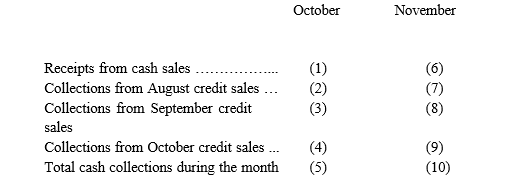
(Essay)
4.9/5  (76)
(76) A company's history indicates that 20% of its sales are for cash and the rest are on credit. Collections on credit sales are 30% in the month of the sale, 50% in the next month, and 15% the following month. Projected sales for January, February, and March are $60,000, $85,000 and $95,000, respectively. The March expected cash receipts from all current and prior credit sales is:
(Multiple Choice)
4.8/5 (72)
(72) Zhang Industries sells a product for $700. Unit sales for May were 400 and each month's sales are expected to exceed the prior month's results by 3%.
- Zhang pays a sales manager a monthly salary of $3,000 and a commission of 2% of sales in dollars. Assume 30% of Zhang's sales are for cash. The remaining 70% are credit sales; these customers pay in the month following the sale. Compute the budgeted cash receipts for June.
(Multiple Choice)
4.9/5 (95)
(95) A master budget refers to a company's sales budget that includes all of its segments or departments.
(True/False)
4.9/5 (79)
(79) Long-term liability data for the budgeted balance sheet is derived from:
(Multiple Choice)
4.8/5 (94)
(94) If budgeted beginning inventory is $8,300, budgeted ending inventory is $9,400, and budgeted cost of goods sold is $10,260, budgeted purchases should be:
(Multiple Choice)
4.8/5 (91)
(91) Snap, Inc., provides the following data for the next four months:
April May June Budgeted production units 442 570 544 Ending Raw Materials Inventory ...... 663 lbs. Ending Finished Goods Inventory ...... 174 Units Desired Ending Inventory:
Raw Materials = 30% of next month's production needs Pounds of raw material required for each finished Unit = 5 lbs.
Required:
Calculate the amount of purchases of raw materials in pounds for April and May.
(Essay)
4.8/5 (92)
(92) The sales budget for Modesto Corp. shows that 20,000 units of Product A and 22,000 units of Product B are going to be sold for prices of $10 and $12, respectively. The desired ending inventory of Product A is 20% higher than its beginning inventory of 2,000 units. The beginning inventory of Product B is 2,500 units.
- The desired ending inventory of B is 3,000 units. Budgeted purchases of Product A for the year would be:
(Multiple Choice)
4.9/5 (86)
(86) The production budget is derived from the sales budget and the company's desired inventory levels.
(True/False)
4.7/5 (91)
(91) Use the following data to determine the company's cash disbursements for August and September:
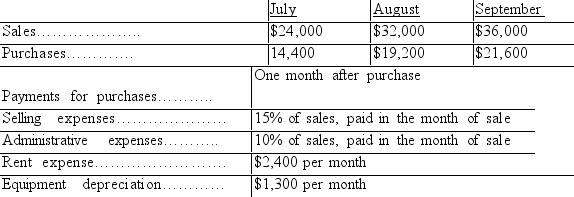
(Essay)
4.7/5 (75)
(75) Aloan Co. provides the following sales forecast for the next three months: Sales units
January February March 3.000 4,200 5,000 The company wants to end each month with ending finished goods inventory equal to 10% of the next month's sales. Finished goods inventory on December 31 is 300 units.
- The budgeted production units for January are:
(Multiple Choice)
4.7/5 (80)
(80) Masterson Company's budgeted production calls for 56,000 liters in April and 52,000 liters in May of a key raw material that costs $1.85 per liter. Each month's ending raw materials inventory should equal 30% of the following month's budgeted materials. The April 1 inventory for this material is 16,800 liters. What is the budgeted materials purchases for April?
(Multiple Choice)
4.7/5 (70)
(70) Webster Corporation is preparing a master budget for the first quarter of the year. The company budgets production of 2,680 units in January, 2,600 units in February and 2,740 units in March. Each unit requires 0.6 hours of direct labor. The direct labor rate is $12 per hour. Compute the budgeted direct labor cost for the first quarter budget.
(Multiple Choice)
4.9/5 (84)
(84) Briefly describe a master budget and the sequence in which the individual budgets within the master budget are prepared.
(Essay)
4.7/5 (84)
(84) Wichita Industries' sales are 10% for cash and 90% on credit. Credit sales are collected as follows: 30% in the month of sale, 50% in the next month, and 20% in the following month. On December 31, the accounts receivable balance includes $12,000 from November sales and $42,000 from December sales. Assume that total sales for January and February are budgeted to be $50,000 and $100,000, respectively. What are the expected cash receipts for February from current and past sales?
(Multiple Choice)
4.9/5 (77)
(77) The merchandise purchases budget is the starting point for preparing the master budget of a merchandiser.
(True/False)
4.8/5 (71)
(71) A plan showing the planned sales units and the revenue to be derived from these sales, and is the usual starting point in the budgeting process, is called the:
(Multiple Choice)
5.0/5 (83)
(83) 
Filters
- Essay(0)
- Multiple Choice(0)
- Short Answer(0)
- True False(0)
- Matching(0)