



 Chat with AI
Exam 22: Master Budgets and Planning

Exam 1: Accounting in Business298 Questions
Exam 2: Analyzing and Recording Transactions253 Questions
Exam 3: Adjusting Accounts and Preparing Financial Statements247 Questions
Exam 4: Completing the Accounting Cycle186 Questions
Exam 5: Accounting for Merchandising Operations258 Questions
Exam 6: Inventories and Cost of Sales232 Questions
Exam 7: Accounting Information Systems177 Questions
Exam 8: Cash and Internal Controls220 Questions
Exam 9: Accounting for Receivables217 Questions
Exam 10: Plant Assets Natural Resoures and Intangibles245 Questions
Exam 11: Current Liabilities and Payroll Accounting210 Questions
Exam 12: Accounting for Partnerships172 Questions
Exam 13: Accounting for Corporations228 Questions
Exam 14: Long-Term Liabilities234 Questions
Exam 15: Investments220 Questions
Exam 16: Reporting the Statement of Cash Flows237 Questions
Exam 17: Analysis of Financial Statements235 Questions
Exam 18: Managerial Accounting Concepts and Principles246 Questions
Exam 19: Job Order Costing213 Questions
Exam 20: Process Costing230 Questions
Exam 21: Cost-Volume-Profit Analysis244 Questions
Exam 22: Master Budgets and Planning216 Questions
Exam 23: Flexible Budgets and Standard Costs223 Questions
Exam 24: Performance Measurement and Responsibility Accounting208 Questions
Exam 25: Capital Budgeting and Managerial Decisions190 Questions
Exam 26: Present and Future Values in Accounting84 Questions
Exam 27: Activity-Based Costing70 Questions
Select questions type


Traditional budgeting is generally better than activity-based budgeting when attempting to reduce costs by eliminating non-value-added activities.
(True/False)
4.9/5  (85)
(85) Ratchet Manufacturing anticipates total sales for August, September, and October of $200,000, $210,000, and $220,500 respectively. Cash sales are normally 25% of total sales and the remaining sales are on credit. All credit sales are collected in the first month after the sale.
-Compute the amount of cash received for September.
(Multiple Choice)
4.9/5 (75)
(75) Larger, more complex organizations usually require a longer time to prepare their budgets than smaller organizations because of the considerable effort to coordinate the different units within the business.
(True/False)
4.8/5 (80)
(80) Briefly describe the process by which budgets are developed and administered.
(Essay)
4.8/5 (59)
(59) Trago Company manufactures a single product and has a JIT policy that ending inventory must equal 5% of the next month's sales. It estimates that May's ending inventory will consist of 14,000 units. June and July sales are estimated to be 280,000 and 290,000 units, respectively.
- Trago assigns variable overhead at a rate of $1.80 per unit of production. Fixed overhead equals $400,000 per month. Compute the number of units to be produced and use this amount to compute the total budgeted overhead that would appear on the factory overhead budget for the month of June.
(Multiple Choice)
4.8/5 (79)
(79) Budgets are normally more effective when all levels of management are involved in the budgeting process.
(True/False)
4.9/5 (69)
(69) A plan that shows the expected cash inflows and cash outflows during the budget period, including receipts from loans needed to maintain a minimum cash balance and repayments of such loans, is called a(n):
(Multiple Choice)
4.9/5 (88)
(88) Calgary Industries is preparing a budgeted income statement for 2018 and has accumulated the following information. Predicted sales for the year are $730,000 and cost of goods sold is 40% of sales. The expected selling expenses are $81,000 and the expected general and administrative expenses are $90,000, which includes $23,000 of depreciation. The company's income tax rate is 30%. The budgeted net income for 2018 is:
(Multiple Choice)
4.9/5 (92)
(92) Webster Corporation is preparing its cash budget for April. The March 31 cash balance is $36,400. Cash receipts are expected to be $641,000 and cash payments for purchases are expected to be $608,500. Other cash expenses expected are $27,000 selling and $33,500 general and administrative. The company desires a minimum cash balance at the end of each month of $30,000. If necessary, the company borrows enough cash to meet the minimum using a short-term note.
-
Webster's preliminary cash balance before loan activity for April is expected to be:
(Multiple Choice)
4.8/5 (77)
(77) Dado, Inc. is preparing its budget for the second quarter. The following sales data have been forecasted:
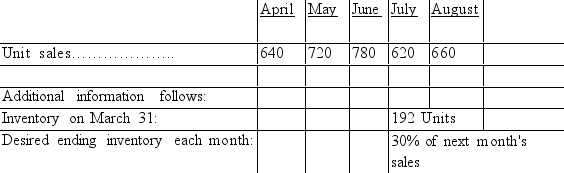 Prepare a merchandise purchases budget for the total units to be purchased in the months of April, May, and June, as well as the total unit purchases for entire the quarter.
 (Essay)
4.9/5 (75)
(75) A manufacturing budget shows dollar amounts estimated to be spent to purchase additional plant assets and amounts expected to be received from plant asset disposals.
(True/False)
4.8/5 (76)
(76) A company's history indicates that 20% of its sales are for cash and the remaining 80% are on credit. Collections on credit sales are 30% in the month of the sale and 70% the following month. Projected sales for January, February, and March are $75,000, $92,000 and $60,000, respectively. The March expected cash receipts are $77,920.
(True/False)
4.9/5 (86)
(86) Budget preparation is best determined in a top-down managerial approach.
(True/False)
4.8/5 (90)
(90) Which of the following factors is least likely to be considered in preparing a sales budget?
(Multiple Choice)
4.9/5 (73)
(73) Oxford, Inc., is preparing its master budget for the quarter ended June 30. It sells a single product for $40 each. Sales are 60% cash and 40% on credit. All credit sales are collected in the month following the sale. At March 31, the balance in accounts receivable is $12,000, which represents the uncollected balance on March sales. Budgeted sales for the next four months follow:
April May June July Sales in Units \ldots\ldots\ldots\ldots 800 1,000 600 1,200 The product cost is $20 per unit, and desired ending inventory is 60% of the following month's sales
in units. Inventory at March 31 is 480 units. Purchases are paid 50% in the month of purchase and 50% in the following month. At March 31, the balance in accounts payable is $11,000, which represents the unpaid purchases from March. Operating expenses are paid in the month incurred and consist of:
· Commissions (10% of sales)
· Shipping (3% of sales)
· Office salaries ($3,000 per month)
· Rent ($5,000 per month)
Depreciation is $2,000 per month. Income taxes are 40%, and will be paid on July 1. There are no taxes payable at March 31. A minimum cash balance of $12,000 is required, and the beginning cash balance is $12,000. Loans are obtained at the end of any month when a cash shortage occurs.
Interest is 1% per month based on the beginning of the month loan balance and is paid at each month end. If the ending cash balance exceeds the minimum, the excess will be applied to repaying any outstanding loan balance. At March 31, the loan balance is $2,000. Prepare a master budget
(round all dollar amounts to the nearest whole dollar) for each of the months of April, May, and June that includes the:
· Sales budget
· Schedule of cash receipts
· Merchandise purchases budget
· Schedule of cash disbursements for purchases of merchandise
· Schedule of cash disbursements for selling and administrative expenses (combined)
· Cash budget, including information on the loan balance
· Budgeted income statement for the quarter
(Essay)
4.8/5 (82)
(82) The production budget for Greski Company revealed the following production volume for the months of July-September. Each unit produced requires 2.5 hours of direct labor. The direct labor rate is predicted to be $16 per hour in all months. Prepare a direct labor budget for Greski Company for July-September. July Aug Sept Units to be produced 620 680 540
(Essay)
4.8/5 (89)
(89) There are at least five benefits from budgeting. Identify two of these benefits: (1) ________
(2) ________
(Short Answer)
4.8/5 (82)
(82) In a company that employs continuous budgeting on a quarterly basis and has an accounting period that ends December 31 of each year, what period would the first revision and update to the January through December 2017 budget cover?
(Multiple Choice)
4.9/5 (86)
(86) 
Filters
- Essay(0)
- Multiple Choice(0)
- Short Answer(0)
- True False(0)
- Matching(0)