



 Chat with AI
Exam 23: Mirrors and Lenses

Exam 1: Introduction32 Questions
Exam 2: Kinematics: Motion in One Dimension162 Questions
Exam 3: Newtonian Mechanics54 Questions
Exam 4: Applying Newtons Laws178 Questions
Exam 5: Circular Motion119 Questions
Exam 6: Impulse and Linear Momentum82 Questions
Exam 7: Work and Energy191 Questions
Exam 8: Extended Bodies at Rest59 Questions
Exam 9: Rotational Motion124 Questions
Exam 10: Gases84 Questions
Exam 11: Static Fluids65 Questions
Exam 12: Fluids in Motion30 Questions
Exam 13: First Law of Thermodynamics119 Questions
Exam 14: Second Law of Thermodynamics70 Questions
Exam 15: Electric Charge force and Energy78 Questions
Exam 16: The Electric Field151 Questions
Exam 17: Dc Circuits225 Questions
Exam 18: Magnetism136 Questions
Exam 19: Electromagnetic Induction99 Questions
Exam 20: Vibrational Motion94 Questions
Exam 21: Mechanical Waves155 Questions
Exam 22: Reflection and Refraction36 Questions
Exam 23: Mirrors and Lenses221 Questions
Exam 24: Wave Optics135 Questions
Exam 25: Electromagnetic Waves79 Questions
Exam 26: Special Relativity124 Questions
Exam 27: Quantum Optics100 Questions
Exam 28: Atomic Physics141 Questions
Exam 29: Nuclear Physics155 Questions
Exam 30: Particle Physics21 Questions
Select questions type


A farsighted boy has a near point at 2.3 m and requires contact lenses to correct his vision to the normal near point.What is the correct choice of lens power for the contact lenses?
(Multiple Choice)
4.9/5  (82)
(82) You have a choice between two lenses of focal lengths fa and fb,where fb = 2fa,to use as the objective lens in building a compound microscope.If the magnification you obtain using lens a is Ma,what will be the magnification when using lens b?
(Multiple Choice)
4.8/5 (92)
(92) An object is placed 60 cm from a convex lens with a focal length of magnitude 10 cm.What is the magnification?
(Multiple Choice)
5.0/5 (88)
(88) What power contact lens should be used to correct the vision of a farsighted person whose near point is 80 cm so she can see things clearly that are 25 cm in front of her?
(Multiple Choice)
4.9/5 (100)
(100) The near point of a farsighted person is 65 cm.What power contact lens must he use to correct this problem and be able to read a book at a normal near point of 25 cm?
(Multiple Choice)
4.9/5 (77)
(77) A lighted candle is placed a short distance from a plane mirror,as shown in the figure.At which location will the image of the flame appear to be located? 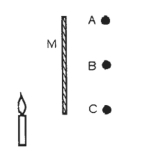
(Multiple Choice)
4.8/5 (86)
(86) You have available lenses of focal lengths 2.0 cm,4.0 cm,8.0 cm,and 16 cm.If you could use any two of these lenses to build a telescope,what is the lens separation for the telescope to provide the maximum magnification for comfortable viewing of a planet?
(Multiple Choice)
4.8/5 (75)
(75) A stature that is 3.0 cm tall statue is 24 cm in front of a concave mirror.The magnitude of the radius of curvature of the mirror is 20 cm.
(a)Is the image real or virtual?
(b)How far is the image from the mirror?
(c)Is the image upright or inverted?
(d)How tall is the image?
(Short Answer)
4.7/5 (74)
(74) A refracting telescope has an eyepiece of focal length -80 mm and an objective of focal length 36 cm.What is the magnification of this instrument?
(Short Answer)
4.9/5 (74)
(74) The focal lengths of the objective lens and the eyepiece of a microscope are 0.50 cm and 2.0 cm,respectively,and their separation adjusted for minimum eyestrain is 6.0 cm.If the microscope is focused on a small object,what is the distance between the object and the objective lens?
(Multiple Choice)
4.8/5 (78)
(78) A compound microscope consists of an objective lens of focal length f0 and an eyepiece that by itself produces an angular magnification 25.0.The microscope is designed so that the object to be viewed is on the left side of the objective lens and is focused in a plane that is 28.00 cm away from the right-hand (or inside)focal point of the objective lens.When properly adjusted,the eyepiece and the objective lens are 29.90 cm apart.The eyepiece magnification is based on an image at infinity and a near point at 25.0 cm.What is f0?
(Short Answer)
4.8/5 (81)
(81) You are given two converging lenses to build a compound microscope.Lens A has focal length 0.50 cm and lens B has focal length of 3.0 cm.Which one of the two lenses would you use for the objective?
(Multiple Choice)
4.7/5 (76)
(76) For relaxed viewing with a microscope or a telescope,the eyepiece is adjusted to place the image at
(Multiple Choice)
4.8/5 (73)
(73) The length of a telescope is 1.60 m and it has a magnification of 60.0.What is the focal length of the eyepiece?
(Multiple Choice)
4.8/5 (73)
(73) A nearsighted person wears contact lenses having a power of -0.15 diopters.What is the person's uncorrected far point?
(Multiple Choice)
4.8/5 (83)
(83) Which one of the following is a characteristic of a compound microscope?
(Multiple Choice)
4.8/5 (71)
(71) The objective lens and the eyepiece of a microscope have focal lengths of 4.0 mm and 25 mm,respectively.The objective produces a real image 30 times the size of the object,with the final image viewed at infinity.The near point of the microscope user is at 25 cm.What is the magnitude of the overall magnification of the microscope?
(Multiple Choice)
4.9/5 (82)
(82) The focal length of the objective lens of a telescope is 75.0 cm,and the eyepiece has a focal length of 6.00 cm.What is the magnification of this telescope?
(Multiple Choice)
4.9/5 (84)
(84) Cal is viewing the Moon with his new telescope,using a 10-mm focal length eyepiece.For greater detail,he wishes to double the magnification of his telescope.An eyepiece having which one of the following characteristics will accomplish this for him?
(Multiple Choice)
5.0/5 (84)
(84) A person cannot see clearly objects more than 70.0 cm away.What power of corrective lens should be prescribed if the glass is to be worn 1.00 cm in front of the eye?
(Multiple Choice)
4.9/5 (87)
(87) 
Filters
- Essay(0)
- Multiple Choice(0)
- Short Answer(0)
- True False(0)
- Matching(0)