



 Chat with AI
Exam 23: Mirrors and Lenses

Exam 1: Introduction32 Questions
Exam 2: Kinematics: Motion in One Dimension162 Questions
Exam 3: Newtonian Mechanics54 Questions
Exam 4: Applying Newtons Laws178 Questions
Exam 5: Circular Motion119 Questions
Exam 6: Impulse and Linear Momentum82 Questions
Exam 7: Work and Energy191 Questions
Exam 8: Extended Bodies at Rest59 Questions
Exam 9: Rotational Motion124 Questions
Exam 10: Gases84 Questions
Exam 11: Static Fluids65 Questions
Exam 12: Fluids in Motion30 Questions
Exam 13: First Law of Thermodynamics119 Questions
Exam 14: Second Law of Thermodynamics70 Questions
Exam 15: Electric Charge force and Energy78 Questions
Exam 16: The Electric Field151 Questions
Exam 17: Dc Circuits225 Questions
Exam 18: Magnetism136 Questions
Exam 19: Electromagnetic Induction99 Questions
Exam 20: Vibrational Motion94 Questions
Exam 21: Mechanical Waves155 Questions
Exam 22: Reflection and Refraction36 Questions
Exam 23: Mirrors and Lenses221 Questions
Exam 24: Wave Optics135 Questions
Exam 25: Electromagnetic Waves79 Questions
Exam 26: Special Relativity124 Questions
Exam 27: Quantum Optics100 Questions
Exam 28: Atomic Physics141 Questions
Exam 29: Nuclear Physics155 Questions
Exam 30: Particle Physics21 Questions
Select questions type


Two thin lenses,one a convex lens and the other a concave lens,are separated by 1.00 m along the same principal axis,as shown in the figure.The magnitude of the focal length of the convex lens is 25 cm,while the magnitude of the focal length of the concave lens is 40 cm.An object 8.25 cm tall is placed 35 cm to the left of the convex lens.
(a)Where is the final image produced by this combination of lenses? (Give your answer relative to the diverging lens.)
(b)Compared to the object,is the final image upright or inverted? Is it real or virtual? 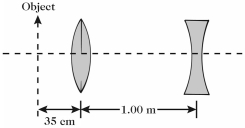
(Short Answer)
4.9/5  (77)
(77) A convex spherical mirror has a focal length of magnitude 20 cm.If an object is placed 10 cm in front of the mirror on the mirror's axis,where is the image located?
(Multiple Choice)
4.9/5 (81)
(81) An object is placed 9.5 cm in front of a convex lens with a focal length of magnitude 24 cm.
(a)Where is the image formed and how far is it from the lens?
(b)What is the magnification produced by the lens?
(Short Answer)
4.9/5 (81)
(81) If you stand in front of a convex mirror,at the same distance from it as its focal length,
(Multiple Choice)
4.9/5 (77)
(77) A 35-mm single lens reflex (SLR)digital camera is using a lens of focal length 35.0 mm to photograph a person who is 1.80 m tall and located 3.60 m from the lens.
(a)How far is the CCD sensor from the lens when the person is in focus?
(b)How tall is the person's image on the CCD sensor?
(Short Answer)
4.9/5 (82)
(82) What power (in diopters)of corrective contact lens is required to correct the vision of a myopic eye whose far point is at 170 cm?
(Short Answer)
4.8/5 (78)
(78) Starting from very far away,an object is moved closer and closer to a concave lens,eventually reaching the lens.What happens to its image formed by that lens? (There could be more than one correct choice.)
(Multiple Choice)
4.9/5 (81)
(81) A beam of light that is parallel to the principal axis strikes a concave mirror.What happens to the reflected beam of light?
(Multiple Choice)
4.8/5 (82)
(82) If a spherical convex mirror has a radius of curvature R,the magnitude of its focal length is
(Multiple Choice)
4.9/5 (64)
(64) The objective lens of a microscope has a focal length of 2.4 mm and the eyepiece has an angular magnification of 15.The object is positioned 0.060 mm beyond the focal point of the objective.The focal point of the eyepiece is positioned at the real image formed by the objective.The near point of the microscope user is at 25 cm.What is the distance between the objective lens and the eyepiece?
(Multiple Choice)
4.9/5 (74)
(74) A myopic (nearsighted)child wears contact lenses that allow her to have clear distant vision.The power of the lenses of her eyeglasses is -3.00 diopters.Without the corrective lenses,what is the far point of the girl?
(Multiple Choice)
4.8/5 (84)
(84) A telescope has an angular magnification of 250 when used with a 20 mm eyepiece.What is the focal length of the objective lens?
(Multiple Choice)
4.8/5 (87)
(87) A convex lens has focal length f.If an object is placed at a distance of 2f from the lens on the principal axis,the image is located at a distance from the lens
(Multiple Choice)
4.9/5 (74)
(74) An object that is 10.0 cm tall is placed 37.0 cm in front of a concave mirror of focal length 18.5 cm.How tall is the image?
(Multiple Choice)
4.8/5 (76)
(76) A simple refracting telescope provides large magnification by employing
(Multiple Choice)
4.8/5 (80)
(80) The objective lens and the eyepiece of a microscope have focal lengths of 4.0 mm and 25 mm,respectively.The objective produces a real image 30 times the size of the object,with the final image viewed at infinity.The near point of the microscope user is at 25 cm.What is the distance between the object and the focal point of the objective lens?
(Multiple Choice)
4.8/5 (79)
(79) A little known fact is that both Robinson Crusoe and Friday wore eyeglasses.As it so happens,Robinson Crusoe was farsighted while Friday was nearsighted.Whose eyeglasses did they use whenever they wanted to start a fire by focusing the sun's rays?
(Multiple Choice)
4.7/5 (71)
(71) What power contact lens must be used to correct the vision of a nearsighted person whose far point is 40 cm?
(Multiple Choice)
4.9/5 (80)
(80) A student constructs an astronomical telescope and wishes it to have a magnification of 10.If the telescope has an objective lens of focal length 0.50 m,what must be the focal length of the eyepiece?
(Multiple Choice)
4.9/5 (77)
(77) Suppose you wanted to start a fire using a mirror to focus sunlight.Which of the following statements is most accurate?
(Multiple Choice)
4.9/5 (89)
(89) 
Filters
- Essay(0)
- Multiple Choice(0)
- Short Answer(0)
- True False(0)
- Matching(0)