



 Chat with AI
Exam 40: Quantum Mechanics

Exam 1: Units,physical Quantities,and Vectors107 Questions
Exam 2: Motion Along a Straight Line59 Questions
Exam 3: Motion in Two or Three Dimensions50 Questions
Exam 4: Newtons Laws of Motion44 Questions
Exam 5: Applying Newtons Laws95 Questions
Exam 6: Work and Kinetic Energy54 Questions
Exam 7: Potential Energy and Energy Conservation55 Questions
Exam 8: Momentum,impulse,and Collisions50 Questions
Exam 9: Rotation of Rigid Bodies26 Questions
Exam 10: Dynamics of Rotational Motion49 Questions
Exam 11: Equilibrium and Elasticity50 Questions
Exam 12: Fluid Mechanics50 Questions
Exam 13: Gravitation50 Questions
Exam 14: Periodic Motion50 Questions
Exam 15: Mechanical Waves44 Questions
Exam 16: Sound and Hearing65 Questions
Exam 17: Temperature and Heat63 Questions
Exam 18: Thermal Properties of Matter58 Questions
Exam 19: The First Law of Thermodynamics52 Questions
Exam 20: The Second Law of Thermodynamics50 Questions
Exam 21: Electric Charge and Electric Field60 Questions
Exam 22: Gausss Law41 Questions
Exam 23: Electric Potential55 Questions
Exam 24: Capacitance and Dielectrics52 Questions
Exam 25: Current,resistance,and Electromotive Force55 Questions
Exam 26: Direct-Current Circuits53 Questions
Exam 27: Magnetic Field and Magnetic Forces42 Questions
Exam 28: Sources of Magnetic Field52 Questions
Exam 29: Electromagnetic Induction39 Questions
Exam 30: Inductance27 Questions
Exam 31: Alternating Current50 Questions
Exam 32: Electromagnetic Waves47 Questions
Exam 33: The Nature and Propagation of Light28 Questions
Exam 34: Geometric Optics81 Questions
Exam 35: Interference33 Questions
Exam 36: Diffraction49 Questions
Exam 37: Relativity51 Questions
Exam 38: Photons: Light Waves Behaving As Particles38 Questions
Exam 39: Particles Behaving As Waves52 Questions
Exam 40: Quantum Mechanics43 Questions
Exam 41: Atomic Structure53 Questions
Exam 42: Molecules and Condensed Matter31 Questions
Exam 43: Nuclear Physics90 Questions
Exam 44: Particle Physics and Cosmology54 Questions
Select questions type


A particle is confined to a one-dimensional box (an infinite well)on the x-axis between  and
 .The potential height of the walls of the box is infinite.The normalized wave function of the particle,which is in the ground state,is given by ψ(x)=
 sin
 ,with
 .What is the probability of finding the particle between x = 0 and x = L/3?
and .The potential height of the walls of the box is infinite.The normalized wave function of the particle,which is in the ground state,is given by ψ(x)= sin ,with .What is the probability of finding the particle between x = 0 and x = L/3? (Multiple Choice)
4.8/5  (88)
(88) An electron is in an infinite square well (a box)that is 2.0 nm wide.The electron makes a transition from the  to the
 state,what is the wavelength of the emitted photon?
 ,mel = 9.11 × 10⁻³¹ kg,1 eV = 1.60 × 10⁻¹⁹)
to the state,what is the wavelength of the emitted photon? ,mel = 9.11 × 10⁻³¹ kg,1 eV = 1.60 × 10⁻¹⁹) (Multiple Choice)
4.9/5 (87)
(87) The wave function of an electron in a rigid box (infinite well)is shown in the figure.If the electron energy 98.0 eV,what is the energy of the electron's ground state? 
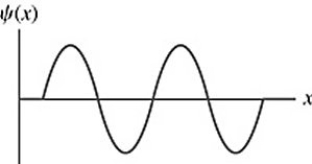
(Multiple Choice)
4.9/5 (89)
(89) The atoms in a nickel crystal vibrate as harmonic oscillators with an angular frequency of 2.3 × 10¹³ rad/s.The mass of a nickel atom is 9.75 × 10⁻²⁶ kg.What is the difference in energy between adjacent vibrational energy levels of nickel? (h = 6.626 × 10⁻³⁴ J • s,
H = 1.055 × 10⁻³⁴ J • s,1 eV = 1.60 × 10⁻¹⁹ J)
(Multiple Choice)
4.8/5 (89)
(89) The wave function for a particle must be normalizable because
(Multiple Choice)
4.8/5 (84)
(84) The energy of a proton is 1.0 MeV below the top of a 1.2-MeV-high energy barrier that is 6.8 fm wide.What is the probability that the proton will tunnel through the barrier?  ,mproton = 1.67 × 10⁻²⁷ kg,h = 1.055 × 10⁻³⁴ J • s,

,mproton = 1.67 × 10⁻²⁷ kg,h = 1.055 × 10⁻³⁴ J • s, (Multiple Choice)
5.0/5 (86)
(86) An electron is confined in a one-dimensional box (an infinite well).Two adjacent allowed energies of the electron are 1.068 × 10⁻¹⁸ J and 1.352 × 10⁻¹⁸ J.What is the length of the box? (h = 6.626 × 10⁻³⁴ J • s,mel = 9.11 × 10⁻³¹ kg)
(Multiple Choice)
4.7/5 (82)
(82) An electron in an infinite potential well (a box)makes a transition from the n = 3 level to the ground state and in so doing emits a photon of wavelength 20.9 nm.(c = 3.00 × 10⁸ m/s,  ,mel = 9.11 × 10⁻³¹ kg)
(a)What is the width of this well?
(b)What wavelength photon would be required to excite the electron from its original level to the next higher one?
,mel = 9.11 × 10⁻³¹ kg)
(a)What is the width of this well?
(b)What wavelength photon would be required to excite the electron from its original level to the next higher one? (Short Answer)
4.9/5 (79)
(79) The wave function for an electron that is confined to x ≥ 0 nm is
ψ(x)= 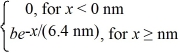 (a)What must be the value of b?
(b)What is the probability of finding the electron in a 0.010 nm-wide region centered at
 ?
(a)What must be the value of b?
(b)What is the probability of finding the electron in a 0.010 nm-wide region centered at ? (Short Answer)
4.9/5 (85)
(85) Calculate the ground state energy of a harmonic oscillator with a classical frequency of 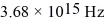 .(1 eV = 1.60 × 10⁻¹⁹ J,h = 1.055 × 10⁻³⁴ J • s,

.(1 eV = 1.60 × 10⁻¹⁹ J,h = 1.055 × 10⁻³⁴ J • s, (Multiple Choice)
4.9/5 (85)
(85) An electron is in an infinite square well that is 2.6 nm wide.What is the smallest value of the state quantum number n for which the energy level exceeds 100 eV?  ,
 ,1 eV = 1.60 × 10⁻¹⁹)
, ,1 eV = 1.60 × 10⁻¹⁹) (Multiple Choice)
4.8/5 (91)
(91) You want to have an electron in an energy level where its speed is no more than 66 m/s.What is the length of the smallest box (an infinite well)in which you can do this?  ,mel = 9.11 × 10⁻³¹ kg)
 (Multiple Choice)
4.8/5 (76)
(76) An electron is in an infinite square well (a box)that is 8.9 nm wide.What is the ground state energy of the electron? (h = 6.626 × 10⁻³⁴ J ∙ s,mel = 9.11 × 10⁻³¹ kg, 
(Multiple Choice)
4.9/5 (69)
(69) An electron is trapped in an infinite square well (a box)of width  Find the wavelength of photons emitted when the electron drops from the n = 5 state to the
 in this system.(c = 3.00 × 10⁸ m/s,h = 6.626 × 10⁻³⁴J • s,mel = 9.11 × 10⁻³¹ kg)
Find the wavelength of photons emitted when the electron drops from the n = 5 state to the in this system.(c = 3.00 × 10⁸ m/s,h = 6.626 × 10⁻³⁴J • s,mel = 9.11 × 10⁻³¹ kg) (Multiple Choice)
4.9/5 (79)
(79) A 3.10-eV electron is incident on a 0.40-nm barrier that is 5.67 eV high.What is the probability that this electron will tunnel through the barrier? (1 eV = 1.60 × 10⁻¹⁹ J,  ,h = 1.055 × 10⁻³⁴ J • s,h = 6.626 × 10⁻³⁴ J • s)
 (Multiple Choice)
4.7/5 (92)
(92) If an atom in a crystal is acted upon by a restoring force that is directly proportional to the distance of the atom from its equilibrium position in the crystal,then it is impossible for the atom to have zero kinetic energy.
(True/False)
4.7/5 (68)
(68) The ground state energy of a particle in a one-dimensional infinite potential well of width  is
 .The ground state energy of the same particle in a one-dimensional finite potential well with
 in the region 0 < x < 1.5 nm,and U0 = 50 eV everywhere else, would be
is .The ground state energy of the same particle in a one-dimensional finite potential well with in the region 0 < x < 1.5 nm,and U0 = 50 eV everywhere else, would be (Multiple Choice)
4.7/5 (82)
(82) Find the wavelength of the photon emitted during the transition from the second EXCITED state to the ground state in a harmonic oscillator with a classical frequency of 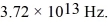 (c = 3.00 × 10⁸ m/s,1 eV = 1.60 × 10⁻¹⁹ J,h = 1.055 × 10⁻³⁴ J • s,

(c = 3.00 × 10⁸ m/s,1 eV = 1.60 × 10⁻¹⁹ J,h = 1.055 × 10⁻³⁴ J • s, (Multiple Choice)
4.9/5 (78)
(78) The square of the wave function of a particle,|ψ(x)|2,gives the probability of finding the particle at the point x.
(True/False)
4.7/5 (85)
(85) The smallest kinetic energy that an electron in a box (an infinite well)can have is zero.
(True/False)
4.8/5 (79)
(79) 
Filters
- Essay(0)
- Multiple Choice(0)
- Short Answer(0)
- True False(0)
- Matching(0)