



 Chat with AI
Exam 22: Gausss Law

Exam 1: Units,physical Quantities,and Vectors107 Questions
Exam 2: Motion Along a Straight Line59 Questions
Exam 3: Motion in Two or Three Dimensions50 Questions
Exam 4: Newtons Laws of Motion44 Questions
Exam 5: Applying Newtons Laws95 Questions
Exam 6: Work and Kinetic Energy54 Questions
Exam 7: Potential Energy and Energy Conservation55 Questions
Exam 8: Momentum,impulse,and Collisions50 Questions
Exam 9: Rotation of Rigid Bodies26 Questions
Exam 10: Dynamics of Rotational Motion49 Questions
Exam 11: Equilibrium and Elasticity50 Questions
Exam 12: Fluid Mechanics50 Questions
Exam 13: Gravitation50 Questions
Exam 14: Periodic Motion50 Questions
Exam 15: Mechanical Waves44 Questions
Exam 16: Sound and Hearing65 Questions
Exam 17: Temperature and Heat63 Questions
Exam 18: Thermal Properties of Matter58 Questions
Exam 19: The First Law of Thermodynamics52 Questions
Exam 20: The Second Law of Thermodynamics50 Questions
Exam 21: Electric Charge and Electric Field60 Questions
Exam 22: Gausss Law41 Questions
Exam 23: Electric Potential55 Questions
Exam 24: Capacitance and Dielectrics52 Questions
Exam 25: Current,resistance,and Electromotive Force55 Questions
Exam 26: Direct-Current Circuits53 Questions
Exam 27: Magnetic Field and Magnetic Forces42 Questions
Exam 28: Sources of Magnetic Field52 Questions
Exam 29: Electromagnetic Induction39 Questions
Exam 30: Inductance27 Questions
Exam 31: Alternating Current50 Questions
Exam 32: Electromagnetic Waves47 Questions
Exam 33: The Nature and Propagation of Light28 Questions
Exam 34: Geometric Optics81 Questions
Exam 35: Interference33 Questions
Exam 36: Diffraction49 Questions
Exam 37: Relativity51 Questions
Exam 38: Photons: Light Waves Behaving As Particles38 Questions
Exam 39: Particles Behaving As Waves52 Questions
Exam 40: Quantum Mechanics43 Questions
Exam 41: Atomic Structure53 Questions
Exam 42: Molecules and Condensed Matter31 Questions
Exam 43: Nuclear Physics90 Questions
Exam 44: Particle Physics and Cosmology54 Questions
Select questions type


At a distance D from a very long (essentially infinite)uniform line of charge,the electric field strength is 1000 N/C.At what distance from the line will the field strength to be 2000 N/C?
(Multiple Choice)
4.9/5  (75)
(75) If a rectangular area is rotated in a uniform electric field from the position where the maximum electric flux goes through it to an orientation where only half the flux goes through it,what has been the angle of rotation?
(Multiple Choice)
4.8/5 (85)
(85) If the electric flux through a closed surface is zero,the electric field at points on that surface must be zero.
(True/False)
5.0/5 (72)
(72) A solid nonconducting sphere of radius R carries a uniform charge density throughout its volume.At a radial distance  from the center,the electric field has a magnitude E0.What is the magnitude of the electric field at a radial distance
 ?
from the center,the electric field has a magnitude E0.What is the magnitude of the electric field at a radial distance ? (Multiple Choice)
4.9/5 (86)
(86) Two concentric conducting spherical shells produce a radially outward electric field of magnitude 49,000 N/C at a point 4.10 m from the center of the shells.The outer surface of the larger shell has a radius of 3.75 m.If the inner shell contains an excess charge of -5.30 μC,find the amount of charge on the outer surface of the larger shell. 
(Short Answer)
4.9/5 (87)
(87) Under electrostatic conditions,the electric field just outside the surface of any charged conductor
(Multiple Choice)
4.9/5 (91)
(91) The cross section of a long coaxial cable is shown in the figure,with radii as given.The linear charge density on the inner conductor is  and the linear charge density on the outer conductor is
 The inner and outer cylindrical surfaces are respectively denoted by A,B,C,and D,as shown.
 The magnitude of the electric field at a point that is
 from the axis is closest to
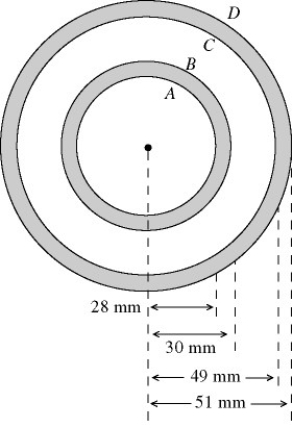
and the linear charge density on the outer conductor is The inner and outer cylindrical surfaces are respectively denoted by A,B,C,and D,as shown. The magnitude of the electric field at a point that is from the axis is closest to (Multiple Choice)
4.9/5 (78)
(78) A hollow conducting spherical shell has radii of 0.80 m and 1.20 m,as shown in the figure.The sphere carries an excess charge of  .A point charge of
 is present at the center.The surface charge density on the inner spherical surface is closest to
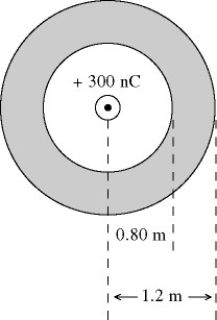
.A point charge of is present at the center.The surface charge density on the inner spherical surface is closest to (Multiple Choice)
4.9/5 (91)
(91) A nonuniform electric field is directed along the x-axis at all points in space.This magnitude of the field varies with x,but not with respect to y or z.The axis of a cylindrical surface,0.80 m long and 0.20 m in diameter,is aligned parallel to the x-axis,as shown in the figure.The electric fields E1 and E2,at the ends of the cylindrical surface,have magnitudes of  and
 respectively,and are directed as shown.What is the net electric flux passing through the cylindrical surface?

and respectively,and are directed as shown.What is the net electric flux passing through the cylindrical surface? (Multiple Choice)
5.0/5 (81)
(81) A nonuniform electric field is directed along the x-axis at all points in space.This magnitude of the field varies with x,but not with respect to y or z.The axis of a cylindrical surface,0.80 m long and 0.20 m in diameter,is aligned parallel to the x-axis,as shown in the figure.The electric fields E1 and E2,at the ends of the cylindrical surface,have magnitudes of  and
 respectively,and are directed as shown.
 The charge enclosed by the cylindrical surface is closest to
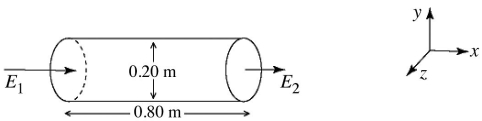
and respectively,and are directed as shown. The charge enclosed by the cylindrical surface is closest to (Multiple Choice)
4.8/5 (66)
(66) As shown in the figure,a square insulating slab 5.0 mm thick measuring  has a charge of
 distributed uniformly throughout its volume.Use Gauss's law to determine the electric field at point P,which is located within the slab beneath its center,1.0 mm from one of the faces.

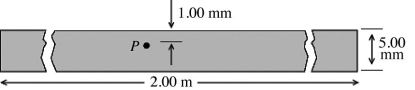
has a charge of distributed uniformly throughout its volume.Use Gauss's law to determine the electric field at point P,which is located within the slab beneath its center,1.0 mm from one of the faces. (Multiple Choice)
4.8/5 (79)
(79) An irregular conductor carries a surface charge density of -6.75 µC/m2 at and in the vicinity of a point P on the surface.An electron is released just above P outside the conductor.What are the magnitude and direction of its acceleration the instant after it is released?  ,
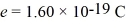 ,

, ,
(Essay)
4.7/5 (82)
(82) Four dipoles,each consisting of a +10-µC charge and a -10-µC charge,are located in the xy-plane with their centers 1.0 mm from the origin,as shown.A sphere passes through the dipoles,as shown in the figure.What is the electric flux through the sphere due to these dipoles? 
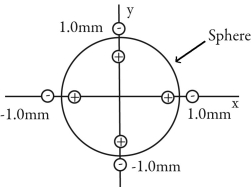
(Multiple Choice)
4.9/5 (82)
(82) A non-conducting sphere of radius R = 7.0 cm carries a charge Q = 4.0 mC distributed uniformly throughout its volume.At what distance,measured from the center of the sphere,does the electric field reach a value equal to half its maximum value?
(Multiple Choice)
4.9/5 (77)
(77) A very large sheet of a conductor carries a uniform charge density of  on its surfaces.What is the electric field strength 3.00 mm outside the surface of the conductor?

on its surfaces.What is the electric field strength 3.00 mm outside the surface of the conductor? (Multiple Choice)
4.9/5 (71)
(71) A charge of 1.0 × 10⁻⁶ μC is located inside a sphere,1.25 cm from its center.What is the electric flux through the sphere due to this charge? 
(Multiple Choice)
4.7/5 (82)
(82) The cube of insulating material shown in the figure has one corner at the origin.Each side of the cube has length 0.080 m so the top face of the cube is parallel to the xz-plane and is at  .It is observed that there is an electric field
 that is in the +y direction and whose magnitude depends only on y.Use Gauss's law to calculate the net charge enclosed by the cube.

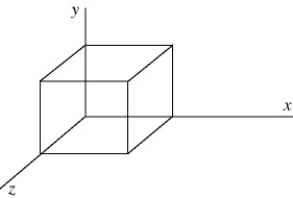
.It is observed that there is an electric field that is in the +y direction and whose magnitude depends only on y.Use Gauss's law to calculate the net charge enclosed by the cube. (Short Answer)
4.8/5 (72)
(72) The figure shows four Gaussian surfaces surrounding a distribution of charges. 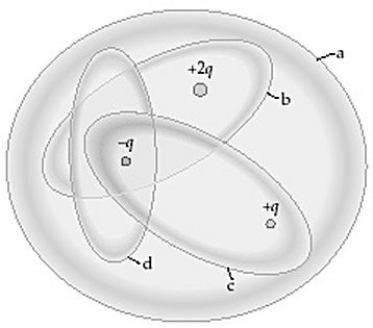 (a)Which Gaussian surfaces have an electric flux of +q/ε0 through them? (b)Which Gaussian surfaces have no electric flux through them?
 (Short Answer)
4.7/5 (73)
(73) Consider a spherical Gaussian surface of radius R centered at the origin.A charge Q is placed inside the sphere.To maximize the magnitude of the flux of the electric field through the Gaussian surface,the charge should be located
(Multiple Choice)
4.9/5 (74)
(74) Two extremely large nonconducting horizontal sheets each carry uniform charge density on the surfaces facing each other.The upper sheet carries  .The electric field midway between the sheets is
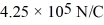 pointing downward.What is the surface charge density on the lower sheet?

.The electric field midway between the sheets is pointing downward.What is the surface charge density on the lower sheet? (Short Answer)
4.8/5 (77)
(77) 
Filters
- Essay(0)
- Multiple Choice(0)
- Short Answer(0)
- True False(0)
- Matching(0)