



 Chat with AI
Exam 21: Electric Charge and Electric Field

Exam 1: Units,physical Quantities,and Vectors107 Questions
Exam 2: Motion Along a Straight Line59 Questions
Exam 3: Motion in Two or Three Dimensions50 Questions
Exam 4: Newtons Laws of Motion44 Questions
Exam 5: Applying Newtons Laws95 Questions
Exam 6: Work and Kinetic Energy54 Questions
Exam 7: Potential Energy and Energy Conservation55 Questions
Exam 8: Momentum,impulse,and Collisions50 Questions
Exam 9: Rotation of Rigid Bodies26 Questions
Exam 10: Dynamics of Rotational Motion49 Questions
Exam 11: Equilibrium and Elasticity50 Questions
Exam 12: Fluid Mechanics50 Questions
Exam 13: Gravitation50 Questions
Exam 14: Periodic Motion50 Questions
Exam 15: Mechanical Waves44 Questions
Exam 16: Sound and Hearing65 Questions
Exam 17: Temperature and Heat63 Questions
Exam 18: Thermal Properties of Matter58 Questions
Exam 19: The First Law of Thermodynamics52 Questions
Exam 20: The Second Law of Thermodynamics50 Questions
Exam 21: Electric Charge and Electric Field60 Questions
Exam 22: Gausss Law41 Questions
Exam 23: Electric Potential55 Questions
Exam 24: Capacitance and Dielectrics52 Questions
Exam 25: Current,resistance,and Electromotive Force55 Questions
Exam 26: Direct-Current Circuits53 Questions
Exam 27: Magnetic Field and Magnetic Forces42 Questions
Exam 28: Sources of Magnetic Field52 Questions
Exam 29: Electromagnetic Induction39 Questions
Exam 30: Inductance27 Questions
Exam 31: Alternating Current50 Questions
Exam 32: Electromagnetic Waves47 Questions
Exam 33: The Nature and Propagation of Light28 Questions
Exam 34: Geometric Optics81 Questions
Exam 35: Interference33 Questions
Exam 36: Diffraction49 Questions
Exam 37: Relativity51 Questions
Exam 38: Photons: Light Waves Behaving As Particles38 Questions
Exam 39: Particles Behaving As Waves52 Questions
Exam 40: Quantum Mechanics43 Questions
Exam 41: Atomic Structure53 Questions
Exam 42: Molecules and Condensed Matter31 Questions
Exam 43: Nuclear Physics90 Questions
Exam 44: Particle Physics and Cosmology54 Questions
Select questions type


When two point charges are a distance d part,the electric force that each one feels from the other has magnitude F.In order to make this force twice as strong,the distance would have to be changed to
(Multiple Choice)
4.8/5  (72)
(72) A very long wire carries a uniform linear charge density of  What is the electric field strength
 from the center of the wire at a point on the wire's perpendicular bisector?

What is the electric field strength from the center of the wire at a point on the wire's perpendicular bisector? (Multiple Choice)
4.7/5 (83)
(83) Three equal negative point charges are placed at three of the corners of a square of side d as shown in the figure.Which of the arrows represents the direction of the net electric field at the center of the square? 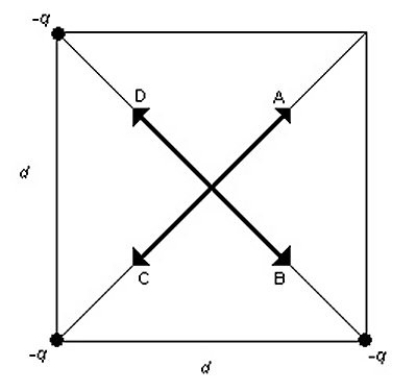
(Multiple Choice)
4.8/5 (74)
(74) A pair of charged conducting plates produces a uniform field of 12,000 N/C,directed to the right,between the plates.The separation of the plates is 40 mm.An electron is projected from plate A,directly toward plate B,with an initial velocity of 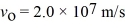 ,as shown in the figure.
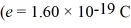 ,ε0 =
 ,
 The velocity of the electron as it strikes plate B is closest to
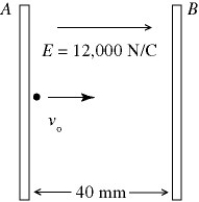
,as shown in the figure. ,ε0 = , The velocity of the electron as it strikes plate B is closest to (Multiple Choice)
4.9/5 (73)
(73) A positive point charge Q is fixed on a very large horizontal frictionless tabletop.A second positive point charge q is released from rest near the stationary charge and is free to move.Which statement best describes the motion of q after it is released?
(Multiple Choice)
4.8/5 (87)
(87) The figure shows two tiny 5.0-g spheres suspended from two very thin 1.0-m-long threads.The spheres repel each other after being charged to  and hang at rest as shown.What is the angle θ? (k = 1/4πε0 =

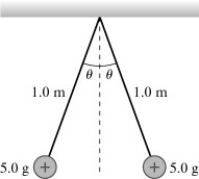
and hang at rest as shown.What is the angle θ? (k = 1/4πε0 = (Multiple Choice)
5.0/5 (72)
(72) What is the minimum magnitude of an electric field that balances the weight of a plastic sphere of mass  that has been charged to

that has been charged to (Multiple Choice)
5.0/5 (68)
(68) At a distance of 4.3 cm from the center of a very long uniformly charged wire,the electric field has magnitude 2000 N/C and is directed toward the wire.What is the charge on a 1.0 cm length of wire near the center? 
(Multiple Choice)
4.9/5 (80)
(80) The point charge at the bottom of the figure is  ,and the curve is a circular arc.What is the magnitude of the force on the charge Q due to the other point charges shown?

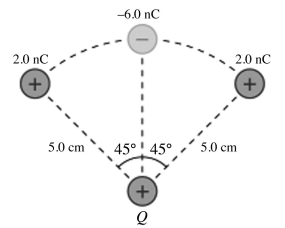
,and the curve is a circular arc.What is the magnitude of the force on the charge Q due to the other point charges shown? (Multiple Choice)
4.9/5 (81)
(81) A 3.0-μC positive point charge is located at the origin and a  positive point charge is located at

 Find the coordinates of the point where the net electric field strength due to these charges is zero.
positive point charge is located at Find the coordinates of the point where the net electric field strength due to these charges is zero. (Multiple Choice)
4.7/5 (91)
(91) An atomic nucleus has a charge of +40e.What is the magnitude of the electric field at a distance of 1.0 m from the center of the nucleus? (k = 1/4πε0 =  ,

, (Multiple Choice)
4.9/5 (86)
(86) The electric field 1.5 cm from a very small charged object points toward the object with a magnitude of 180,000 N/C.What is the charge on the object? 
(Multiple Choice)
4.7/5 (89)
(89) A long,thin rod parallel to the y-axis is located at x = -1.0 cm and carries a uniform linear charge density of +1.0 nC/m.A second long,thin rod parallel to the z-axis is located at  and carries a uniform linear charge density of -1.0 nC/m.What is the net electric field due to these rods at the origin?

and carries a uniform linear charge density of -1.0 nC/m.What is the net electric field due to these rods at the origin? (Multiple Choice)
4.9/5 (79)
(79) A small sphere with a mass of 441 g is moving upward along the vertical +y-axis when it encounters an electric field of 5.00 N/C  .If,due to this field,the sphere suddenly acquires a horizontal acceleration of 13.0 m/s2
 ,what is the charge that it carries?
.If,due to this field,the sphere suddenly acquires a horizontal acceleration of 13.0 m/s2 ,what is the charge that it carries? (Multiple Choice)
4.9/5 (79)
(79) A +7.00 μC point charge and -9.00 μC point charge are placed along the x-axis at x = 0.000 cm and x = 40.0 cm,respectively.Where must a third charge,q,be placed along the x-axis so that it does not experience any net electric force due to the other two charges?
(Multiple Choice)
4.9/5 (73)
(73) Two point charges,Q1 = -1.0 μC and Q2 = + 4.0 μC,are placed as shown in the figure.  The y component of the electric field,at the origin O,is closest to
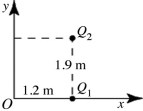
The y component of the electric field,at the origin O,is closest to (Multiple Choice)
4.7/5 (81)
(81) A point charge Q = -500 nC and two unknown point charges,q1 and q2,are placed as shown in the figure.The electric field at the origin O,due to charges Q,q1 and q2,is equal to zero.The charge q1 is closest to 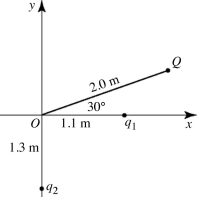
(Multiple Choice)
4.8/5 (78)
(78) A point charge Q of mass 8.50 g hangs from the horizontal ceiling by a light 25.0-cm thread.When a horizontal electric field of magnitude 1750 N/C is turned on,the charge hangs away from the vertical as shown in the figure.The magnitude of Q is closest to 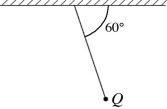
(Multiple Choice)
4.9/5 (79)
(79) In the figure,charge  = 3.1 ×
 C is placed at the origin and charge
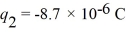 is placed on the x-axis,at x = -0.20 m.Where along the x-axis can a third charge
 be placed such that the resultant force on this third charge is zero?
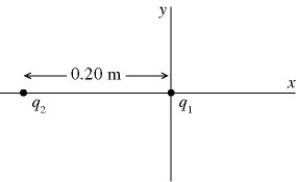
= 3.1 × C is placed at the origin and charge is placed on the x-axis,at x = -0.20 m.Where along the x-axis can a third charge be placed such that the resultant force on this third charge is zero? (Short Answer)
4.9/5 (74)
(74) Two very large,flat plates are parallel to each other.Plate A,located at y = 1.0 cm,is along the xz-plane and carries a uniform surface charge density -1.00 μC/  .Plate B is located at y = -1.0 cm and carries a uniform surface charge density +2.00 μC/
 .What is the electric field vector at the point having x,y,z coordinates (-0.50 cm,0.00 cm,0.00 cm)?

.Plate B is located at y = -1.0 cm and carries a uniform surface charge density +2.00 μC/ .What is the electric field vector at the point having x,y,z coordinates (-0.50 cm,0.00 cm,0.00 cm)? (Multiple Choice)
4.9/5 (71)
(71) 
Filters
- Essay(0)
- Multiple Choice(0)
- Short Answer(0)
- True False(0)
- Matching(0)