



 Chat with AI
Exam 14: Periodic Motion

Exam 1: Units,physical Quantities,and Vectors107 Questions
Exam 2: Motion Along a Straight Line59 Questions
Exam 3: Motion in Two or Three Dimensions50 Questions
Exam 4: Newtons Laws of Motion44 Questions
Exam 5: Applying Newtons Laws95 Questions
Exam 6: Work and Kinetic Energy54 Questions
Exam 7: Potential Energy and Energy Conservation55 Questions
Exam 8: Momentum,impulse,and Collisions50 Questions
Exam 9: Rotation of Rigid Bodies26 Questions
Exam 10: Dynamics of Rotational Motion49 Questions
Exam 11: Equilibrium and Elasticity50 Questions
Exam 12: Fluid Mechanics50 Questions
Exam 13: Gravitation50 Questions
Exam 14: Periodic Motion50 Questions
Exam 15: Mechanical Waves44 Questions
Exam 16: Sound and Hearing65 Questions
Exam 17: Temperature and Heat63 Questions
Exam 18: Thermal Properties of Matter58 Questions
Exam 19: The First Law of Thermodynamics52 Questions
Exam 20: The Second Law of Thermodynamics50 Questions
Exam 21: Electric Charge and Electric Field60 Questions
Exam 22: Gausss Law41 Questions
Exam 23: Electric Potential55 Questions
Exam 24: Capacitance and Dielectrics52 Questions
Exam 25: Current,resistance,and Electromotive Force55 Questions
Exam 26: Direct-Current Circuits53 Questions
Exam 27: Magnetic Field and Magnetic Forces42 Questions
Exam 28: Sources of Magnetic Field52 Questions
Exam 29: Electromagnetic Induction39 Questions
Exam 30: Inductance27 Questions
Exam 31: Alternating Current50 Questions
Exam 32: Electromagnetic Waves47 Questions
Exam 33: The Nature and Propagation of Light28 Questions
Exam 34: Geometric Optics81 Questions
Exam 35: Interference33 Questions
Exam 36: Diffraction49 Questions
Exam 37: Relativity51 Questions
Exam 38: Photons: Light Waves Behaving As Particles38 Questions
Exam 39: Particles Behaving As Waves52 Questions
Exam 40: Quantum Mechanics43 Questions
Exam 41: Atomic Structure53 Questions
Exam 42: Molecules and Condensed Matter31 Questions
Exam 43: Nuclear Physics90 Questions
Exam 44: Particle Physics and Cosmology54 Questions
Select questions type


The simple harmonic motion of an object is described by the graph shown in the figure.What is the equation for the position x(t)of the object as a function of time t? 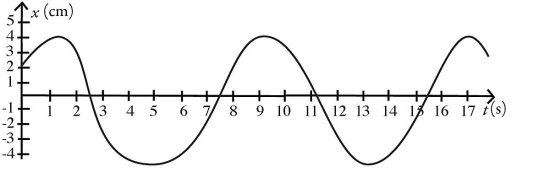
(Multiple Choice)
4.9/5  (84)
(84) A 25 kg object is undergoing lightly damped harmonic oscillations.If the maximum displacement of the object from its equilibrium point drops to 1/3 its original value in 1.8 s,what is the value of the damping constant b?
(Multiple Choice)
4.7/5 (87)
(87) The amplitude of a lightly damped harmonic oscillator decreases from 60.0 cm to 40.0 cm in 10.0 s.What will be the amplitude of the harmonic oscillator after another 10.0 s passes?
(Multiple Choice)
4.7/5 (90)
(90) The position x of an object varies with time t.For which of the following equations relating x and t is the motion of the object simple harmonic motion? (There may be more than one correct choice.)
(Multiple Choice)
4.9/5 (67)
(67) If we double only the amplitude of a vibrating ideal mass-and-spring system,the mechanical energy of the system
(Multiple Choice)
4.8/5 (84)
(84) The position of an object that is oscillating on an ideal spring is given by the equation  .At time
 ,
(a)how fast is the object moving?
(b)what is the magnitude of the acceleration of the object?
.At time ,
(a)how fast is the object moving?
(b)what is the magnitude of the acceleration of the object? (Short Answer)
5.0/5 (78)
(78) A frictionless pendulum clock on the surface of the earth has a period of 1.00 s.On a distant planet,the length of the pendulum must be shortened slightly to have a period of 1.00 s.What is true about the acceleration due to gravity on the distant planet?
(Multiple Choice)
4.8/5 (80)
(80) If we double only the spring constant of a vibrating ideal mass-and-spring system,the mechanical energy of the system
(Multiple Choice)
4.7/5 (78)
(78) A sewing machine needle moves up and down in simple harmonic motion with an amplitude of 1.27 cm and a frequency of 2.55 Hz.
(a)What is the maximum speed of the needle?
(b)What is the maximum acceleration of the needle?
(Short Answer)
4.8/5 (81)
(81) The x component of the velocity of an object vibrating along the x-axis obeys the equation  .
(a)What is the amplitude of the motion of this object?
(b)What is the maximum acceleration of the vibrating object?
.
(a)What is the amplitude of the motion of this object?
(b)What is the maximum acceleration of the vibrating object? (Short Answer)
4.8/5 (80)
(80) 
Filters
- Essay(0)
- Multiple Choice(0)
- Short Answer(0)
- True False(0)
- Matching(0)