



 Chat with AI
Exam 7: Potential Energy and Energy Conservation

Exam 1: Units,physical Quantities,and Vectors107 Questions
Exam 2: Motion Along a Straight Line59 Questions
Exam 3: Motion in Two or Three Dimensions50 Questions
Exam 4: Newtons Laws of Motion44 Questions
Exam 5: Applying Newtons Laws95 Questions
Exam 6: Work and Kinetic Energy54 Questions
Exam 7: Potential Energy and Energy Conservation55 Questions
Exam 8: Momentum,impulse,and Collisions50 Questions
Exam 9: Rotation of Rigid Bodies26 Questions
Exam 10: Dynamics of Rotational Motion49 Questions
Exam 11: Equilibrium and Elasticity50 Questions
Exam 12: Fluid Mechanics50 Questions
Exam 13: Gravitation50 Questions
Exam 14: Periodic Motion50 Questions
Exam 15: Mechanical Waves44 Questions
Exam 16: Sound and Hearing65 Questions
Exam 17: Temperature and Heat63 Questions
Exam 18: Thermal Properties of Matter58 Questions
Exam 19: The First Law of Thermodynamics52 Questions
Exam 20: The Second Law of Thermodynamics50 Questions
Exam 21: Electric Charge and Electric Field60 Questions
Exam 22: Gausss Law41 Questions
Exam 23: Electric Potential55 Questions
Exam 24: Capacitance and Dielectrics52 Questions
Exam 25: Current,resistance,and Electromotive Force55 Questions
Exam 26: Direct-Current Circuits53 Questions
Exam 27: Magnetic Field and Magnetic Forces42 Questions
Exam 28: Sources of Magnetic Field52 Questions
Exam 29: Electromagnetic Induction39 Questions
Exam 30: Inductance27 Questions
Exam 31: Alternating Current50 Questions
Exam 32: Electromagnetic Waves47 Questions
Exam 33: The Nature and Propagation of Light28 Questions
Exam 34: Geometric Optics81 Questions
Exam 35: Interference33 Questions
Exam 36: Diffraction49 Questions
Exam 37: Relativity51 Questions
Exam 38: Photons: Light Waves Behaving As Particles38 Questions
Exam 39: Particles Behaving As Waves52 Questions
Exam 40: Quantum Mechanics43 Questions
Exam 41: Atomic Structure53 Questions
Exam 42: Molecules and Condensed Matter31 Questions
Exam 43: Nuclear Physics90 Questions
Exam 44: Particle Physics and Cosmology54 Questions
Select questions type


When a particle is a distance r from the origin,its potential energy function is given by the equation  ,where k is a constant and
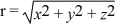 (a)What are the SI units of k?
(b)Find a mathematical expression in terms of x,y,and z for the y component of the force on the particle.
(c)If U = 3.00 J when the particle is 2.00 m from the origin,find the numerical value of the y component of the force on this particle when it is at the point (-1.00 m,2.00 m,3.00 m).
,where k is a constant and (a)What are the SI units of k?
(b)Find a mathematical expression in terms of x,y,and z for the y component of the force on the particle.
(c)If U = 3.00 J when the particle is 2.00 m from the origin,find the numerical value of the y component of the force on this particle when it is at the point (-1.00 m,2.00 m,3.00 m). (Short Answer)
5.0/5  (87)
(87) A 2.0 g bead slides along a frictionless wire,as shown in the figure.At point A,the bead is moving to the right but with negligible speed. 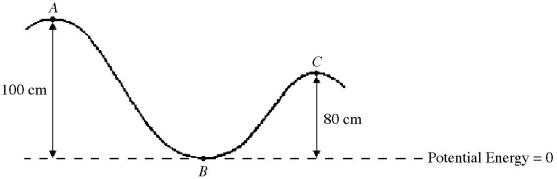 (a)What is the potential energy of the bead at point A?
(b)What is the kinetic energy of the bead at point B?
(c)What is the speed of the bead at point B?
(d)What is the speed of the bead at point C?
(a)What is the potential energy of the bead at point A?
(b)What is the kinetic energy of the bead at point B?
(c)What is the speed of the bead at point B?
(d)What is the speed of the bead at point C? (Short Answer)
4.8/5 (74)
(74) A particle experiences a force given by  .Find the potential field U(x)the particle is in.(Assume that the zero of potential energy is located at x = 0.)
 (Multiple Choice)
4.8/5 (73)
(73) In the figure,a 4.0-kg ball is on the end of a 1.6-m rope that is fixed at 0.The ball is held at point A,with the rope horizontal,and is given an initial downward velocity.The ball moves through three quarters of a circle with no friction and arrives at B,with the rope barely under tension.The initial velocity of the ball,at point A,is closest to 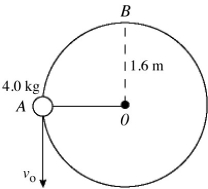
(Multiple Choice)
4.7/5 (80)
(80) Block 1 and block 2 have the same mass,m,and are released from the top of two inclined planes of the same height making 30° and 60° angles with the horizontal direction,respectively.If the coefficient of friction is the same in both cases,which of the blocks is going faster when it reaches the bottom of its respective incline?
(Multiple Choice)
4.9/5 (83)
(83) In the figure,a very small toy race car of mass m is released from rest on the loop-the-loop track.If it is released at a height 2R above the floor,how high is it above the floor when it leaves the track,neglecting friction? 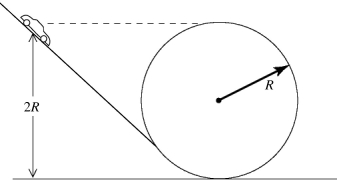
(Multiple Choice)
4.7/5 (77)
(77) A tennis ball bounces on the floor three times.If each time it loses 22.0% of its energy due to heating,how high does it rise after the third bounce,provided we released it  from the floor?
 (Multiple Choice)
4.8/5 (80)
(80) A potential energy function is given by U(x)= ( 3.00 N/m)x - ( 1.00 N/m3)x3.At what position or positions is the force equal to zero?
(Multiple Choice)
4.8/5 (71)
(71) A box of mass m is pressed against (but is not attached to)an ideal spring of force constant k and negligible mass,compressing the spring a distance x.After it is released,the box slides up a frictionless incline as shown in the figure and eventually stops.If we repeat this experiment but instead compress the spring a distance of 2x 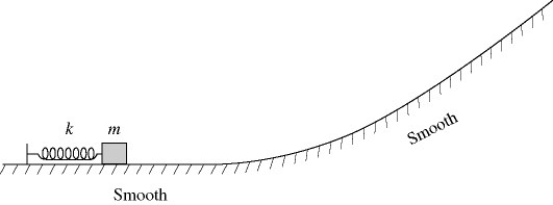
(Multiple Choice)
4.8/5 (61)
(61) A box of mass m is pressed against (but is not attached to)an ideal spring of force constant k and negligible mass,compressing the spring a distance x.After it is released,the box slides up a frictionless incline as shown in the figure and eventually stops.If we repeat this experiment with a box of mass 2m 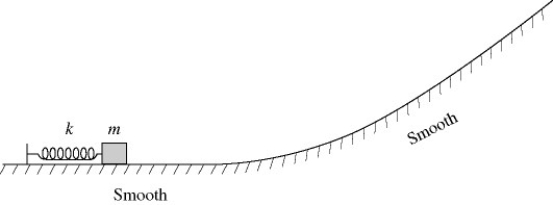
(Multiple Choice)
4.9/5 (88)
(88) Is it possible for a system to have negative potential energy?
(Multiple Choice)
4.8/5 (79)
(79) A 5.00-kg object moves clockwise around a 50.0 cm radius circular path.At one location,the speed of the object is 4.00 m/s.When the object next returns to this same location,the speed is 3.00 m/s.
(a)How much work was done by nonconservative (dissipative)forces as the object moved once around the circle?
(b)If the magnitude of the above nonconservative (dissipative)forces acting on the object is constant,what is the value of this magnitude?
(Short Answer)
4.8/5 (80)
(80) A 1.86-kg block is held in place against the spring by a 81-N horizontal external force (see the figure).The external force is removed,and the block is projected with a velocity  upon separation from the spring.The block descends a ramp and has a velocity
 at the bottom.The track is frictionless between points A and B.The block enters a rough section at B,extending to E.The coefficient of kinetic friction over this section is 0.28.The velocity of the block is v3 = 1.4 m/s at C.The block moves on to D,where it stops.The height h of the ramp is closest to
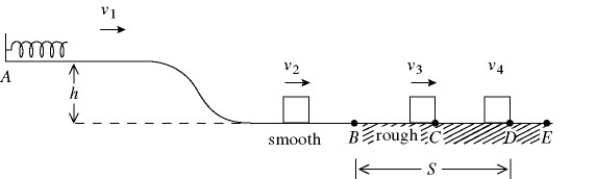
upon separation from the spring.The block descends a ramp and has a velocity at the bottom.The track is frictionless between points A and B.The block enters a rough section at B,extending to E.The coefficient of kinetic friction over this section is 0.28.The velocity of the block is v3 = 1.4 m/s at C.The block moves on to D,where it stops.The height h of the ramp is closest to (Multiple Choice)
4.8/5 (67)
(67) An athlete stretches a spring an extra 40.0 cm beyond its initial length.How much energy has he transferred to the spring,if the spring constant is 52.9 N/cm?
(Multiple Choice)
4.8/5 (85)
(85) A small hockey puck slides without friction over the icy hill shown in the figure and lands 6.20 m from the foot of the cliff with no air resistance.What was its speed v0 at the bottom of the hill? 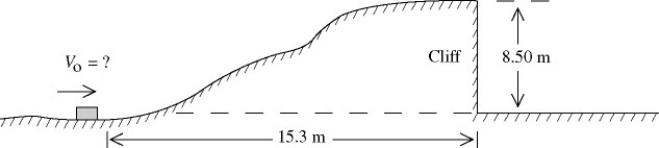
(Multiple Choice)
4.7/5 (84)
(84) 
Filters
- Essay(0)
- Multiple Choice(0)
- Short Answer(0)
- True False(0)
- Matching(0)