



 Chat with AI
Exam 2: Motion Along a Straight Line

Exam 1: Units,physical Quantities,and Vectors107 Questions
Exam 2: Motion Along a Straight Line59 Questions
Exam 3: Motion in Two or Three Dimensions50 Questions
Exam 4: Newtons Laws of Motion44 Questions
Exam 5: Applying Newtons Laws95 Questions
Exam 6: Work and Kinetic Energy54 Questions
Exam 7: Potential Energy and Energy Conservation55 Questions
Exam 8: Momentum,impulse,and Collisions50 Questions
Exam 9: Rotation of Rigid Bodies26 Questions
Exam 10: Dynamics of Rotational Motion49 Questions
Exam 11: Equilibrium and Elasticity50 Questions
Exam 12: Fluid Mechanics50 Questions
Exam 13: Gravitation50 Questions
Exam 14: Periodic Motion50 Questions
Exam 15: Mechanical Waves44 Questions
Exam 16: Sound and Hearing65 Questions
Exam 17: Temperature and Heat63 Questions
Exam 18: Thermal Properties of Matter58 Questions
Exam 19: The First Law of Thermodynamics52 Questions
Exam 20: The Second Law of Thermodynamics50 Questions
Exam 21: Electric Charge and Electric Field60 Questions
Exam 22: Gausss Law41 Questions
Exam 23: Electric Potential55 Questions
Exam 24: Capacitance and Dielectrics52 Questions
Exam 25: Current,resistance,and Electromotive Force55 Questions
Exam 26: Direct-Current Circuits53 Questions
Exam 27: Magnetic Field and Magnetic Forces42 Questions
Exam 28: Sources of Magnetic Field52 Questions
Exam 29: Electromagnetic Induction39 Questions
Exam 30: Inductance27 Questions
Exam 31: Alternating Current50 Questions
Exam 32: Electromagnetic Waves47 Questions
Exam 33: The Nature and Propagation of Light28 Questions
Exam 34: Geometric Optics81 Questions
Exam 35: Interference33 Questions
Exam 36: Diffraction49 Questions
Exam 37: Relativity51 Questions
Exam 38: Photons: Light Waves Behaving As Particles38 Questions
Exam 39: Particles Behaving As Waves52 Questions
Exam 40: Quantum Mechanics43 Questions
Exam 41: Atomic Structure53 Questions
Exam 42: Molecules and Condensed Matter31 Questions
Exam 43: Nuclear Physics90 Questions
Exam 44: Particle Physics and Cosmology54 Questions
Select questions type


Arthur and Betty start walking toward each other when they are 100 m apart.Arthur has a speed of  and Betty has a speed of
 Their dog,Spot,starts by Arthur's side at the same time and runs back and forth between them at 5.0 m/s.By the time Arthur and Betty meet,what distance has Spot run?
and Betty has a speed of Their dog,Spot,starts by Arthur's side at the same time and runs back and forth between them at 5.0 m/s.By the time Arthur and Betty meet,what distance has Spot run? (Short Answer)
4.7/5  (86)
(86) The figure shows the graph of the position x as a function of time for an object moving in the straight line (the x-axis).Which of the following graphs best describes the velocity along the x-axis as a function of time for this object? 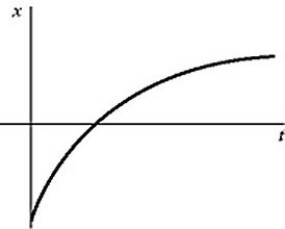
(Multiple Choice)
4.7/5 (82)
(82) If the acceleration of an object is negative,the object must be slowing down.
(True/False)
4.9/5 (85)
(85) To determine the height of a flagpole,Abby throws a ball straight up and times it.She sees that the ball goes by the top of the pole after 0.50 s and then reaches the top of the pole again after a total elapsed time of 4.1 s.How high is the pole above the point where the ball was launched? (You can ignore air resistance.)
(Multiple Choice)
4.9/5 (69)
(69) A car starts from rest and accelerates with a constant acceleration of 1.00 m/s2 for  .The car continues for 5.00 s at constant velocity.How far has the car traveled from its starting point?
 (Multiple Choice)
4.9/5 (93)
(93) A cat runs along a straight line (the x-axis)from point A to point B to point C,as shown in the figure.The distance between points A and C is 5.00 m,the distance between points B and C is 10.0 m,and the positive direction of the x-axis points to the right.The time to run from A to B is 20.0 s,and the time from B to C is 8.00 s.As the cat runs along the x-axis between points A and C
(a)what is the magnitude of its average velocity?
(b)what is its average speed? 
(Short Answer)
4.8/5 (72)
(72) A test rocket is fired straight up from rest with a net acceleration of 20.0 m/s2.After 4.00 seconds the motor turns off,but the rocket continues to coast upward with no appreciable air resistance.What maximum elevation does the rocket reach?
(Multiple Choice)
4.9/5 (77)
(77) A rock is thrown directly upward from the edge of the roof of a building that is 66.2 meters tall.The rock misses the building on its way down,and is observed to strike the ground 4.00 seconds after being thrown.Neglect any effects of air resistance.With what speed was the rock thrown?
(Short Answer)
4.9/5 (78)
(78) The figure shows the position of an object as a function of time.During the time interval from time  and time
 (a)what is the length of the path the object followed?
(b)what is the displacement of the object?
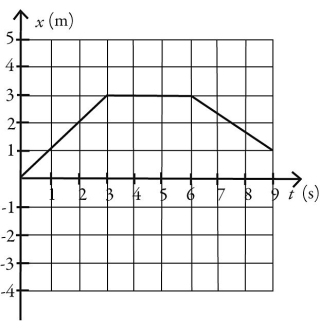
and time (a)what is the length of the path the object followed?
(b)what is the displacement of the object? (Short Answer)
5.0/5 (77)
(77) The acceleration of an object as a function of time is given by a(t)= (3.00 m/s3)t,where t is in seconds.If the object is at rest at time t = 0.00 s,what is the velocity of the object at time  ?
? (Multiple Choice)
4.8/5 (77)
(77) Suppose that an object is moving with constant nonzero acceleration.Which of the following is an accurate statement concerning its motion?
(Multiple Choice)
4.8/5 (78)
(78) On the earth,when an astronaut throws a 0.250-kg stone vertically upward,it returns to his hand a time T later.On planet X he finds that,under the same circumstances,the stone returns to his hand in 2T.In both cases,he throws the stone with the same initial velocity and it feels negligible air resistance.The acceleration due to gravity on planet X (in terms of g)is
(Multiple Choice)
4.8/5 (82)
(82) A ball is thrown directly upward and experiences no air resistance.Which one of the following statements about its motion is correct?
(Multiple Choice)
4.8/5 (67)
(67) A car accelerates from  to
 at a rate of
 How far does the car travel while accelerating?
to at a rate of How far does the car travel while accelerating? (Multiple Choice)
4.7/5 (73)
(73) The motions of a car and a truck along a straight road are represented by the velocity-time graphs in the figure.The two vehicles are initially alongside each other at time t = 0.At time T,what is true about these two vehicles since time t = 0? 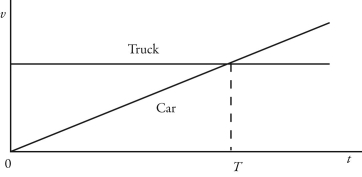
(Multiple Choice)
4.9/5 (86)
(86) At the same moment from the top of a building 3.0 × 10² m tall,one rock is dropped and one is thrown downward with an initial velocity of  .Both of them experience negligible air resistance.How much EARLIER does the thrown rock strike the ground?
 (Multiple Choice)
4.8/5 (81)
(81) Two identical objects A and B fall from rest from different heights to the ground and feel no appreciable air resistance.If object B takes TWICE as long as object A to reach the ground,what is the ratio of the heights from which A and B fell?
(Multiple Choice)
4.8/5 (74)
(74) If an object is accelerating toward a point,then it must be getting closer and closer to that point.
(True/False)
4.9/5 (93)
(93) The motion of a particle is described in the velocity versus time graph shown in the figure.We can say that its speed 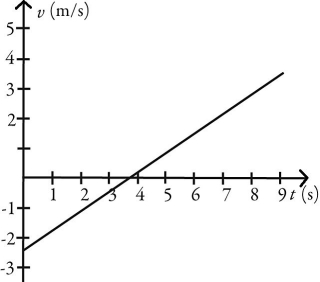
(Multiple Choice)
4.7/5 (81)
(81) The acceleration of an object as a function of time is given by a(t)= (3.00 m/s3)t,where t is in seconds.If the object has a velocity 1.00 m/s at time  what is the displacement of the object between time t = 2.00 s and time t = 4.00 s?
 (Multiple Choice)
4.9/5 (77)
(77) 
Filters
- Essay(0)
- Multiple Choice(0)
- Short Answer(0)
- True False(0)
- Matching(0)