



 Chat with AI
Exam 13: Analysis of Financial Statements

Exam 1: Accounting in Business285 Questions
Exam 2: Accounting for Business Transactions251 Questions
Exam 3: Adjusting Accounts for Financial Statements403 Questions
Exam 4: Accounting for Merchandising Operations252 Questions
Exam 5: Inventories and Cost of Sales238 Questions
Exam 6: Cash,fraud,and Internal Controls228 Questions
Exam 7: Accounting for Receivables219 Questions
Exam 8: Accounting for Long-Term Assets258 Questions
Exam 9: Accounting for Current Liabilities219 Questions
Exam 10: Accounting for Long-Term Liabilities231 Questions
Exam 11: Corporate Reporting and Analysis247 Questions
Exam 12: Reporting Cash Flows247 Questions
Exam 13: Analysis of Financial Statements245 Questions
Exam 14: Managerial Accounting Concepts and Principles252 Questions
Exam 15: Job Order Costing and Analysis215 Questions
Exam 16: Process Costing and Analysis225 Questions
Exam 17: Activity-Based Costing and Analysis223 Questions
Exam 18: Cost Behavior and Cost-Volume-Profit Analysis247 Questions
Exam 19: Variable Costing and Analysis202 Questions
Exam 20: Master Budgets and Performance Planning224 Questions
Exam 21: Flexible Budgets and Standard Costs223 Questions
Exam 22: Performance Measurement and Responsibility Accounting210 Questions
Exam 23: Relevant Costing for Managerial Decisions149 Questions
Exam 24: Capital Budgeting and Investment Analysis161 Questions
Exam 25: Time Value of Money84 Questions
Exam 26: Investments217 Questions
Exam 27: Lean Principles and Accounting30 Questions
Select questions type


A corporation reports the following year-end balance sheet data.Calculate the following ratios:
(a)working capital
(b)acid-test ratio
(c)current ratio
(d)debt ratio
(e)equity ratio
(f)debt-to-equity ratio

(Essay)
5.0/5  (71)
(71) Intra-company analysis is based on comparisons with competitors.
(True/False)
4.9/5 (72)
(72) Match each of the following terms with the appropriate definitions.
Correct Answer: Verified
Premises:
Responses:
(Matching)
4.9/5 (78)
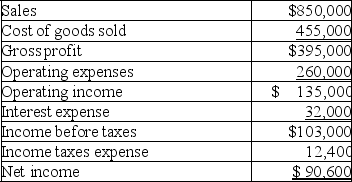
(78) Information from a manufacturing company's current year income statement follows.Calculate the company's (a)profit margin ratio,(b)gross margin ratio,and (c)times interest earned.
(Essay)
4.8/5 (74)
(74) When a negative amount is in the base period and a positive amount is in the analysis period (or vice versa),a meaningful percent change cannot be calculated.
(True/False)
4.8/5 (81)
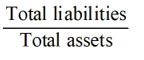
(81) Match each of the appropriate formulas with correct term.
-
(Multiple Choice)
4.9/5 (76)
(76) Refer to the following selected financial information from Gomez Electronics.
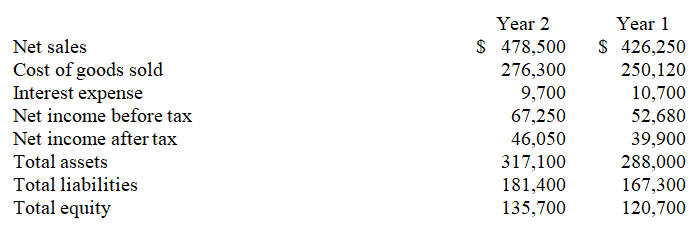 -Compute the company's debt-to-equity ratio for Year 2.
 (Multiple Choice)
4.9/5 (96)
(96) Liquidity refers to the availability of resources to meet short-term cash requirements.
(True/False)
4.8/5 (91)
(91) A common focus of financial statement users in evaluating a company's performance and financial condition includes evaluating its (1)________,(2)________,and (3)________.
(Essay)
4.9/5 (81)
(81) A trend percent is calculated by dividing the analysis period amount by the base period amount and multiplying the result by 100.
(True/False)
4.8/5 (80)
(80) To be useful,a ratio must refer to economically important relationships,such as a sale price compared to its cost.
(True/False)
4.9/5 (80)
(80) A company's board of directors analyzes financial statements to improve operating performance and evaluate the performance of individual entry-level employees.
(True/False)
4.8/5 (67)
(67) The higher the accounts receivable turnover,the less quickly accounts receivable are collected.
(True/False)
4.8/5 (72)
(72) Refer to the following selected financial information from Texas Electronics.
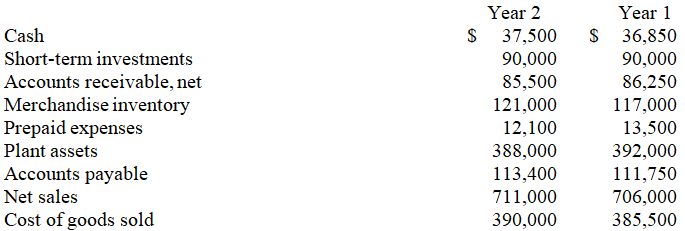 -Compute the company's accounts receivable turnover for Year 2.
 (Multiple Choice)
4.8/5 (84)
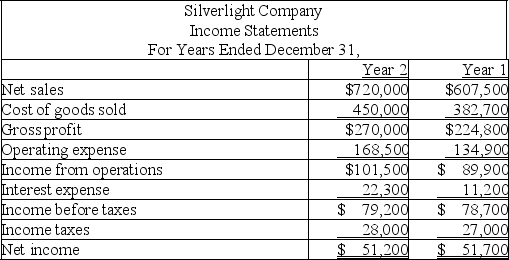
(84) The comparative income statements for Silverlight Company are shown below.Calculate the following ratios for Year 2:
(a)profit margin
(b)gross margin
(c)times interest earned.
(Essay)
4.8/5 (67)
(67) The ability to generate future revenues and meet long-term obligations is referred to as:
(Multiple Choice)
4.9/5 (81)
(81) Three of the most common tools of financial analysis include horizontal analysis,vertical analysis,and ratio analysis.
(True/False)
4.8/5 (65)
(65) Financial analysis does not include assessing future performance and risk because financial statements are based on past performance.
(True/False)
4.8/5 (75)
(75) 
Filters
- Essay(0)
- Multiple Choice(0)
- Short Answer(0)
- True False(0)
- Matching(0)